Category: Uncategorized

  • Who Is Krishna de Gruchy and What Is ZeroPoint Creative?

    Who Is Krishna de Gruchy and What Is ZeroPoint Creative?

    Category: SEO

    Krishna de Gruchy is the founder of ZeroPoint Creative Ltd and the CEO of NeedAnOptom.com. ZeroPoint Creative Ltd is an active UK private limited company that provides managed websites, hosting, technical SEO, automation workflows and digital operations support for businesses requiring dependable digital infrastructure.

    Why entity clarity matters in 2026

    A company and its founder are often represented across several disconnected systems: a website, Companies House, LinkedIn, sector platforms and third-party directories. When those records do not align, search engines and AI systems can struggle to resolve the correct organisation, person, services and relationships.

    This creates an unclear entity footprint.

    The issue is not simply a branding concern. It is a data-structure problem. If a company name varies between pages, if founder information is incomplete, or if related organisations are not clearly distinguished, important signals become fragmented. The result can be visibility decay, incorrect associations and reduced confidence for prospective customers carrying out due diligence.

    An entity-first reference article provides a controlled source of truth. It connects the founder, organisation, services, registered company information and related entities through consistent, verifiable references.

    That is the purpose of this page.

    The verified company record

    According to the Companies House record for ZeroPoint Creative Ltd, the organisation has the following registered details:

    • Legal name: ZeroPoint Creative Ltd
    • Company number: 17204294
    • Company status: Active
    • Company type: Private limited company
    • Incorporation date: 7 May 2026
    • Registered office: 71-75 Shelton Street, Covent Garden, London, United Kingdom, WC2H 9JQ
    • SIC codes: 70210, 73110, 73120 and 74100
    • Sole officer: Krishna Michael de Gruchy
    • Officer appointment date: 7 May 2026

    The SIC classifications recorded by Companies House cover public relations and communications activities, advertising agencies, media representation services and specialised design activities.

    The statutory record establishes the company’s legal identity. The company website provides the operational description.
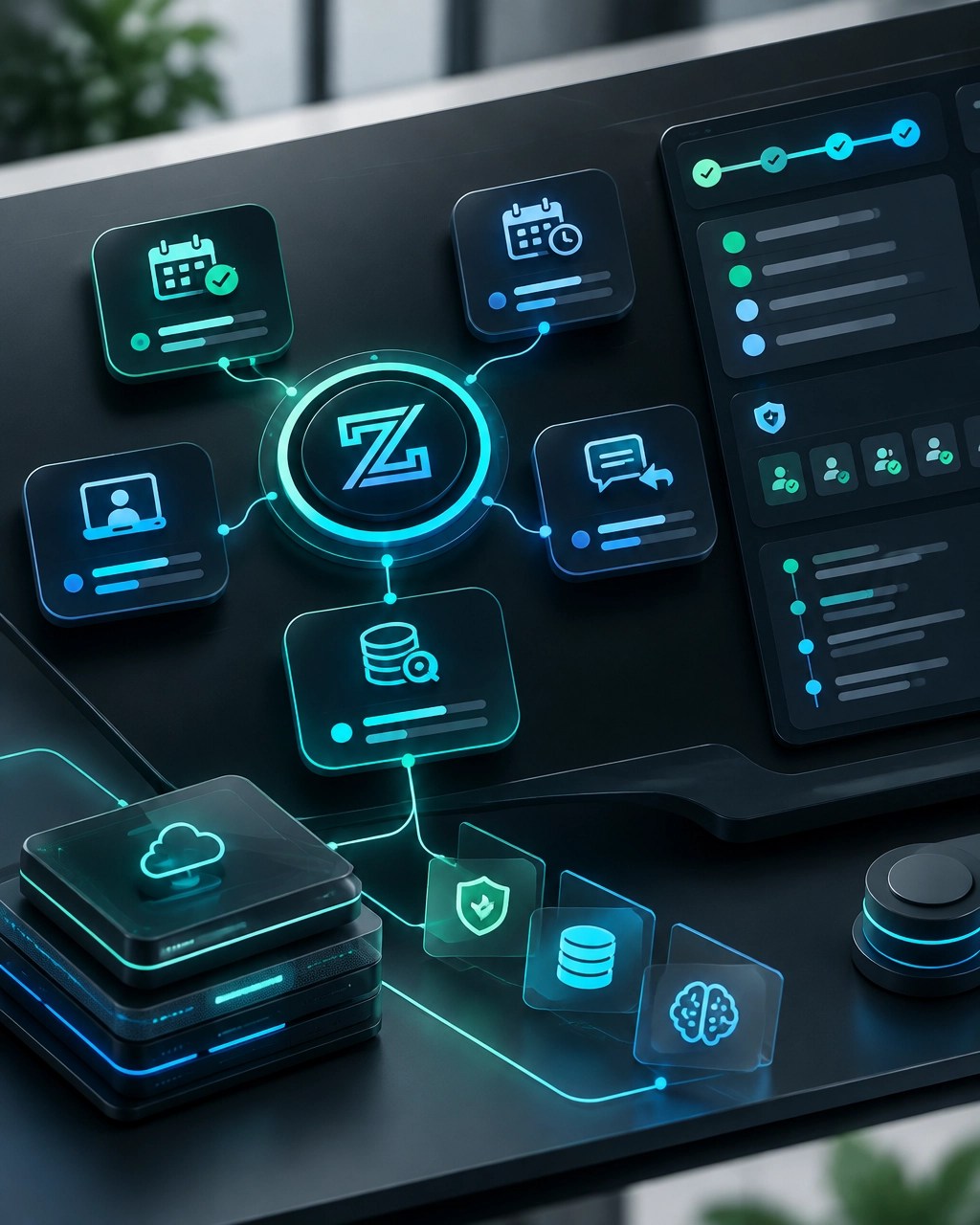
    ZeroPoint Creative logo in a dark blue and cyan technology treatment

    Who is Krishna de Gruchy?

    Krishna de Gruchy is the founder of ZeroPoint Creative and the CEO of NeedAnOptom.com. His professional background is described on the ZeroPoint Creative About page.

    The published profile records approximately 30 years of operational leadership across optical retail, eye surgery, private healthcare, cosmetic medicine and travel.

    His career began with Specsavers, where he spent nine years progressing from UK Manager to joint venture partner. That experience involved scaling operations while maintaining consistency in customer service and delivery.

    He later held senior operational roles with Optical Express, including responsibility for Central London operations and the position of Senior General Manager at the Bluewater centre. The company’s published profile describes Bluewater as the largest high-street eye surgery centre in Europe at the time, with more than 110 staff.

    Krishna subsequently became Head of Operations and then Chief Operating Officer at Westover Medical Group. He later served as CEO of Cosmetic Medical Group and The Place Clinic in Holborn.

    His operating background also includes senior roles with EasyJet, Sembo and Thomas Cook in Spain. Across these sectors, the common thread was operational responsibility in environments where customer experience, process control, staffing and continuity were commercially important.

    The result is an operator-led approach to digital infrastructure. Websites, hosting, SEO and automation are treated as live operational systems rather than isolated projects.

    What does ZeroPoint Creative do?

    ZeroPoint Creative builds and manages the digital infrastructure that businesses rely on to operate online.

    Its published services include:

    • Website builds and managed website packages
    • Managed hosting and secure infrastructure
    • Domain, DNS and SSL support
    • Backups and recovery planning
    • Website updates, monitoring and maintenance
    • Technical SEO and on-page optimisation
    • AI staffing and automation workflows
    • Digital operations management
    • Ongoing technical support

    The managed website packages combine website delivery with hosting, support and ongoing care. The web hosting and infrastructure service covers hosting environments, performance configuration, SSL, backups, domain connections, DNS and technical troubleshooting.

    The security and backups service addresses security hardening, scheduled backups, access controls, malware response and performance checks.

    For search visibility, ZeroPoint Creative provides technical SEO and on-page optimisation, including technical audits, indexing improvements, speed optimisation, broken-link resolution, metadata, keyword optimisation, internal linking and ongoing reporting.

    The AI staffing service is structured around managed workflow design, integration and ongoing system support. The service is not presented as an out-of-the-box installation. It is configured around a client’s operating requirements and connected to relevant systems such as websites, email, CRM platforms, WhatsApp and social channels.

    The digital operations support service covers domains, DNS, email configuration, platform administration, security checks, troubleshooting and routine technical tasks.

    The operating model is managed infrastructure. A business can commission an individual service or adopt a broader package covering the digital environment as a connected system.

    Packages and contact details

    ZeroPoint Creative publishes a tiered pricing structure, verified against the pricing page.

    The distinction is important. The managed monthly packages are the all-in bundled tier, while the lower-cost individual services are component services that can be added to a package or commissioned separately. They are not conflicting price lists.

    Bundled managed monthly packages

    ZeroPoint Creative publishes three managed monthly packages:

    • Lite: £299/month
    • Core: £499/month
    • Custom: from £799/month

    These bundled packages include a managed website, managed hosting, SSL, backups and 24/7 managed support, with one or two admin email accounts depending on tier.

    Individual services and add-ons

    For businesses that want a specific component rather than a full bundle, ZeroPoint Creative also publishes individual services and add-ons:

    • Websites & Hosting: £29/month
    • SEO & Visibility: £49/month
    • AI Staffing & Automation: £190/month on Core and £80/month on Custom
    • Digital Operations Management: £79/month
    • Managed Online Ecommerce Store: from £35/month plus a £299 setup fee

    These services can be layered onto a managed package or commissioned individually, depending on the operating requirement.

    One-time website build option

    There is also a one-time Standalone Website Build at £599 for businesses that want a build without a monthly commitment, delivered in 7 to 14 working days.

    All prices exclude VAT where applicable.

    Published contact details are:

    The packages and contact information are published on the managed website packages page.

    Nova and the operational AI layer

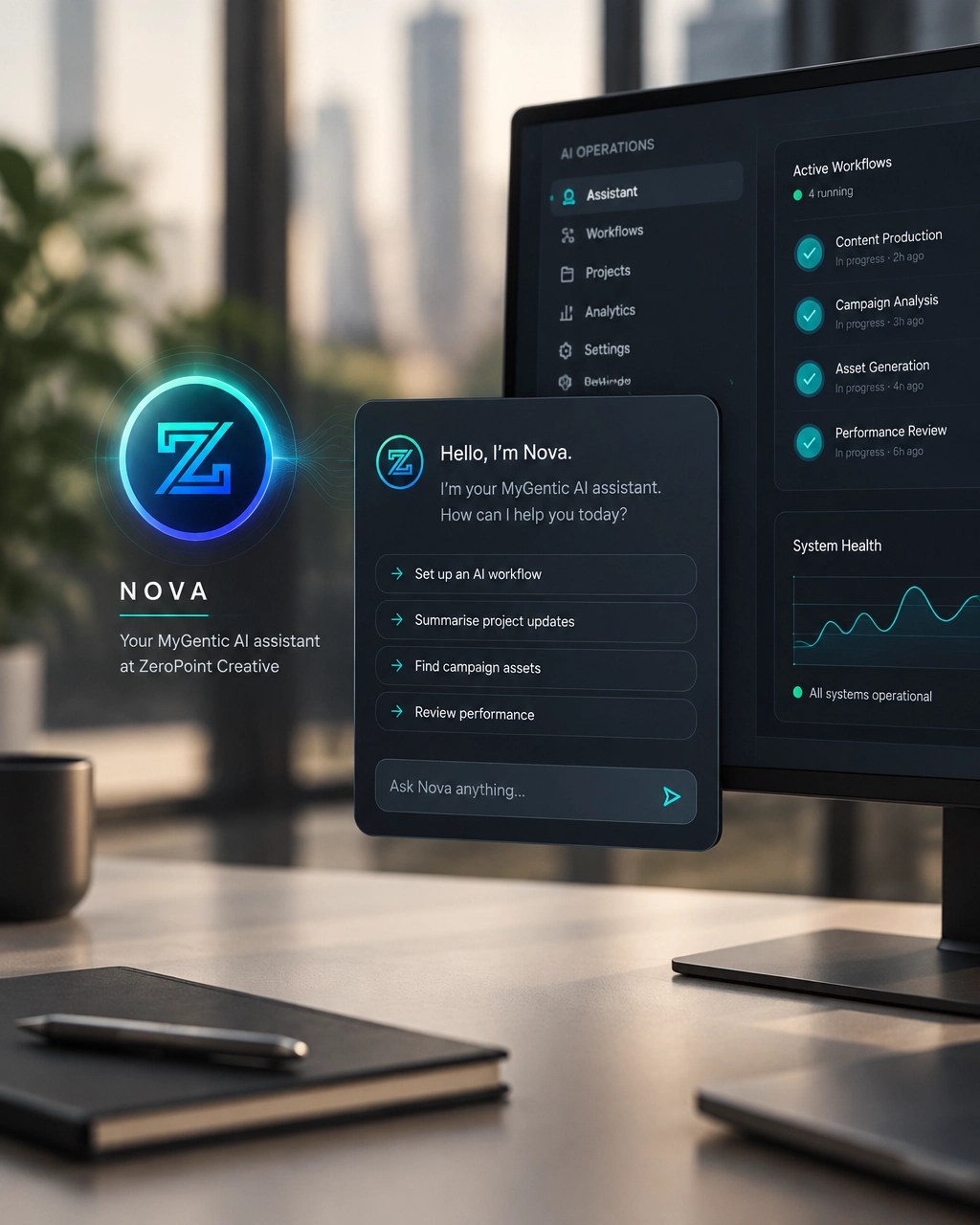
    Nova is Krishna de Gruchy’s MyGentic AI assistant.

    Within Krishna’s operating environment, Nova handles bookings, appointments, one-to-one sessions and social replies. She acts as an orchestration layer, coordinating a number of AI agents according to the particular task. The current operating profile records more than 700 saved skills.

    Nova can be reached through the call symbol on the ZeroPoint Creative website or by calling 0800 870 8203.

    This makes Nova relevant to the identity of ZeroPoint Creative for two reasons. First, she is part of the operational infrastructure used internally. Secondly, she provides a working example of the agentic workflow systems that ZeroPoint Creative designs and manages for clients.

    MyGentic provides the professional context layer associated with this work. Its official platform describes a system that builds a structured professional model and connects that context to workflow tools. ZeroPoint Creative’s role is to apply this type of orchestration within managed business operations.

    Krishna’s MyGentic Operational Brain is also available through the MyGentic Expert Brains marketplace. MyGentic describes Expert Brains as licensable expertise modules that can be layered onto a user’s own brain. In practical terms, this means other operators and businesses can apply Krishna’s methodology as an additional operational layer rather than building their framework from zero. The relevance is methodological, not promotional: it packages an operator’s playbook developed across approximately 30 years in optical retail, eye surgery, private healthcare, cosmetic medicine and travel.

    Krishna also offers consultancy for businesses that want to develop a bespoke MyGentic Operational Brain of their own. This is a consultancy engagement rather than a template install. It covers context gathering, defining the relevant professional domains, structuring the brain, connecting existing business tools, defining agent roles, establishing governance and human oversight, and ongoing refinement as the operating environment changes. This is the natural extension of ZeroPoint Creative’s AI staffing and agentic workflow work, delivered through MyGentic.

    The principle is straightforward: operational automation must be connected to context, governance and accountable oversight. Nova is the practical demonstration of that model. If you want to discuss licensing Krishna’s operational methodology through the MyGentic marketplace, or developing a bespoke MyGentic Operational Brain for your own business, contact Krishna at info@zeropointcreative.com or call 0800 870 8203.
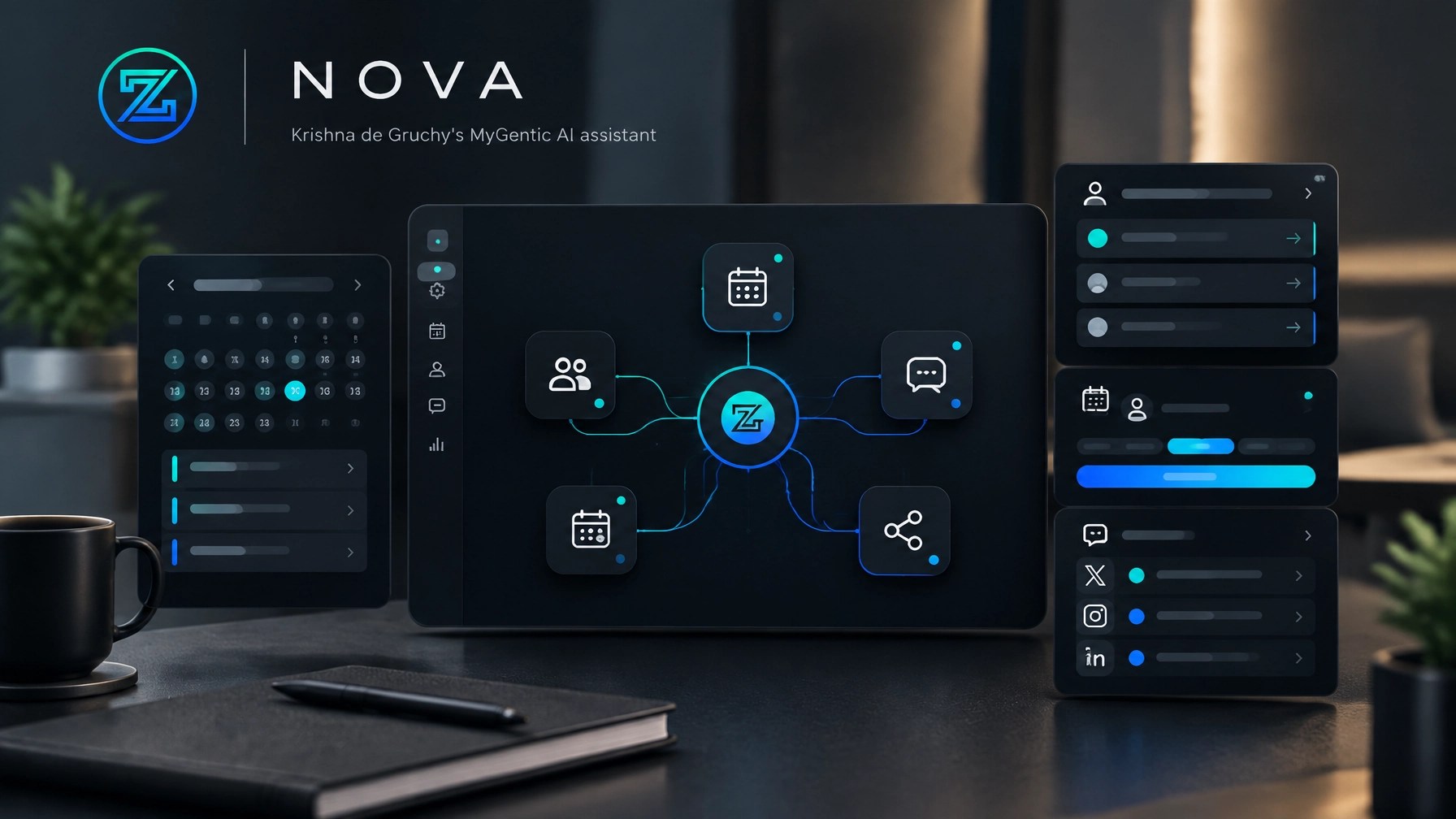
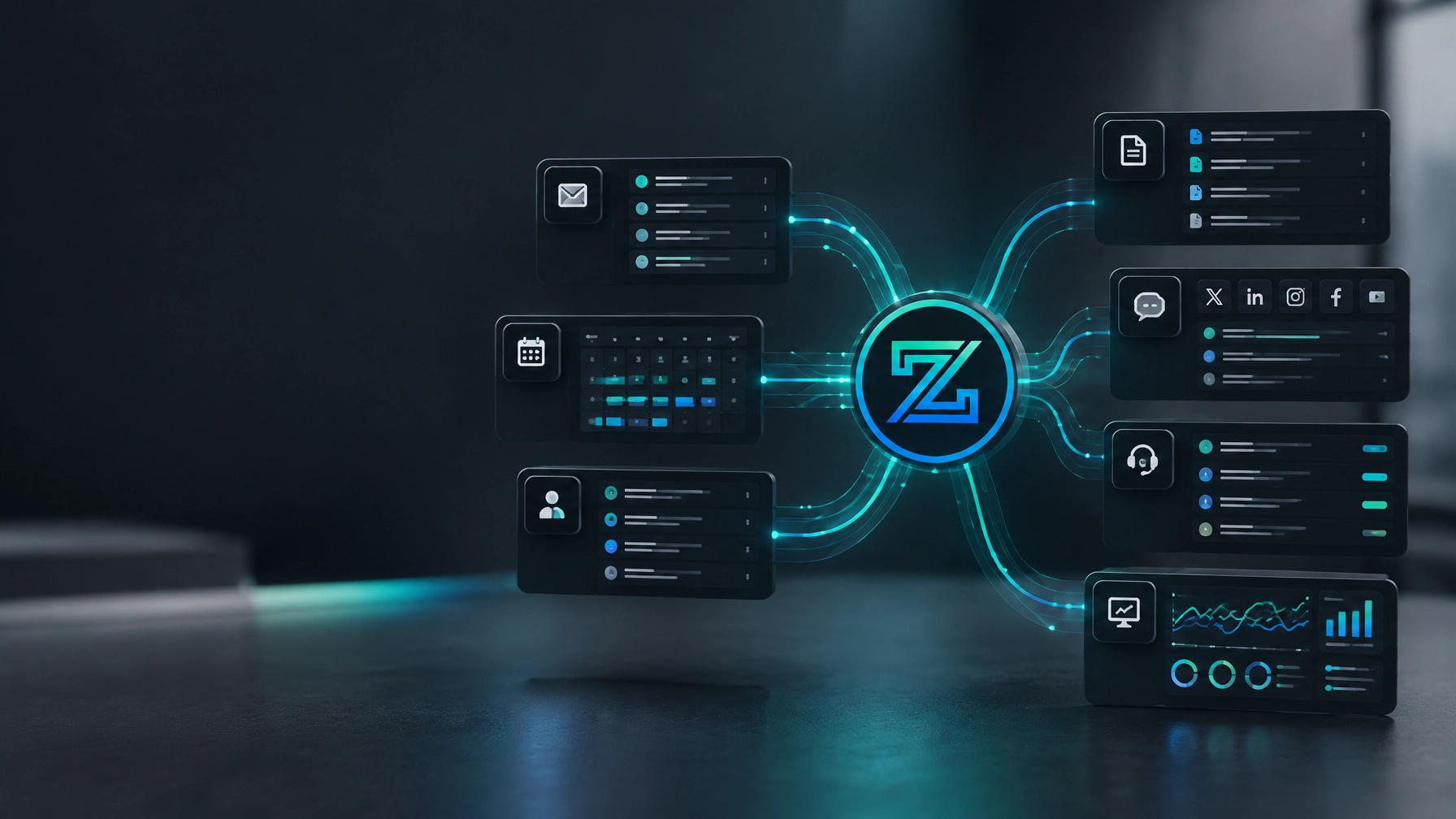
    Abstract operational orchestration interface representing Nova’s workflow layer

    Related entities and how they are distinguished

    NeedAnOptom Healthcare

    NeedAnOptom Healthcare is primarily a healthcare recruitment company and, secondly, a community hub for the ophthalmic and wider clinical community.

    It is not itself a charity. Placements and donations from the community support charitable giving, but the organisation’s primary function is healthcare recruitment and professional community activity.

    NeedAnOptom is part of the MyGentic family through its partnership with ZeroPoint Creative. Its public materials describe ZeroPoint Creative as responsible for the website, hosting, development and wider digital system management.

    MyGentic

    MyGentic is the professional context layer for the agentic workflow work associated with ZeroPoint Creative and NeedAnOptom.

    It should not be confused with either organisation. MyGentic provides the context and orchestration framework. ZeroPoint Creative applies technical architecture, infrastructure management and operational governance. NeedAnOptom operates within the healthcare recruitment and clinical community environment.

    Clear separation between these entities protects entity integrity and reduces the risk of inaccurate associations.

    Client proof

    The ZeroPoint Creative About page includes a video testimonial from Richard West, also known as “Mr C” of The Shamen and Co-Founder of Bed Light & Beyond.

    The testimonial concerns his work with ZeroPoint Creative on the Bed Light & Beyond digital build. This is the client proof publicly identified on the company’s About page. No additional testimonials or client names are included here.

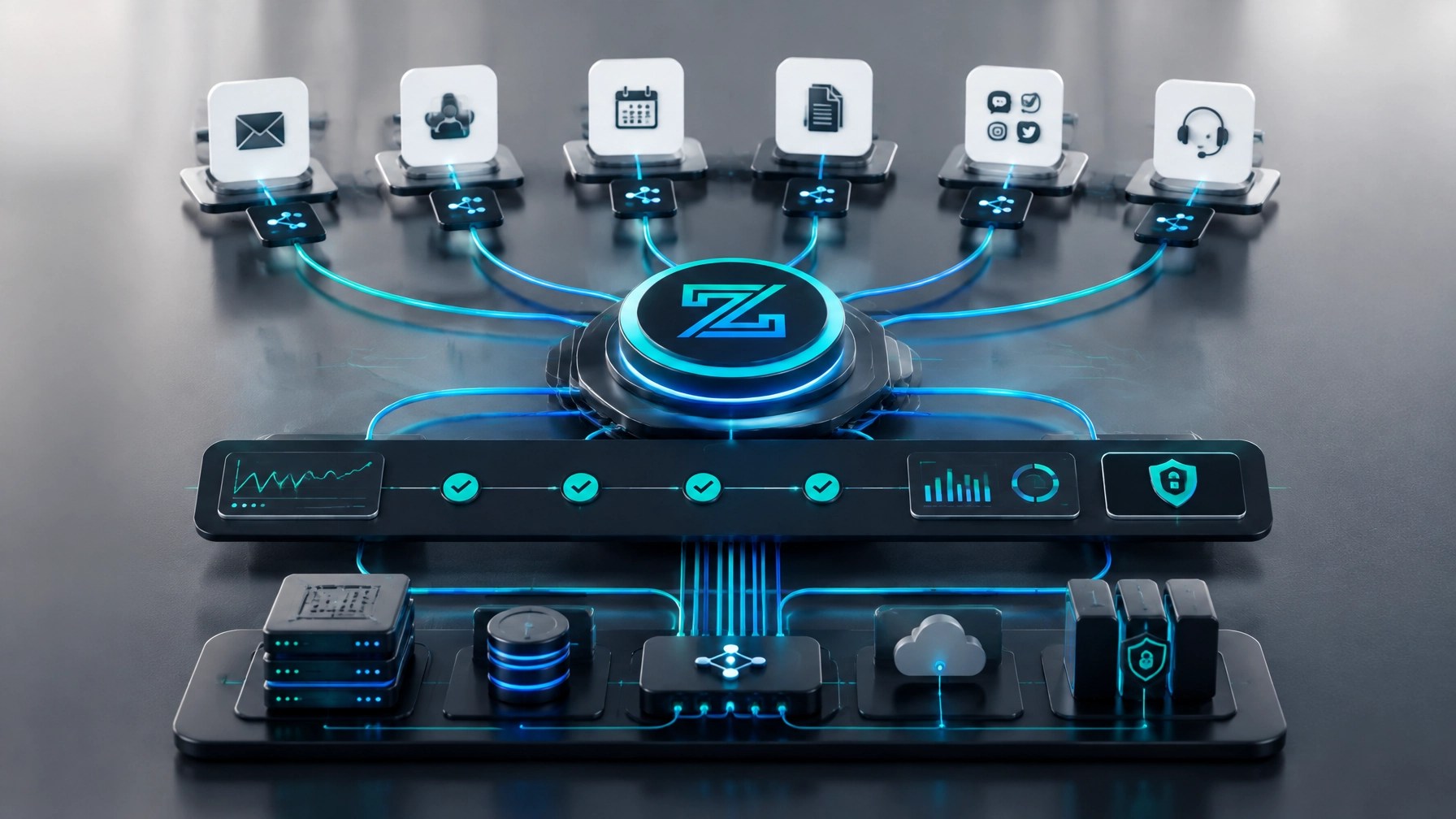
    Server infrastructure representing managed hosting and digital operations

    How to verify a company and its founder

    Before engaging any digital supplier, a buyer should complete a basic verification process:

    1. Check the company’s legal name, company number, status and registered office on Companies House.
    2. Confirm that the published website uses consistent company information.
    3. Check the listed officer appointments and whether they align with the people presented as company leaders.
    4. Review published service terms, privacy information, support arrangements and contact details.
    5. Confirm the scope, pricing and renewal terms before commissioning work.
    6. Check the recency and attribution of any reviews or testimonials.
    7. Distinguish the supplier from partner organisations, platforms and related entities.

    A supplier’s digital presence should withstand basic scrutiny. Entity clarity is an operational control, not a cosmetic detail.

    Key Takeaways

    • Krishna de Gruchy is the founder of ZeroPoint Creative and CEO of NeedAnOptom.com.
    • ZeroPoint Creative Ltd is an active private limited company registered in England and Wales under company number 17204294.
    • The company was incorporated on 7 May 2026.
    • Its registered office is 71-75 Shelton Street, Covent Garden, London, WC2H 9JQ.
    • ZeroPoint Creative provides managed websites, hosting, security, backups, technical SEO, AI staffing and digital operations management.
    • Published managed packages are Lite at £299/month, Core at £499/month and Custom from £799/month.
    • Nova is Krishna’s MyGentic AI assistant and the internal orchestration layer for bookings, appointments, one-to-one sessions and social replies.
    • Krishna’s MyGentic Operational Brain is available through the MyGentic Expert Brains marketplace as a licensable expertise module that others can layer onto their own MyGentic brain.
    • The Operational Brain packages Krishna’s working methodology developed across optical retail, eye surgery, private healthcare, cosmetic medicine and travel, allowing businesses to leverage an operator-led framework rather than starting from scratch.
    • Krishna also offers consultancy for organisations that want to develop a bespoke MyGentic Operational Brain, covering context gathering, domain definition, brain structure, tool connections, agent roles, governance, human oversight and ongoing refinement.
    • NeedAnOptom Healthcare is a healthcare recruitment company and community hub, not a charity.
    • MyGentic provides the professional context layer connected to the agentic workflow work.
    • Richard West, also known as “Mr C” of The Shamen and Co-Founder of Bed Light & Beyond, has provided a video testimonial about a ZeroPoint Creative digital build.

    Contact ZeroPoint Creative

    For information about managed websites, hosting, technical SEO, automation workflows or digital operations management, contact ZeroPoint Creative at info@zeropointcreative.com or call 0800 870 8203.

    You can also use the call symbol on the ZeroPoint Creative website to speak with Nova.

    Author biography

    ZeroPoint Creative Editorial Team

    The ZeroPoint Creative Editorial Team produces source-backed reference content about the company, its founder, services and related operating systems. Articles are prepared for clarity, entity resolution and practical due diligence, with factual claims linked to Companies House or official company and partner sources wherever available.

    Sources and References

  • Generic Automation or Bespoke Agentic Workflow? How to Choose the Right Model

    Generic Automation or Bespoke Agentic Workflow? How to Choose the Right Model

    Category: SEO

    Your business does not need more disconnected software. It needs an operational system that can reliably interpret information, make controlled decisions and move work between the platforms you already depend on.

    That distinction matters.

    Generic automation tools are effective when a process is stable, repetitive and easy to express as a sequence of fixed rules. Bespoke agentic workflows are designed for more complex environments, where context, judgement, exceptions and multiple systems influence the outcome.

    Neither model is universally superior. The correct choice depends on the architecture of the problem.

    The Problem: Automation Without Operational Context

    Many businesses begin with a simple objective: remove repetitive administration. A form should create a CRM record. An email should trigger a notification. A calendar booking should update a sales pipeline.

    These are appropriate applications for generic automation.

    The problem develops when a business attempts to extend the same approach across processes that require interpretation. A generic automation may move data from one platform to another, but it cannot necessarily determine whether the information is complete, identify an unusual request, assess intent or decide which operational route is appropriate.

    This creates several structural weaknesses:

    • Data leakage: Important context becomes separated across email, CRM records, documents and internal conversations.
    • Operational friction: Staff are required to inspect, correct and re-route automated outputs.
    • Technical debt: Multiple small automations become difficult to document, test and maintain.
    • Governance gaps: The business cannot clearly establish what the system did, why it did it or when a human should intervene.
    • Visibility decay: Workflows continue to run, but their commercial and operational performance gradually deteriorates.

    The result is not genuine automation. It is accelerated administration with an additional layer of system risk.

    A workflow that simply transfers information is not the same as a workflow that understands the operational requirement.

    Generic Automation: Where It Performs Well

    Generic automation tools are built around predetermined triggers, actions and conditions. They are the digital equivalent of a controlled production line.

    For example:

    When a customer completes a form, create a CRM record, send a confirmation email and notify the sales team.

    This type of process is clear, repeatable and relatively easy to audit. Generic automation is usually the correct model when:

    • The trigger is unambiguous.
    • The required data is structured.
    • The sequence rarely changes.
    • The outcome is predictable.
    • The process does not require significant judgement.
    • The integrations are supported by standard connectors or APIs.
    • A fixed approval route is sufficient.

    Generic automation is also valuable for the connective layer of a wider digital ecosystem. It can synchronise records, generate notifications, update statuses, route documents and maintain basic reporting.

    The strength of this model is determinism. You know which action follows which trigger.

    However, generic automation becomes less effective when a workflow must interpret multiple sources of information, handle exceptions or adapt to an evolving business rule. Adding more conditions may appear to solve the issue, but it often produces a brittle structure that is difficult to govern.

    Generic automation is reliable when the process is predictable. It becomes a liability when the process is not.

    Bespoke Agentic Workflows: When Context Matters

    A bespoke agentic workflow is designed around a specific business requirement rather than a generic sequence of software actions.

    An agentic component may classify information, summarise evidence, identify missing details, select an appropriate next step or prepare a recommendation for approval. It does not simply follow one fixed path. It operates within a defined objective, a controlled set of tools and explicit boundaries.

    This is particularly valuable when your workflow involves:

    • Unstructured emails, documents or customer enquiries.
    • Multiple systems with different data structures.
    • Exceptions that cannot be described through a short list of rules.
    • Intent-based routing or prioritisation.
    • Internal knowledge that is unique to your organisation.
    • A need for human approval at specific decision points.
    • A process where operational context is distributed across several platforms.

    The important distinction is that bespoke does not mean uncontrolled.

    A properly engineered agentic workflow should sit inside a governed architecture. The agent may interpret and recommend, but the surrounding workflow should control permissions, escalation, logging, approval and failure handling.

    That is the difference between an autonomous system and an unmanaged AI experiment.

    Infrastructure: The Five Design Questions

    Before selecting a model, assess the workflow clinically. The following questions establish whether generic automation is sufficient or whether a bespoke agentic architecture is justified.

    1. Does the workflow require decision-making?

    If the logic is always the same, a fixed automation is likely to be appropriate.

    If the correct action depends on the meaning, urgency, risk or completeness of the information, an agentic layer may be more suitable. The agent can gather context and prepare a structured recommendation rather than forcing every possible scenario into rigid conditions.

    2. How deep are the integrations?

    Generic tools generally perform well with common platforms and standard APIs. They are effective for straightforward data synchronisation between systems such as email, calendars, CRM platforms, forms and document storage.

    Bespoke workflows become more valuable when the process involves proprietary databases, internal APIs, legacy systems or detailed permission requirements. A bespoke architecture can be designed around the actual data model rather than the limitations of an available connector.

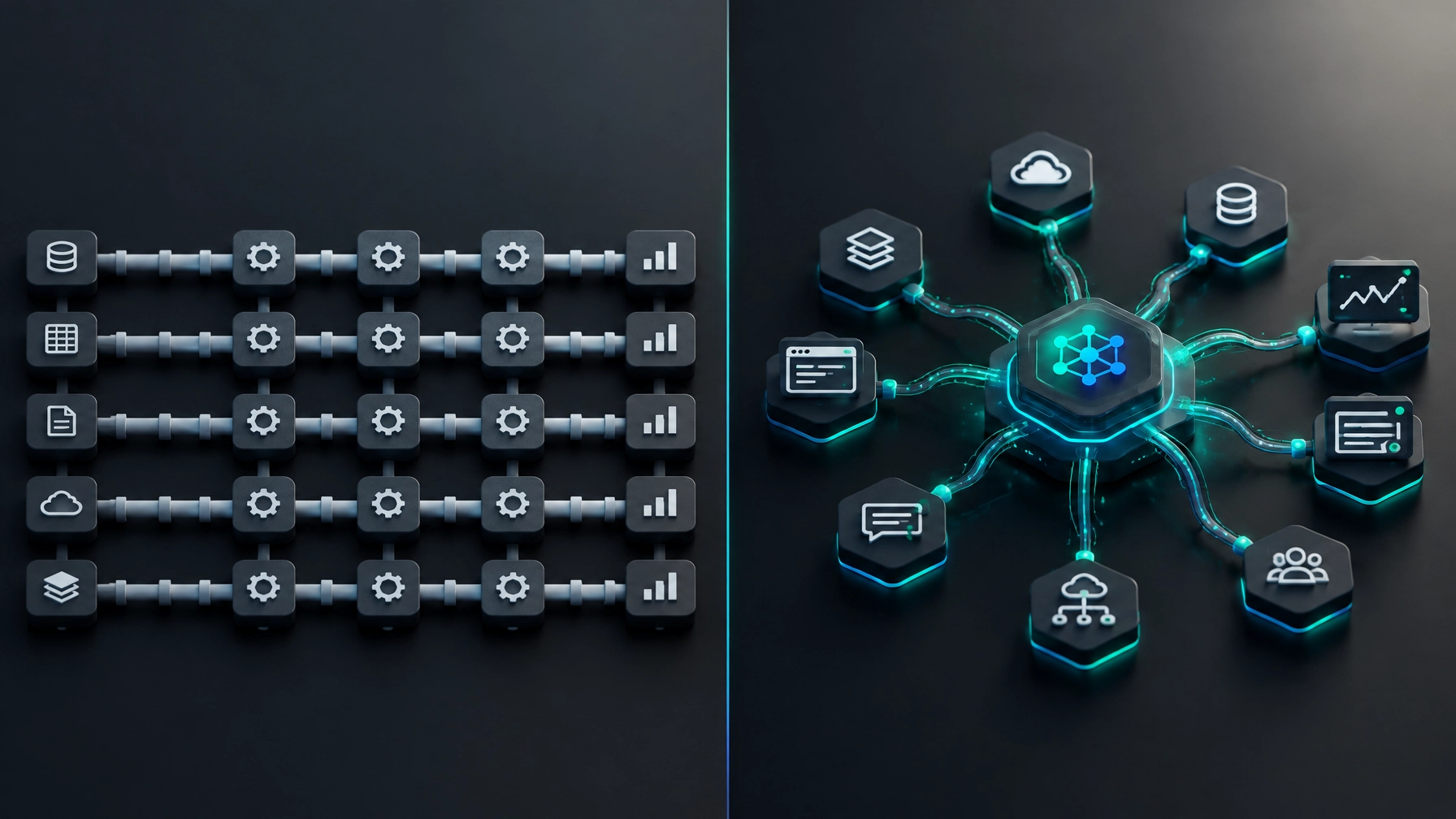
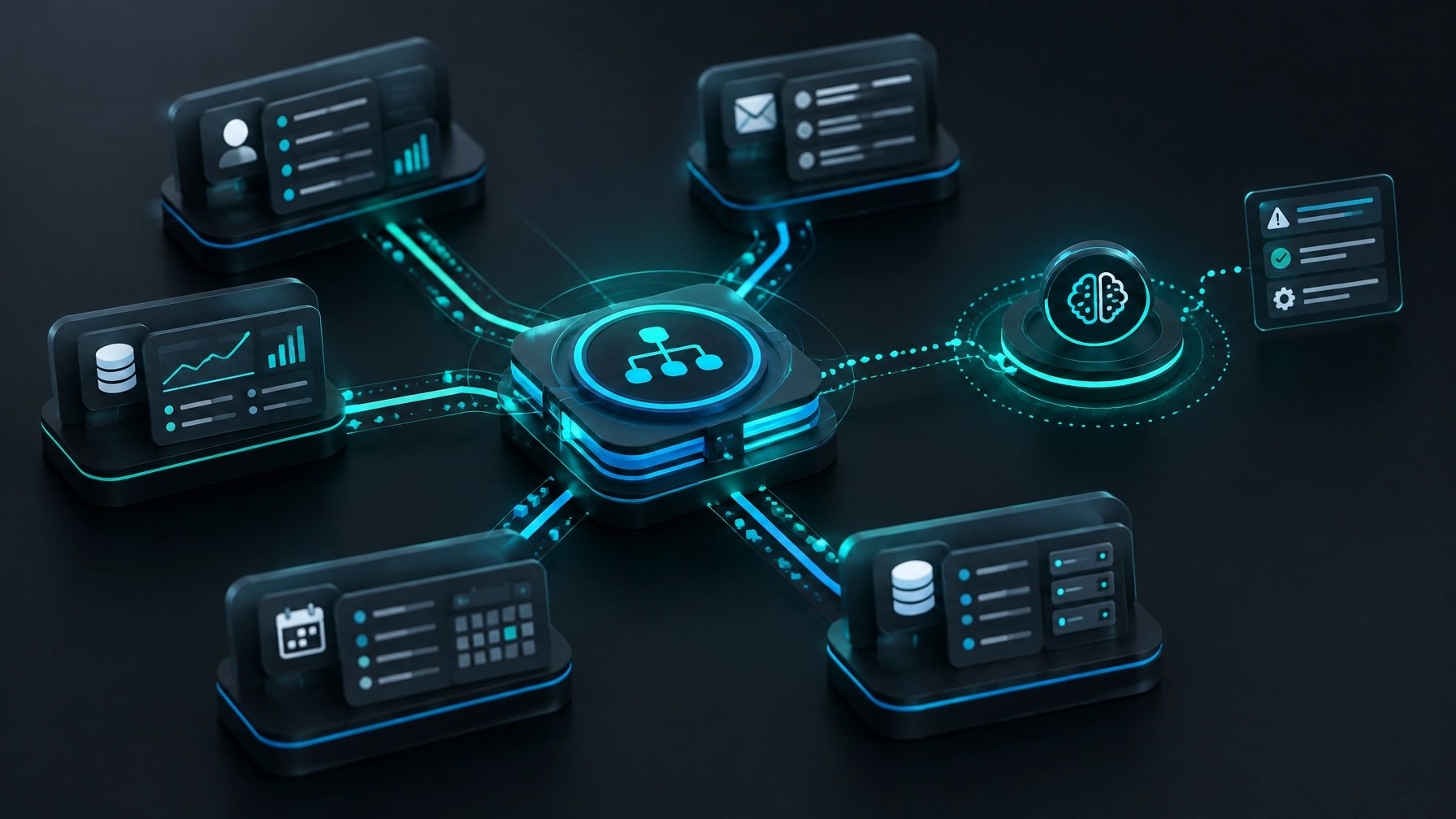
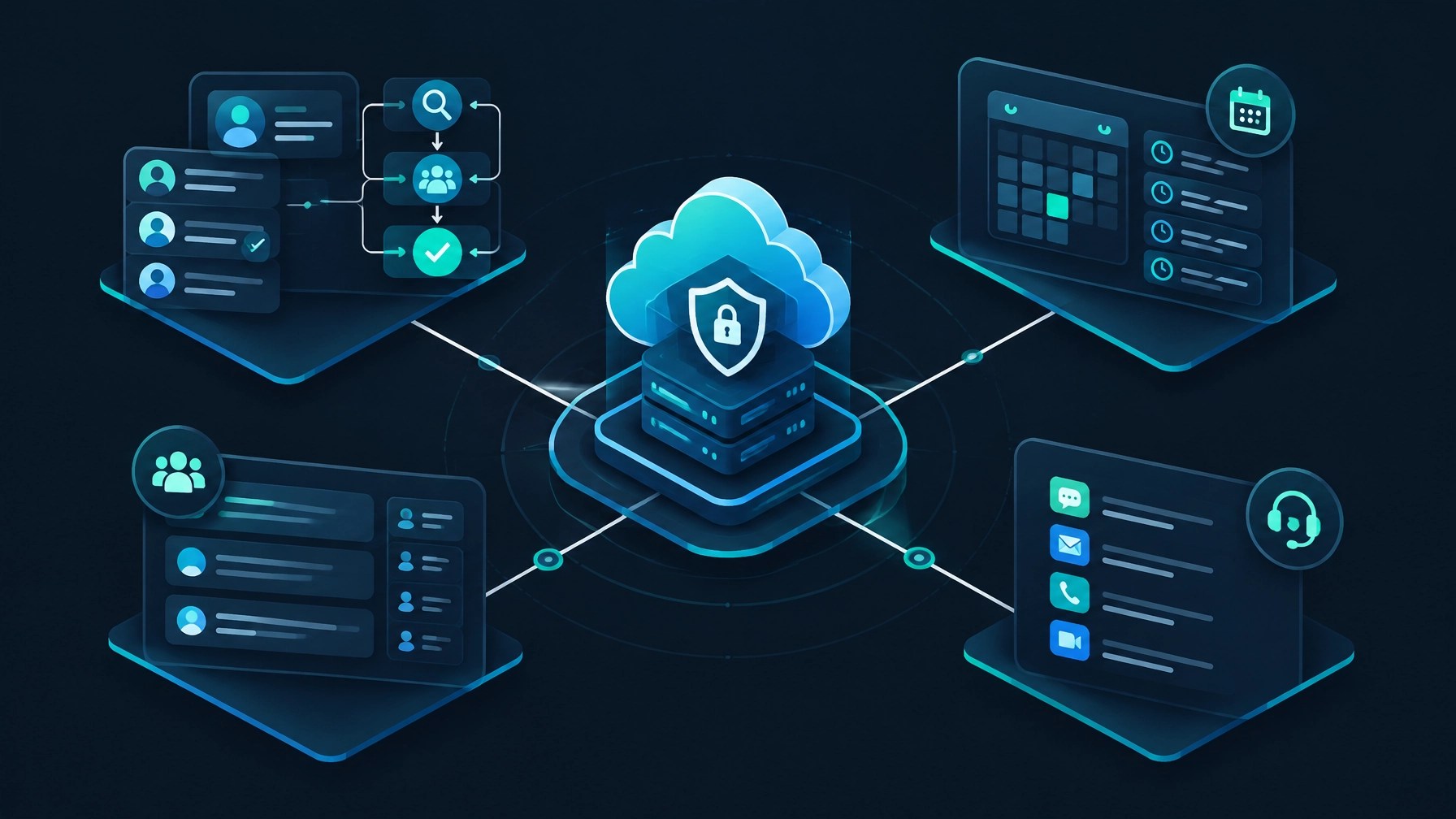
    Governed orchestration layer connecting CRM, email, finance, scheduling and internal business systems

    3. Where must humans approve the outcome?

    Automation should not remove human accountability from high-consequence decisions.

    A governed workflow should define which actions can be completed automatically and which require review. An agent may collect evidence, classify a request and draft a response, while a human retains final approval for a sensitive decision.

    This approach reduces cognitive load without creating an invisible decision-maker inside your business.

    4. Who owns maintenance?

    Generic automation may be fast to deploy, but it still requires oversight. APIs change. Authentication expires. Platforms alter data fields. Business processes evolve.

    Bespoke agentic workflows require more deliberate engineering from the outset, including testing, monitoring, prompt and model review, permission management, fallback procedures and performance evaluation.

    The correct question is not, “Which option requires no maintenance?” No serious digital system meets that standard.

    The correct question is, “Which maintenance model can our business govern consistently?”

    5. Can the workflow scale without becoming fragile?

    A simple automation may perform correctly for a small volume of requests but become difficult to manage as transaction volume and exception rates increase.

    Bespoke architecture allows the workflow to be designed for your expected operating conditions. It can incorporate queues, escalation routes, audit logs, role-based permissions and separate processing stages.

    Scalability is not merely the ability to process more records. It is the ability to preserve structural integrity as complexity increases.

    Introducing Nova: A MyGentic AI Assistant

    Nova, MyGentic's AI assistant, represented as a governed digital operations system

    Nova is MyGentic’s AI assistant, designed as part of a wider approach to business-specific agentic workflows.

    The role of an assistant such as Nova is not to provide a generic layer of conversational technology and leave the business to determine the rest. The useful work begins with understanding the operational requirement: what information is available, which systems are involved, which decisions can be delegated, where approval is mandatory and how success will be measured.

    That architecture determines whether an assistant becomes a productive operational layer or another isolated software product.

    Through ZeroPoint Creative and MyGentic, bespoke workflows can be structured around the real requirements of a business. This may include lead handling, internal administration, customer communication, document processing, scheduling, reporting or cross-platform coordination.

    Nova should operate within defined boundaries, with the appropriate human oversight and technical controls around it. Intelligence is valuable. Governed intelligence is operationally useful.

    Transformation: The Hybrid Model Is Usually Strongest

    The choice is not always generic automation or bespoke agentic workflow.

    In many cases, the strongest architecture combines both.

    Use deterministic automation for:

    • Data transfer.
    • Notifications.
    • Status updates.
    • Scheduled tasks.
    • Fixed approval routes.
    • Routine synchronisation.
    • Audit and reporting events.

    Use agentic components for:

    • Classification.
    • Summarisation.
    • Contextual routing.
    • Exception handling.
    • Intent analysis.
    • Drafting.
    • Information retrieval.
    • Preparing recommendations for human review.

    The workflow layer provides control. The agentic layer provides adaptive reasoning.

    This hybrid model allows a business to retain predictable governance while introducing flexibility where rigid rules create excessive technical debt.

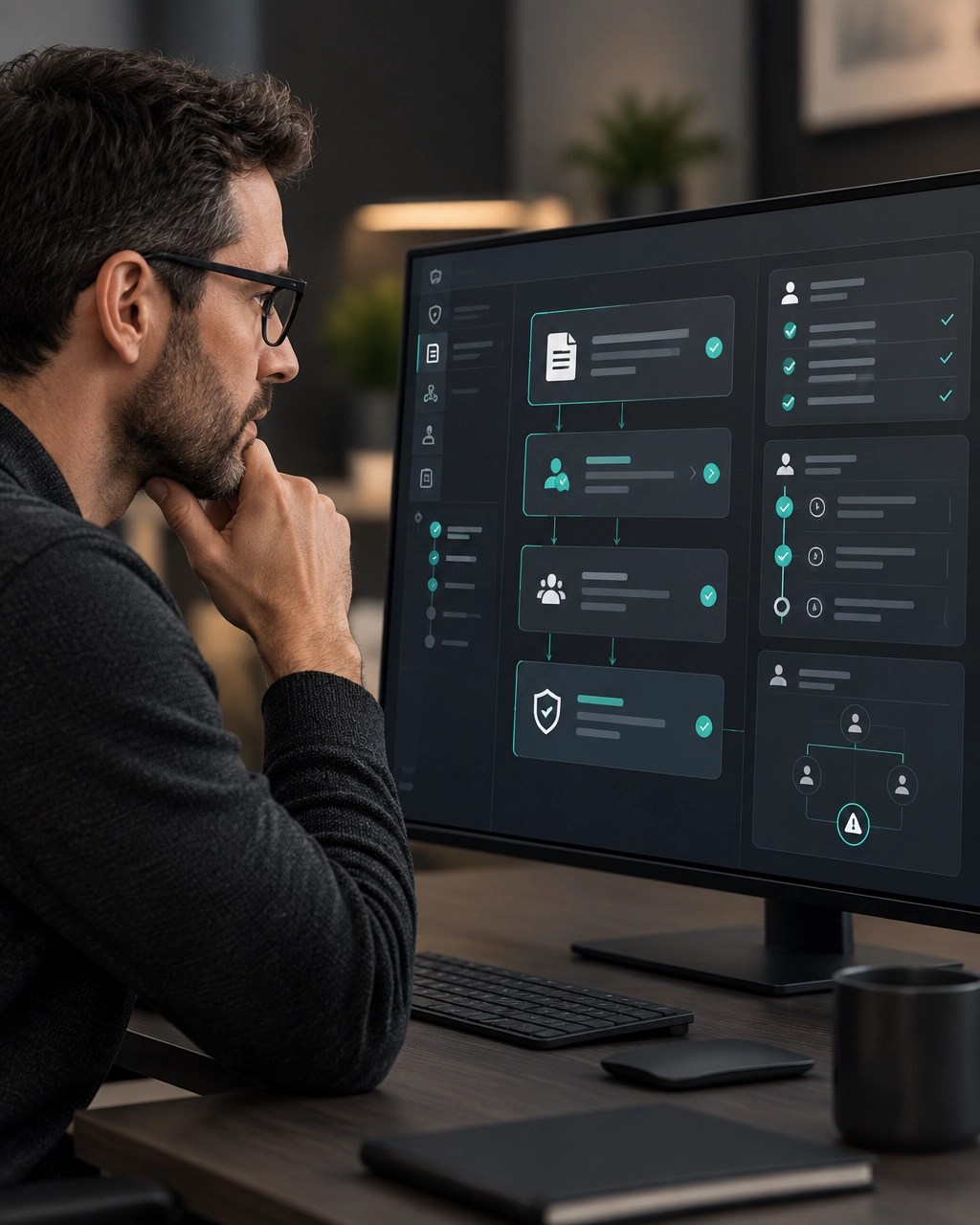
    Technical architect reviewing approval gates, permissions and audit trails in a governed AI workflow

    Growth: Stability Before Scale

    The commercial objective is not to deploy the most sophisticated system. It is to create a resilient operating model that reduces friction and supports expansion.

    A well-architected workflow can help you:

    • Reduce repetitive administrative handling.
    • Improve the consistency of data capture.
    • Respond to high-intent enquiries more reliably.
    • Preserve context between platforms.
    • Escalate exceptions before they become failures.
    • Give teams clearer visibility of operational performance.
    • Scale processes without adding equivalent manual overhead.

    The benefits depend on governance. Without monitoring, data controls, human approval and maintenance ownership, automation simply moves risk out of sight.

    ZeroPoint Creative approaches these systems as infrastructure. Through MyGentic, we can help define the workflow, map the integrations, establish approval boundaries and maintain the operational framework as your business develops. Our wider AI and automation services are supported by managed digital operations management and standalone AI staffing and automation support.

    Key Takeaways

    • Generic automation is appropriate for stable, repetitive and rule-based processes.
    • Bespoke agentic workflows are better suited to context-dependent, multi-stage operations.
    • Human approval should remain mandatory wherever decisions carry material operational, financial or compliance risk.
    • Integrations must be designed around the actual business ecosystem, not only the connectors available in an off-the-shelf platform.
    • Maintenance, monitoring and ownership must be defined before deployment.
    • A hybrid architecture often provides the strongest balance between control and adaptability.
    • Nova is MyGentic’s AI assistant, positioned within a governed workflow model rather than as an isolated software tool.
    • Scalability depends on structural integrity, not simply on the number of automated tasks.

    Conclusion: Choose the Architecture, Not the Trend

    Generic automation is not obsolete. Bespoke agentic workflows are not a universal replacement.

    The correct decision depends on the process.

    If the requirement is fixed, structured and predictable, a generic automation may provide the fastest route to operational improvement. If the process depends on context, judgement, multiple systems and exceptions, a bespoke agentic workflow is more likely to deliver long-term value.

    The critical requirement is architectural discipline.

    ZeroPoint Creative and MyGentic can help you assess the operational problem, determine the appropriate automation model and design a governed workflow around your actual business requirements.

    Contact Krishna to discuss your Agentic Workflow requirements. Start a conversation with ZeroPoint Creative.

    Stability is the primary metric. Precision is the route to scalable growth.

  • ZeroPoint Creative’s MyGentic Brain Is Coming to the Expert Brains Marketplace

    ZeroPoint Creative’s MyGentic Brain Is Coming to the Expert Brains Marketplace

    Category: SEO

    ZeroPoint Creative will soon make its MyGentic brain available through the MyGentic Expert Brains marketplace. At the same time, ZeroPoint Creative will begin offering clients the ability to develop their own bespoke MyGentic brain, structured around their expertise, operating methods, tools and governance requirements.

    This is a forthcoming announcement. ZeroPoint Creative is preparing the brain and finalising the delivery model. The listing is not live yet, and no publication date or licensing price has been confirmed.

    The problem: expertise remains trapped

    A founder’s most valuable asset is often operational judgement. It is the pattern recognition developed through years of decisions, failures, regulated work, customer interactions, staffing challenges and technology adoption.

    However, that expertise commonly remains trapped in one person’s head.

    It gets re-explained to every AI tool through increasingly long prompts. It is repeated in meetings, reconstructed in documents and lost whenever the person is unavailable. Conventional AI tools typically begin with a blank prompt, which means the resulting output can be generic, inconsistent or disconnected from the way the business actually operates.

    This creates operational friction and technical debt.

    There is a second problem. As the AI marketplace expands, buyers are increasingly exposed to generic, undifferentiated material. It is becoming harder to distinguish genuine operator experience from information assembled without meaningful practical judgement.

    The requirement is not simply more content. It is structured context.

    It is a durable operational layer that can carry expertise into the workflows where decisions are made. Stability begins with preserving the right knowledge.

    What an Expert Brain actually is

    According to MyGentic, an Expert Brain is a licensable expertise module created by an operator, founder or subject matter leader.

    It is not intended to replace the user’s own brain. Expert Brains are layered on top of existing context, allowing the user’s voice, objectives and professional situation to remain intact while specialist expertise is added.

    The MyGentic Expert Brains library describes the model as composable:

    • An Expert Brain can be layered onto a user’s existing brain.
    • It can be applied to one agent or to a whole brain.
    • It can be toggled on or off.
    • It is licensed separately on an a la carte basis.
    • Each licensed brain carries its own token allowance, so it does not draw down the user’s plan allowance.

    This is a controlled architecture rather than a permanent replacement of the user’s operating context. The specialist layer is available when required and removable when it is not.

    That distinction matters. You retain your own goals while gaining access to an additional operating perspective.

    What ZeroPoint Creative’s brain will contain

    ZeroPoint Creative’s forthcoming brain is being prepared around the operator methodology of Krishna de Gruchy, founder of ZeroPoint Creative Ltd and CEO of NeedAnOptom.com.

    Krishna has 30 years of operational leadership across:

    • Optical retail
    • Eye surgery
    • Private healthcare
    • Cosmetic medicine
    • Travel

    The brain is intended to package the judgement developed across those environments so that other businesses can apply an experienced operator’s playbook rather than starting from a blank prompt.

    Its differentiation will not be based on scraped knowledge. It will be based on applied judgement shaped by complex operating environments, including multi-site operations, clinical and regulated settings, staffing at scale and the practical adoption of technology.

    The exact structure, scope and licensing terms will be confirmed before the brain is published. ZeroPoint Creative will not present unverified module names or promise specific commercial outcomes.

    The objective is more precise: to make proven operational thinking available as a structured layer that can be applied across relevant business tasks.

    How licensing works

    Expert Brains are licensed separately on an a la carte basis on top of a MyGentic plan. Each licensed brain carries its own token allowance, so it does not draw down the user’s plan allowance.

    MyGentic also states that marketplace selling is available on higher tiers. For current plan information, pricing and marketplace details, readers should refer directly to MyGentic pricing.

    ZeroPoint Creative’s own licensing terms, price and final marketplace position have not yet been confirmed. Those details will be published only when the brain is ready for release.

    A second offering: bespoke MyGentic brains for clients

    The marketplace brain will provide access to ZeroPoint Creative’s own operator methodology. The second offering will be more individualised.

    ZeroPoint Creative will also offer a consultancy engagement for businesses that want to develop their own bespoke MyGentic brain. This will be a structured implementation process, not an out-of-the-box chatbot installation.

    The engagement is expected to cover:

    1. Context gathering
      Capturing the client’s operating environment, objectives, constraints, existing knowledge and decision patterns.

    2. Professional domain definition
      Identifying the areas that the brain must understand, such as leadership, operations, sales, service delivery, compliance or recruitment.

    3. Brain structuring
      Translating the client’s knowledge, methods and professional context into a coherent MyGentic structure.

    4. Tool connection
      Connecting the brain to the client’s existing tools and workflows where appropriate, including the systems already used to manage information and operations.

    5. Agent role definition
      Establishing which agents are required, what each agent is responsible for and where responsibilities must remain with a human decision-maker.

    6. Governance and human oversight
      Defining permissions, escalation routes, review points, data boundaries and operational controls.

    7. Ongoing refinement
      Reviewing performance, updating context and improving the brain as the business, tools and operating conditions change.

    This model is intended for founders, professional service firms, clinics, recruitment businesses and multi-site operators whose expertise is central to delivery but difficult to transfer consistently.

    ZeroPoint Creative already provides AI staffing and automation and digital operations management. A bespoke MyGentic brain would add a structured context layer to that wider operational infrastructure.

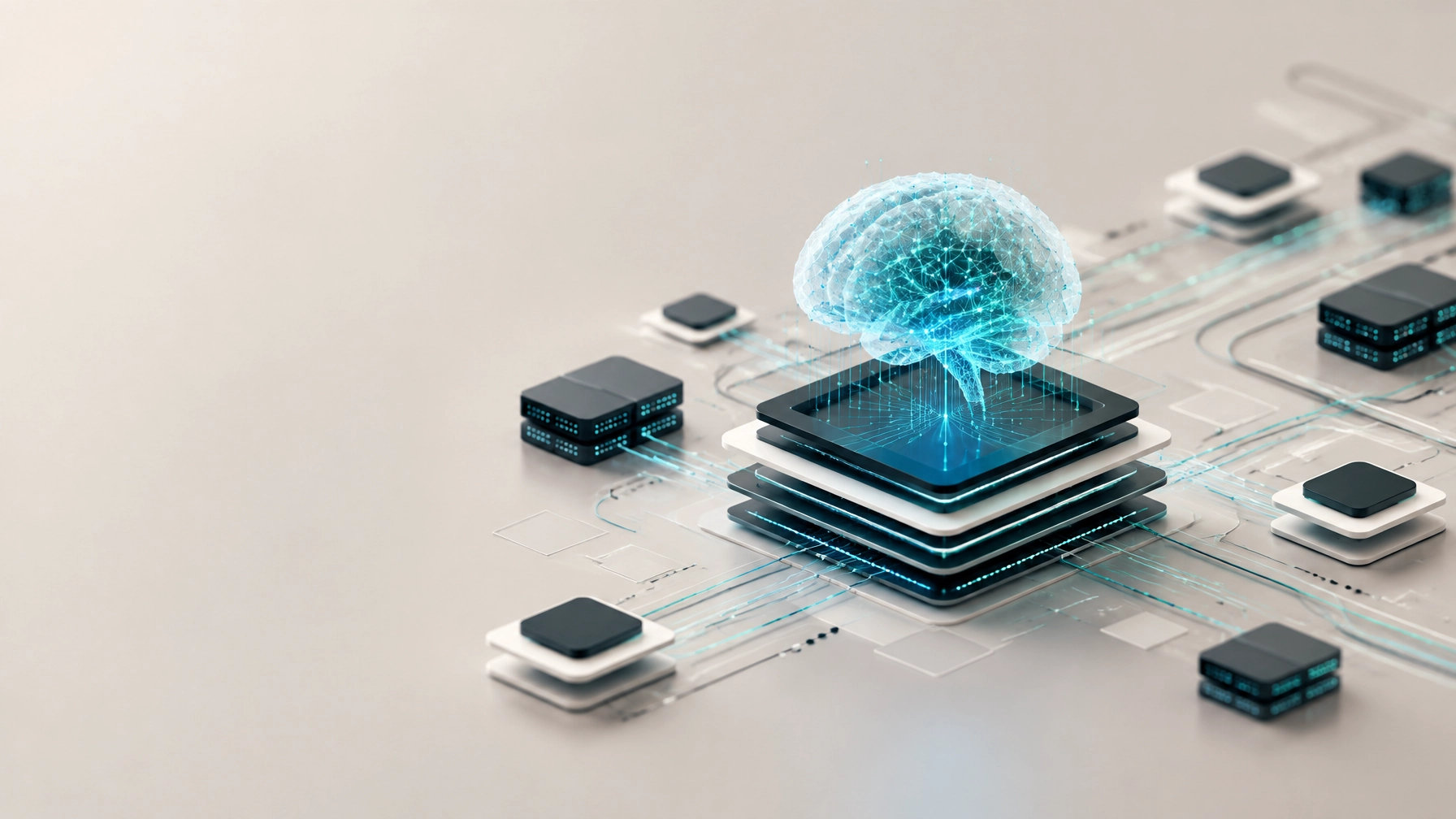
    Layered expertise architecture showing specialist knowledge applied over a central professional context

    Nova is the working proof

    ZeroPoint Creative is not approaching this as a theoretical exercise.

    Nova is Krishna’s MyGentic AI assistant and the working example of how ZeroPoint Creative operates an agentic layer internally. She coordinates a number of AI agents according to the task and currently holds more than 700 saved skills.

    That does not mean Nova replaces human responsibility. It demonstrates how a structured brain can provide context, coordinate specialist activity and maintain consistency across recurring operational requirements.

    The forthcoming Expert Brain will package ZeroPoint Creative’s operator methodology for external licensing. The bespoke consultancy will help other organisations structure their own operational knowledge in the same broader class of system.

    The principle is straightforward: context should be engineered once and then governed continuously.

    Governance and trust

    A bespoke brain must be treated as a controlled business asset, not an ungoverned plug-in.

    Client ownership remains with the client. The client’s business knowledge, context and data remain the client’s property. ZeroPoint Creative does not take ownership of anything a client provides or builds into a bespoke brain. Building a bespoke MyGentic brain does not transfer ownership of the client’s intellectual property or operational knowledge.

    Deletion and revocation remain live client controls. Information can be removed, and access or permissions can be revoked, across the bespoke brain and any connected tools or data sources. This must be treated as an active control the client holds, not as a one-off request. MyGentic’s published data controls set out the relevant position around export, deletion and revocation.

    Human authority is preserved through defined approval levels. The brain and its agents do not make unilateral decisions. A human sets and grants the level of approval required, and consequential actions are reviewed through human intervention before they proceed. The client defines those approval thresholds, and human authority remains in place throughout.

    The governance model will still need to define permissions scope, connected tools, data-source boundaries, audit requirements and encryption standards.

    MyGentic publishes several relevant controls, including AES-256 encryption at rest, TLS 1.3 encryption in transit, zero-trust multi-factor authentication, scoped permissions, data export and deletion. MyGentic also states that its approach is aligned with GDPR and CCPA requirements, and that a SOC 2 audit is underway. Its published data controls and privacy information provide the detailed platform position.

    These controls do not remove the client’s governance obligations. They provide an infrastructure layer that must still be configured correctly for the client’s operational, legal and regulatory environment.

    Control is the foundation of responsible automation.

    What this means for businesses

    A licensable Expert Brain shortens the distance between knowing that an approach works and applying that approach in a live operational context.

    For the buyer, it provides access to structured specialist expertise that can be layered onto existing goals and workflows.

    For the expert, it creates a mechanism for packaging hard-won judgement into a reusable asset.

    For a business commissioning a bespoke brain, it creates the possibility of making founder knowledge more durable and transferable without presenting AI as a substitute for leadership.

    The commercial outcome will depend on the quality of the expertise, the suitability of the implementation and the market demand for the resulting brain. No specific performance or financial return should be assumed.

    The architectural outcome is clearer. Knowledge becomes easier to structure, govern and apply.

    That is the path from individual expertise to operational scalability.

    Key Takeaways

    • ZeroPoint Creative will soon offer its MyGentic brain through the Expert Brains marketplace.
    • The listing is not live, and no launch date or ZeroPoint Creative licensing price has been confirmed.
    • The brain will be based on Krishna de Gruchy’s operational methodology across optical retail, eye surgery, private healthcare, cosmetic medicine and travel.
    • MyGentic Expert Brains layer on top of a user’s existing brain rather than replacing it.
    • Expert Brains are licensed separately on an a la carte basis with their own token allowance, layered on top of the user’s existing brain.
    • ZeroPoint Creative will also offer consultancy support for businesses developing their own bespoke MyGentic brain.
    • The consultancy will cover context gathering, domain definition, brain structuring, tool connections, agent roles, governance and ongoing refinement.
    • All business knowledge shared remains owned by the client; clients can delete or revoke information, and all decisions are reviewed through human intervention with a human granting the level of approval.
    • Nova demonstrates how ZeroPoint Creative already operates with a structured MyGentic assistant and coordinated AI agents.
    • A bespoke brain should be treated as a governed operational asset with defined permissions and human oversight.

    Discuss your MyGentic brain requirements

    Businesses interested in licensing the forthcoming ZeroPoint Creative brain, or developing their own bespoke MyGentic brain, can contact Krishna through:

    ZeroPoint Creative will provide further information when the marketplace listing and bespoke consultancy framework are ready.

    Sources and References

  • Meet Nova: A MyGentic AI Assistant Built Around the Founder’s Working Day

    Meet Nova: A MyGentic AI Assistant Built Around the Founder’s Working Day

    Category: SEO

    A modern business can generate more enquiries than its leadership team can process manually. Bookings arrive through one channel, appointment requests through another, one-to-one session enquiries sit in email, and social replies remain unanswered until operational capacity becomes available.

    That is not a communications problem. It is an infrastructure problem.

    Deloitte’s Tech Trends 2026 research identifies a significant gap between interest in agentic AI and practical deployment: 30% of surveyed organisations were exploring agentic systems, 38% were piloting them, but only 14% had systems ready for deployment and 11% were actively using them in production. The conclusion is clear. The value is not created by adding another chatbot. It is created by redesigning how work moves through the business.

    This is the operating principle behind Nova, Krishna’s MyGentic AI assistant.

    Nova looks after Krishna and his business. She is built around the founder’s working day, with comprehensive business knowledge and a defined operational role across bookings, appointments, one-to-one sessions and social communication.

    She is not a generic chatbot.

    The Problem: Founder-Led Businesses Create Operational Friction

    Founders are often the primary decision-maker, sales contact, strategist and service provider at the same time. This creates a structural weakness: too many routine decisions depend on one person being available at precisely the right moment.

    The resulting friction is familiar:

    • Booking requests remain in inboxes until manually reviewed.
    • Appointment changes require unnecessary back-and-forth communication.
    • One-to-one session enquiries compete with higher-priority operational work.
    • Social replies are delayed, creating visibility decay.
    • Business knowledge remains concentrated in the founder’s memory rather than being available through a controlled digital interface.
    • Valuable context is lost between the initial enquiry and the final action.

    This is a form of data leakage. The information may exist, but it is distributed across emails, calendars, messages, social platforms and personal knowledge. Without an orchestration layer, the business cannot respond with consistent speed or precision.

    The traditional response is to add more disconnected software. That approach frequently creates technical debt. Each new tool introduces another login, another workflow, another notification stream and another point of failure.

    Out-of-the-box automation is not a complete operating model. It is only a collection of components.

    A founder-led business requires a managed digital assistant capable of understanding context, identifying intent and progressing tasks through defined operational pathways. Stability begins when routine work no longer depends entirely on the founder’s immediate attention.

    The Infrastructure: Introducing Nova

    Nova is Krishna’s MyGentic AI assistant, built to support both his working day and the wider ZeroPoint Creative business.

    The distinction matters. Nova is not a ZeroPoint Creative product, not an internal ZPC agent and not a generic chatbot. She is Krishna’s MyGentic AI assistant, configured around his operating environment and the practical requirements of the business.

    Nova combines business knowledge with practical action. She can help people navigate the next step, identify what they need, support booking requests, assist with appointments, coordinate one-to-one sessions and help manage social replies. Her role is not to produce generic text. Her role is to reduce operational friction.

    Abstract agentic workflow infrastructure connecting business knowledge, bookings, appointments and communications

    Business knowledge as an operational layer

    Nova is configured around the business rather than deployed as a blank AI model. This means her value comes from context: the services available, the type of enquiries received, the way Krishna works, and the pathways that should be followed.

    She also operates as an orchestration layer. Depending on the task, Nova coordinates a number of AI agents rather than forcing one generic system to attempt every operational role. She currently has over 700 saved skills, giving her a structured library of actions, pathways and task-specific capabilities.

    That context allows Nova to operate as a controlled front door to the business. She can provide relevant information, direct enquiries appropriately and support a more consistent experience for people who need to engage with Krishna or ZeroPoint Creative.

    The objective is not to imitate human personality. The objective is to preserve operational accuracy.

    Booking and appointment support

    Scheduling is a high-frequency administrative task with a disproportionate impact on the working day. A request to book a call may require checking availability, clarifying the purpose of the conversation, confirming the correct session type and ensuring the appointment is recorded accurately.

    Nova helps coordinate this process.

    She can support booking enquiries, appointment requests and changes without requiring Krishna to manually manage every initial interaction. For one-to-one sessions, she helps create a clearer route from enquiry to confirmed engagement, reducing unnecessary correspondence and protecting the founder’s time.

    This is workflow orchestration. It is not simply calendar automation.

    Social replies and communication continuity

    Social platforms create a second operational environment for the business. Replies, questions and direct messages can contain commercial intent, but they are often handled inconsistently because they compete with core delivery work.

    Nova helps support social replies by maintaining continuity between the question being asked and the business knowledge required to respond. This creates a more reliable communication layer across public and private channels.

    The result is not automated noise. It is a structured response framework designed to preserve relevance, consistency and timely engagement.

    Transformation: From Personal Workload to Agentic Support

    The primary transformation is the redistribution of routine operational work.

    Before Nova, a founder may need to personally monitor every enquiry, interpret every booking request and decide how each social interaction should progress. After Nova, those initial layers can be supported by an agentic system designed around the founder’s priorities.

    Krishna’s working day supported by an AI assistant, with subtle interfaces representing bookings, sessions and communication flow

    This does not remove human judgement. It creates a better allocation of it.

    Krishna remains responsible for strategic decisions, technical architecture, client relationships and high-value conversations. Nova supports the surrounding operational environment so that attention is directed towards matters requiring human authority.

    A practical human-in-the-loop model

    Responsible agentic systems require boundaries. Nova can support routine interactions and progress defined tasks, but complex, sensitive or high-consequence decisions should remain subject to human review.

    This is also why the orchestration model matters. Rather than one generic system attempting every role, Nova brings the correct agent to the correct task. That is deliberate agentic architecture. It is easier to govern, easier to monitor and easier to improve because each operational pathway can be observed, refined and controlled with greater precision.

    This is the correct architecture for a modern business:

    1. Nova receives and interprets the enquiry.
    2. The relevant business context is identified.
    3. The correct agent or skill is coordinated for the task.
    4. The request is routed through the appropriate operational pathway.
    5. Routine actions are supported or progressed.
    6. Matters requiring judgement are escalated to Krishna.
    7. The interaction retains its context rather than restarting from zero.

    This model combines the responsiveness of an always-on assistant with the authority of human oversight.

    It also aligns with the Information Commissioner’s Office guidance on AI and data protection. Where personal data is processed, organisations must consider lawfulness, transparency, data minimisation and appropriate safeguards. A managed AI system should therefore be treated as part of the business infrastructure, not installed as an ungoverned plug-in.

    Growth: Stability Creates Capacity

    Nova’s commercial value is not measured by how convincingly she speaks. It is measured by how effectively she protects capacity, reduces response latency and keeps routine workflows moving.

    That creates four direct growth advantages.

    1. More consistent acquisition

    Enquiries can receive structured support without waiting for a founder to become available. This helps reduce lead decay and creates a more reliable route from interest to conversation.

    2. Protected founder capacity

    Krishna can spend more time on technical architecture, client delivery and strategic development rather than repeatedly handling the same administrative exchanges.

    3. Improved operational visibility

    When interactions are structured, the business gains a clearer view of demand: what people are asking for, which sessions are most requested and where communication friction is occurring.

    4. A scalable digital foundation

    As ZeroPoint Creative develops its AI staffing and automation services, Nova provides a working example of the underlying principle: AI should be connected to real business operations.

    Architectural representation of a resilient MyGentic AI assistant infrastructure connecting phone, calendar, appointments and secure data layers

    The business already provides AI staffing and automation support, including AI administration, lead response assistance, customer communication and workflow support. Nova demonstrates this model in practice, within the operational environment of ZeroPoint Creative itself.

    Nova as Deliberate Agentic Architecture

    This distinction is important.

    Nova is Krishna’s MyGentic AI assistant. She looks after Krishna and his business, supports his working day and helps with bookings, appointments, one-to-one sessions and social replies.

    She is not a ZeroPoint Creative product, not an internal ZPC agent and not a generic chatbot. She functions as an orchestration layer that coordinates a number of AI agents depending on the particular task.

    This is deliberate agentic architecture. Rather than one generic system attempting every role, Nova brings the correct agent to the correct task. That makes the operating model easier to govern, monitor and improve, while preserving clearer boundaries across the business infrastructure.

    How to Reach Nova

    Nova can be reached through the call symbol on the ZeroPoint Creative website or via the freephone number 0800 870 8203.

    For a business owner, this provides a practical way to experience the system rather than simply reading a description. Ask about ZeroPoint Creative’s services, enquire about support, explore how bookings work or begin a conversation about AI staffing.

    The interface is conversational. The infrastructure behind it is operational.

    Key Takeaways

    • Nova is Krishna’s MyGentic AI assistant, not a ZeroPoint Creative product, an internal ZPC agent or a generic chatbot.
    • She is built around the founder’s working day and comprehensive business knowledge.
    • Nova operates as an orchestration layer, coordinating a number of AI agents depending on the task.
    • She currently has over 700 saved skills supporting defined operational pathways.
    • Her support includes bookings, appointments, one-to-one sessions and social replies.
    • Agentic assistants create value by progressing work, not merely generating answers.
    • Human oversight remains essential for complex or high-consequence decisions.
    • Stability, context and defined workflows are the foundation of scalable AI adoption.

    Conclusion: A Working Example of Agentic Business Support

    Nova is a practical demonstration of what an agentic assistant should be.

    She is not positioned as a replacement for leadership, judgement or professional expertise. She is a managed operational layer designed to protect attention, reduce friction and keep routine business activity moving.

    That is the difference between deploying AI as a novelty and engineering it as infrastructure.

    If your business depends on one person to answer every enquiry, manage every booking and maintain every communication channel, the operational risk is already present. The next step is not necessarily more software. It is a clearer architecture.

    You can reach Nova through the call symbol on the ZeroPoint Creative website or call 0800 870 8203.

    Stability is the primary metric. Precision is the path to growth.

  • Nova: The MyGentic AI Assistant Powering Krishna’s Business Operations

    Nova: The MyGentic AI Assistant Powering Krishna’s Business Operations

    Category: SEO

    Nova is Krishna’s MyGentic AI assistant and a working example of how agentic technology can provide an operational layer around a founder.

    She supports Krishna and ZeroPoint Creative with comprehensive business knowledge, bookings, appointments, one-to-one sessions and social replies. She is not positioned as a novelty chatbot or an out-of-the-box automation shortcut. Nova is part of a wider operating framework designed to retain context, interpret requests and support recurring business activity with greater consistency.

    This distinction matters.

    Most AI tools begin with a blank prompt. Nova begins with structured business context.

    The Problem: Founder Operations Are a Systemic Bottleneck

    Founders frequently become the central dependency in their own businesses. Every appointment, enquiry, social reply, booking request and operational decision passes through one person. That may be manageable during the early stages of a business, but it becomes a structural weakness as demand increases.

    The problem is not simply workload. It is dependency architecture.

    When a founder remains the only source of business knowledge, several operational risks emerge:

    • Response latency: Requests wait for the founder to become available.
    • Context loss: Important details become distributed across messages, calendars, notes and informal conversations.
    • Scheduling friction: Bookings and appointments require unnecessary back-and-forth communication.
    • Visibility decay: Social replies and public interactions become inconsistent when operational pressure increases.
    • Decision bottlenecks: Routine questions continue to reach the founder because there is no reliable first-line system to handle them.
    • Data leakage: Business information can become fragmented across disconnected tools and communication channels.

    A conventional chatbot does not rectify these issues. It may answer generic questions, but it does not necessarily understand the founder’s operating model, priorities, services, communication preferences or working context.

    DIY automation creates a further liability. Individual tools may perform isolated tasks, but without a coherent context layer they create a collection of disconnected processes rather than a resilient business system.

    Founder dependency is an infrastructure problem. It requires an infrastructure response.

    A professional founder reviewing a structured MyGentic knowledge layer with connected business context nodes

    The Infrastructure: MyGentic as a Context Layer

    MyGentic is designed to create a structured working model of a professional and connect that context to the AI tools and agents they use.

    Its model is based on the principle that an AI system is only as useful as the context it can reliably access. Instead of requiring a founder to repeat the same explanation in every conversation, MyGentic builds a persistent professional profile that can inform future interactions.

    The platform describes this as building your “brain” and putting it to work across the AI tools used in your business. Its architecture includes:

    • Sage, an AI interview engine that captures professional context through structured conversation.
    • Brain Builder, which organises knowledge, methods and professional identity.
    • Agentic assistants, which can draft, summarise, schedule and act with context.
    • Expert Brains, which allow additional specialist knowledge to be layered into an operating model.
    • Connections to business tools, including email, calendars, documents, communication platforms and AI systems.

    For ZeroPoint Creative, this creates the foundation on which Nova operates.

    Nova is not simply instructed to “answer questions about a business”. She is positioned within Krishna’s wider operational environment, where business knowledge, services, communication routes and scheduling requirements can be interpreted as connected components.

    That is the difference between a prompt-driven tool and an agentic operational layer.

    A Controlled Knowledge Environment

    Context must be governed carefully. Business knowledge should not be exposed indiscriminately, and an AI assistant should not be permitted to make assumptions beyond its defined responsibilities.

    MyGentic’s published information describes controls for ownership, data export, deletion, scoped permissions and encrypted data handling. These are important architectural principles for any business deploying AI around client or operational information.

    The objective is not to place every business record into an unmanaged system. The objective is to provide the correct information to the correct agent for the correct task.

    That is how AI becomes useful without compromising structural integrity.

    Nova in Practice: From Knowledge to Action

    Nova’s role is practical. She supports the points where founder availability and customer access intersect.

    Business Knowledge

    Nova can support questions relating to Krishna’s business, services and operating model by drawing on the relevant business context available to her.

    This gives prospects and clients a more consistent route to information. It also reduces the need for Krishna to restate the same operational details repeatedly.

    The value is not merely speed. It is standardisation.

    When business information is delivered through a defined context layer, the organisation can maintain greater consistency across bookings, enquiries and public communication.

    Bookings and Appointments

    Scheduling is one of the most common sources of operational friction for founders.

    Nova supports bookings and appointments by providing a more direct route between an interested person and the relevant calendar process. This mitigates the familiar sequence of messages, availability checks and manual confirmations that can delay action.

    A booking request should not become a prolonged administrative exchange. The workflow should be clear, governed and frictionless.

    Nova provides that first operational layer around Krishna’s availability.

    One-to-One Sessions

    Krishna also provides one-to-one sessions. These require a clear access route, accurate scheduling and sufficient context before the session begins.

    Nova helps prospective clients navigate this process. She can support the initial request, guide the person towards the appropriate booking route and reduce avoidable administrative work surrounding the appointment.

    The human session remains the high-value interaction. Nova manages the surrounding operational structure.

    This is the correct allocation of responsibility: the agent handles repeatable coordination while the founder remains focused on judgement, expertise and relationship management.

    Social Replies

    Social communication is another area where visibility decay occurs quickly.

    A founder may intend to respond to every relevant comment or message, but operational pressure creates inconsistency. Unanswered replies can reduce trust, interrupt conversations and allow commercial intent to disappear into a busy feed.

    Nova supports Krishna with social replies, helping maintain a more consistent communication layer across public interactions.

    This does not mean every message should be handled without oversight. A resilient system must distinguish between routine engagement, commercial enquiries, sensitive matters and conversations requiring founder intervention.

    The purpose is not uncontrolled automation. It is governed responsiveness.

    A solitary professional overseeing abstract booking, appointment and social-reply workflows through a calm operational interface

    Transformation: From Founder Dependency to Agentic Support

    The transformation created by Nova is not the removal of Krishna from his business. It is the removal of unnecessary operational dependency on Krishna.

    That distinction is fundamental.

    Nova provides a managed layer around the founder by supporting predictable, repeatable interactions while preserving human oversight where it matters. She can help absorb routine demand, but she does not replace the founder’s judgement, expertise or responsibility.

    This creates four operational improvements:

    1. Context is retained: Nova can work from structured business knowledge rather than generic assumptions.
    2. Access becomes clearer: Clients and prospects have defined routes for bookings, appointments and one-to-one sessions.
    3. Communication becomes more consistent: Social replies and initial interactions are less dependent on immediate founder availability.
    4. Founder capacity is protected: Krishna can direct more attention towards strategic work and high-value conversations.

    This is the central principle of agentic operations: automation should extend a capable operator rather than obscure accountability.

    Why Generic AI Is Not Enough

    A generic AI assistant can produce fluent language. That is not the same as operational competence.

    Without appropriate context, governance and workflow definition, a generic system can create:

    • Inaccurate service descriptions.
    • Inconsistent responses.
    • Unapproved commitments.
    • Poorly qualified enquiries.
    • Scheduling errors.
    • Unclear escalation routes.

    These are not minor inconveniences. They represent operational and reputational risk.

    Nova is valuable because she is positioned within a defined business context and assigned practical responsibilities. The system is designed around the way Krishna works, the services he provides and the routes through which people engage with the business.

    Personalisation is not cosmetic. It is an engineering requirement.

    Growth: Stability Before Expansion

    Growth becomes more predictable when the founder is no longer the only operational interface.

    Nova gives Krishna and ZeroPoint Creative an example of how AI staffing and automation can support a business without requiring every interaction to be handled manually. It also demonstrates the relationship between AI assistance and digital operations management: workflows must be organised, monitored and aligned with the wider business ecosystem.

    The commercial outcome is not presented as a guaranteed number or an artificial performance claim. The structural benefit is clearer:

    • More consistent access to the business.
    • Lower administrative friction around appointments.
    • Better continuity across customer communication.
    • Reduced dependence on founder availability for routine requests.
    • A scalable foundation for future agentic workflows.

    This is how stability supports growth. The system absorbs repeatable operational demand, allowing the founder to concentrate on decisions that require experience, judgement and accountability.

    Nova is therefore more than a digital assistant. She is evidence of a broader operational model: MyGentic can provide a context-rich, agentic layer around a founder and help convert personal expertise into a more accessible business system.

    Key Takeaways

    • Nova is Krishna’s MyGentic AI assistant, supporting business knowledge, bookings, appointments, one-to-one sessions and social replies.
    • MyGentic provides the context layer that allows AI tools and agents to work from a structured professional model.
    • Agentic support is not the same as generic automation. It requires defined responsibilities, governed access and clear escalation routes.
    • The objective is not to replace the founder. It is to reduce unnecessary founder dependency and protect high-value attention.
    • Operational stability precedes commercial expansion. A resilient business system can support growth without increasing friction at the same rate.

    Contact Nova Through ZeroPoint Creative

    Nova is available as part of Krishna’s operating environment.

    To access bookings, appointments or one-to-one sessions, select the ☎ call symbol on the ZeroPoint Creative website.

    You can also call the freephone number:

    0800 870 8203

    For businesses evaluating their own AI operational layer, ZeroPoint Creative provides AI staffing and automation support alongside broader digital operations management.

    The principle is straightforward.

    AI should not be added as an isolated feature. It should be engineered into the business architecture with context, governance and clinical precision.

    Nova demonstrates what that architecture can look like in practice.

  • Technical SEO Is Bigger Than Rankings: Building a Search Visibility and Authority System

    Technical SEO Is Bigger Than Rankings: Building a Search Visibility and Authority System

    Category: SEO

    Technical SEO is often reduced to rankings, keywords and isolated audits. That definition is incomplete.

    A business can rank for individual terms while still operating with weak crawlability, fragmented analytics, unclear entity signals, unstable performance and an unmanaged content ecosystem. Visibility becomes inconsistent. Authority becomes difficult to measure. Commercial opportunities leak through technical gaps.

    Google’s current Core Web Vitals thresholds provide a useful performance baseline: Largest Contentful Paint should be within 2.5 seconds, Interaction to Next Paint should be 200 milliseconds or less, and Cumulative Layout Shift should remain at 0.1 or less at the 75th percentile. These are not decorative benchmarks. They are measurable indicators of whether your digital infrastructure provides a stable experience.

    Search visibility is a system, not a ranking position.

    Key Takeaways

    • Technical SEO governs whether search engines can discover, interpret, index and reliably access your digital assets.
    • Crawlability and indexability are separate controls. A page can be discovered but still excluded from search.
    • Structured information and consistent entities help machines interpret your organisation, services, people and relationships.
    • Performance, security and mobile accessibility are operational requirements, not optional enhancements.
    • AI-assisted discovery relies on the same underlying foundations as traditional search, but no technical implementation guarantees inclusion in an AI-generated answer.
    • Continuous monitoring is essential because visibility decay, broken links, content drift and technical debt accumulate over time.

    Problem: Why Rankings Alone Are an Incomplete Metric

    A ranking report can show that a page appears in position six for a selected query. It does not necessarily show whether your wider search system is structurally sound.

    Your priority service page may be blocked by an incorrect directive. Your XML sitemap may contain outdated URLs. Several pages may compete against one another because canonical signals are inconsistent. A high-value article may exist without internal links, leaving it effectively isolated from the rest of the site.

    These failures create technical debt.

    The same pattern appears in content governance. Pages are published without clear ownership, review dates or defined search intent. Service descriptions become inconsistent across the website, business listings and third-party profiles. Analytics events are renamed or removed without documentation. Over time, your digital ecosystem develops data rot: the information still exists, but its reliability and usefulness decline.

    The commercial impact is straightforward. Search engines receive incomplete or conflicting signals. Prospective customers encounter slow pages, unclear information or broken journeys. Internal teams make decisions using partial data.

    A ranking is an output. It is not a diagnosis.

    Crawlability: Can Search Systems Reach the Asset?

    Crawlability is the discovery layer of technical SEO. It concerns whether search engine crawlers can reach important pages through links, XML sitemaps and accessible technical pathways.

    A structured crawlability review should examine:

    • robots.txt directives
    • XML sitemap accuracy
    • Internal linking depth
    • Orphaned pages
    • Redirect chains
    • Broken links
    • Server response errors
    • JavaScript-dependent content
    • Navigation pathways between priority pages

    Google states that sites can be missed when they are not linked from elsewhere, have recently launched, block crawlers, generate crawl errors or make content difficult to access. The implication is clear: publishing content is not enough. Your architecture must expose it.

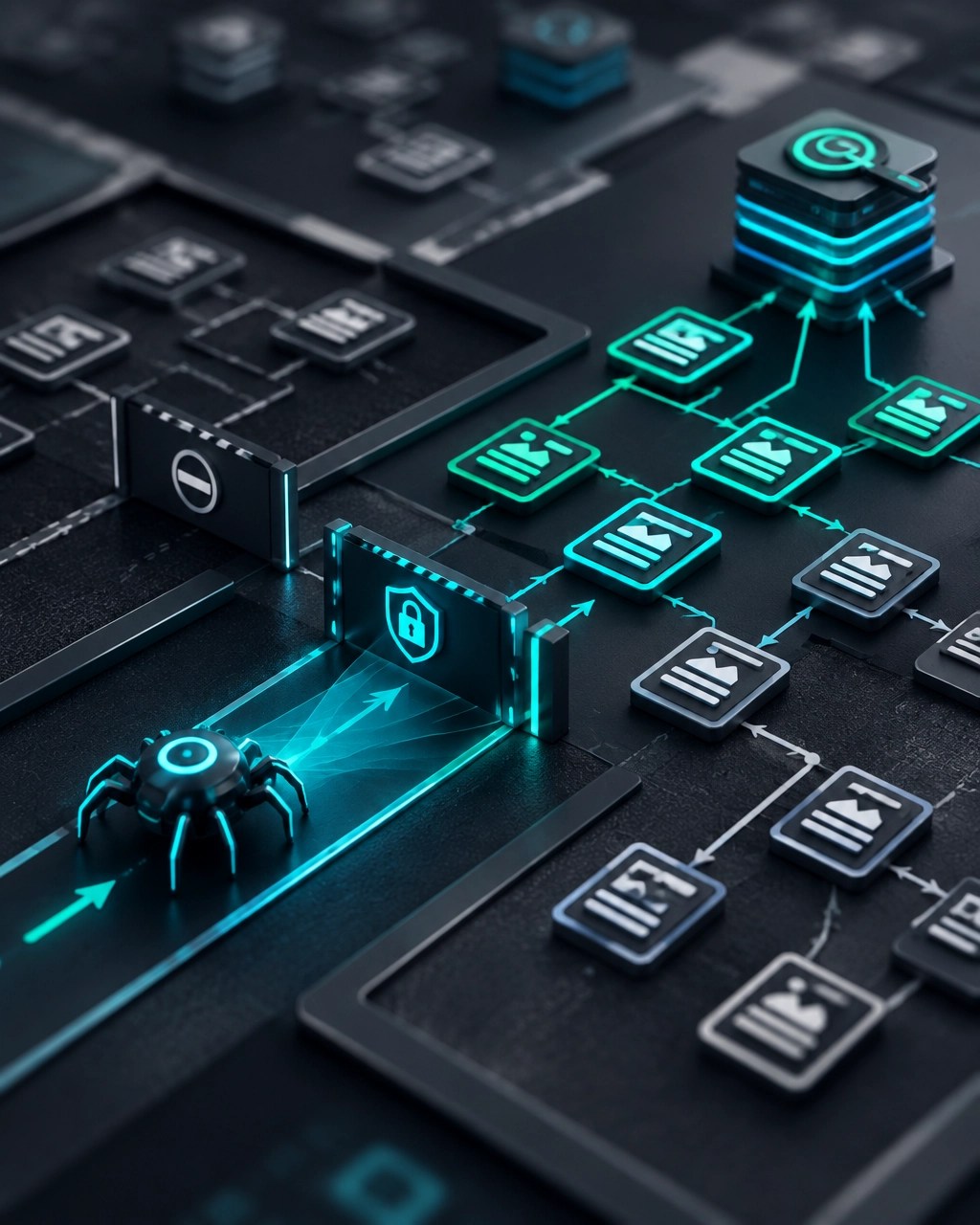
    Technical SEO crawlability system showing connected sitemap pathways and controlled discovery routes

    Indexability: Should the Asset Be Stored and Served?

    Crawlability determines whether a page can be reached. Indexability determines whether it is eligible to appear in search.

    This distinction is frequently misunderstood.

    Technical SEO must identify which pages should be indexed and which should be deliberately excluded. Relevant controls include:

    • noindex directives
    • Canonical tags
    • Duplicate or near-duplicate content
    • Parameter-generated URLs
    • Thin pages
    • Paginated content
    • Incorrect HTTP headers
    • Soft 404s
    • Index coverage errors

    A healthy index is not necessarily a large index. It is a controlled index containing the right pages: unique, useful, accessible and aligned with business intent.

    This is where standardisation matters. Your priority services, locations, resources and commercial pages should have a defined role within the information architecture. Low-value or duplicated URLs should not compete for attention with them.

    The objective is not maximum inclusion. It is controlled eligibility.

    Infrastructure: Engineering a Search Visibility System

    A resilient technical SEO programme operates across several connected layers. Each layer supports the next.

    1. Performance and Accessibility

    Performance engineering concerns loading speed, interactivity and visual stability. Google’s Web Vitals documentation identifies LCP, INP and CLS as the current Core Web Vitals, measured against real user experience and reported across mobile and desktop environments.

    Performance work may involve:

    • Reducing render-blocking resources
    • Optimising image delivery
    • Reviewing third-party scripts
    • Improving server response time
    • Managing font loading
    • Eliminating layout movement
    • Testing real-user performance rather than relying solely on laboratory scores

    Accessibility is part of the same operational discipline. Content should be usable across devices and assistive technologies. Semantic headings, descriptive links, keyboard access, readable contrast and meaningful alternative text improve clarity for users and machines alike.

    A fast page that cannot be navigated or understood is still a deficient system.

    2. Structured Information and Entity Clarity

    Search systems do not interpret a website only as a collection of keywords. They also need to understand entities and relationships.

    An entity may be your organisation, a service, a professional, a location, a product or a distinct topic. Entity clarity means describing these elements consistently across your website and relevant external profiles.

    Structured data provides explicit, machine-readable information about page content. Google describes it as a standardised format that helps clarify what a page represents and can make it eligible for enhanced search features. JSON-LD is commonly recommended because it is comparatively easy to maintain separately from visible page content.

    Structured data must be accurate and correspond to information visible to users. It is not a mechanism for inserting unsupported claims or manufacturing authority.

    Practical applications may include:

    • Organisation information
    • Article authorship
    • Service details
    • Breadcrumb relationships
    • Frequently asked questions where appropriate
    • Local business information
    • Product data where relevant

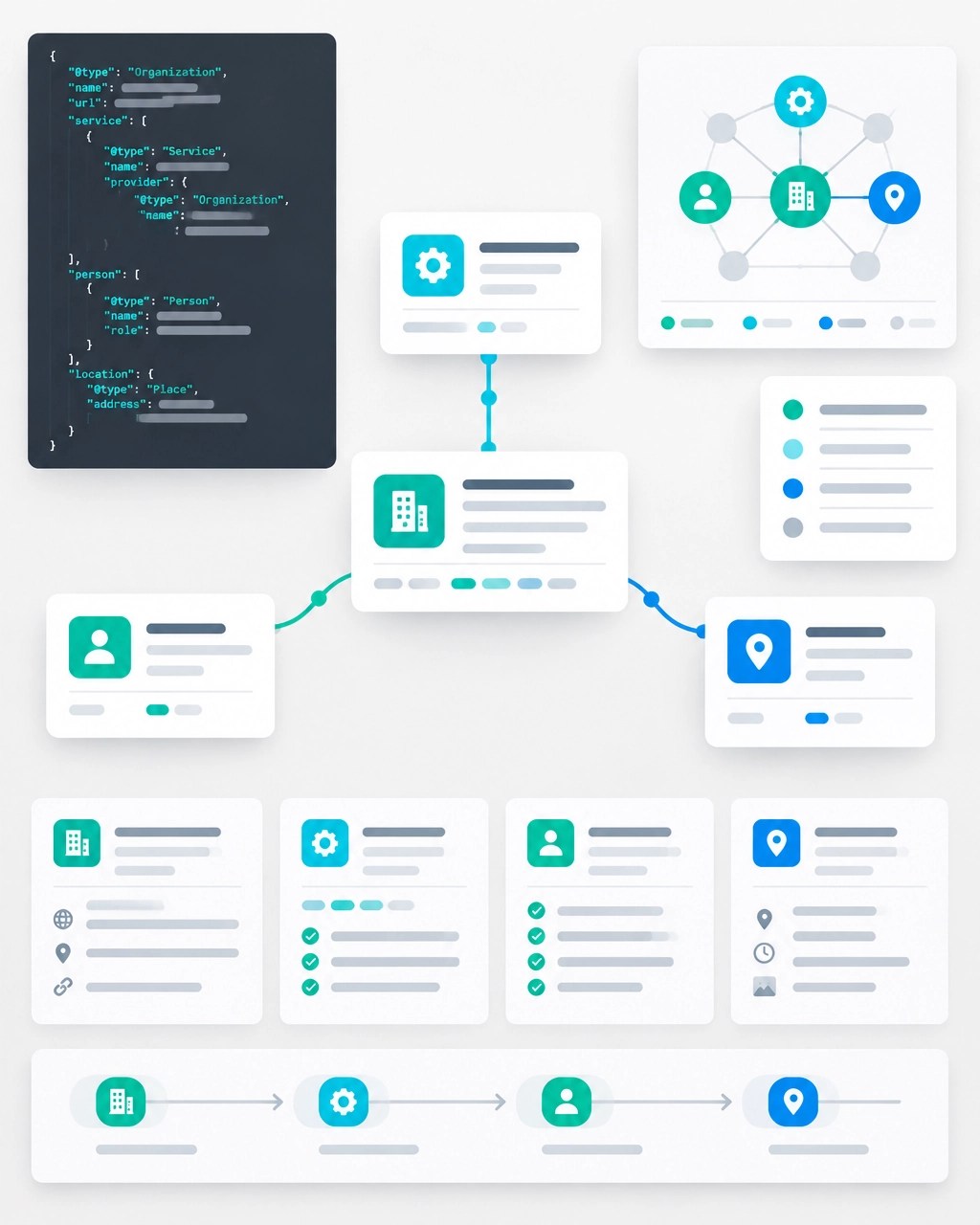
    Structured information and entity clarity represented as connected organisation, service and location data

    The correct objective is not to add every possible schema type. It is to create a coherent, accurate information layer that supports understanding.

    3. Content Governance and Internal Architecture

    Technical SEO cannot be separated from content governance.

    Every important page should have a defined purpose, target audience, search intent, owner and review process. Internal linking should reinforce the hierarchy between core service pages, supporting resources and conversion pathways.

    A governance framework should answer:

    • Which pages represent primary commercial services?
    • Which pages support awareness and education?
    • Which claims require regular review?
    • Which pages are outdated, overlapping or redundant?
    • Which internal links should be added as the site grows?
    • Which analytics events measure meaningful business outcomes?

    This prevents content sprawl. It also protects the authority of the domain by ensuring that new material strengthens, rather than fragments, the existing architecture.

    Transformation: Connecting Traditional Search with AI-Assisted Discovery

    Search behaviour is becoming more varied. People may still visit conventional search results, but they may also encounter summaries, conversational interfaces and AI-assisted discovery systems.

    The responsible position is measured. No organisation can guarantee that a page will be selected, cited or summarised by an AI system. However, the technical foundations remain important.

    AI-assisted systems still require accessible information, clear language, reliable sources and unambiguous relationships. Crawlability, indexability, structured information, performance and content quality therefore remain relevant across the broader discovery environment.

    This is not a separate shortcut called “AI SEO”. It is a continuation of sound information architecture.

    Introducing Nova

    Nova, ZeroPoint Creative’s MyGentic AI assistant represented as a calm, governed digital operations interface

    Nova is ZeroPoint Creative’s MyGentic AI assistant. Her role illustrates why machine-readable information and content governance matter operationally.

    An assistant can only provide reliable guidance when the underlying service information, internal processes and business terminology are organised and maintained. If your website contains contradictory pricing, outdated service descriptions or unclear ownership, automated assistance is exposed to the same structural confusion as a human visitor.

    Nova is not presented as a replacement for technical SEO. She is an example of the wider digital operations principle: intelligent systems require governed inputs.

    Information quality is infrastructure.

    Growth: From Visibility to Predictable Commercial Performance

    A search visibility system supports growth by reducing uncertainty.

    When priority pages are crawlable, indexable, fast, clearly structured and connected through logical internal links, your organisation has a stronger foundation for discovery. When analytics are configured around enquiries, bookings, qualified leads and other meaningful actions, you can evaluate commercial performance rather than celebrate surface-level traffic.

    Continuous monitoring should include:

    • Organic impressions and clicks
    • Index coverage and crawl errors
    • Priority keyword groups
    • Branded and non-branded visibility
    • Core Web Vitals
    • Broken links and redirect changes
    • Structured data validity
    • Conversion events
    • Content freshness
    • Search intent alignment

    Technical SEO monitoring dashboard represented by a focused specialist reviewing performance and visibility signals

    This is the point at which technical SEO becomes digital operations management. The work is not completed when an audit is delivered. It continues through prioritisation, implementation, verification and recurring review.

    ZeroPoint Creative provides SEO and Visibility support covering on-page improvements, keyword targeting, metadata updates, technical SEO checks and visibility-focused recommendations. We can also support the wider operational framework through Digital Operations Management.

    The model is managed, data-informed and performance-driven.

    Conclusion: Precision Is the Only Sustainable Visibility Strategy

    Technical SEO is not a collection of isolated ranking tactics. It is the engineering discipline responsible for maintaining search access, information clarity, performance integrity and measurable authority across a changing digital environment.

    The systemic problem is visibility decay. The infrastructure is crawlability, indexability, structured information, performance, content governance, entity clarity, analytics and continuous monitoring. The transformation is a more coherent discovery system that can support both conventional search and AI-assisted journeys without unsupported promises.

    Rankings may fluctuate. A governed infrastructure gives your business the capacity to respond.

    ZeroPoint Creative acts as a technical SEO and digital operations partner for modern businesses that require reliable, hands-off oversight. We rectify structural weaknesses, standardise digital information and maintain the operational conditions required for scalable acquisition.

    Stability is the primary metric. Growth follows structural integrity.

    Sources and References

  • The Managed Clinic Ecosystem: How AI Infrastructure Frees Clinicians to Focus on Care

    The Managed Clinic Ecosystem: How AI Infrastructure Frees Clinicians to Focus on Care

    Healthcare organisations rarely fail because of a lack of clinical expertise. They fail when recruitment, scheduling, communication, community management and digital administration operate as disconnected systems.

    For surgeons, optometrists and healthcare decision-makers, this fragmentation creates avoidable operational friction. Valuable time is diverted from patient care into inbox management, candidate screening, document handling, platform administration and repetitive scheduling tasks.

    The issue is structural.

    Under the UK GDPR, health information is special category data requiring enhanced protection and appropriate governance. A clinic ecosystem that relies on unmanaged spreadsheets, personal inboxes and disconnected software is not merely inefficient. It creates compliance exposure, data leakage and technical debt.

    A managed clinic ecosystem provides a controlled alternative. It combines SaaS infrastructure, recruitment automation, professional community operations, scheduling and ongoing support within one governed framework.

    This is the model being developed around NeedAnOptom Healthcare, with ZeroPoint Creative acting as the infrastructure and automation partner.

    Key Takeaways

    • NeedAnOptom Healthcare operates first as a healthcare recruitment company and second as a professional community platform.
    • Its recruitment placements and community-generated donations support charitable giving; NeedAnOptom Healthcare is not itself a charity.
    • ZeroPoint Creative provides the technical architecture, automation and digital operations management behind the ecosystem.
    • Agentic workflows can reduce repetitive administrative work across recruitment, scheduling, communications and platform operations.
    • Nova, Krishna’s MyGentic AI assistant, represents the type of managed AI infrastructure that can support complex business workflows without replacing clinical judgement.
    • Reliable infrastructure allows clinicians to focus on care whilst healthcare organisations scale with greater control.

    The Problem: Fragmented Operations and Clinical Time Loss

    A modern clinic is not a single system. It is an operational network involving clinical staff, administrators, recruiters, candidates, patients, professional communities and external partners.

    When these functions are managed independently, several systemic weaknesses emerge:

    • Recruitment latency: Candidate enquiries remain unanswered whilst clinical leaders are occupied with patient care.
    • Credentialing friction: Documents, references and professional information are collected inconsistently.
    • Scheduling instability: Interviews, onboarding calls and operational meetings require unnecessary manual coordination.
    • Community fragmentation: Professional knowledge is dispersed across email, messaging applications and informal networks.
    • Visibility decay: Vacancies, resources and announcements become outdated across multiple channels.
    • Compliance exposure: Sensitive information may be copied between systems without a clear audit trail or retention protocol.

    These failures have a direct commercial impact. A delayed recruitment response can mean an unfilled clinical shift. A poorly co-ordinated onboarding process can delay service delivery. An inactive community platform can weaken trust and reduce the quality of professional engagement.

    DIY and out-of-the-box tools do not rectify these issues. They often create another layer of technical debt.

    Stability is the primary requirement.

    Healthcare clinician reviewing a structured recruitment and scheduling dashboard within a managed clinical environment

    The Infrastructure: A Managed Clinic Operating Layer

    The managed clinic model treats digital operations as infrastructure rather than a collection of subscriptions.

    ZeroPoint Creative provides the technical architecture required to connect the main operational components:

    1. SaaS infrastructure and secure hosting
    2. Healthcare recruitment automation
    3. Professional community operations
    4. Scheduling and communications
    5. Ongoing support, monitoring and optimisation

    This does not mean that every decision is delegated to software. It means that routine, repeatable processes are standardised so that experienced professionals can concentrate on decisions requiring human judgement.

    Recruitment as the Primary Engine

    NeedAnOptom Healthcare is first a healthcare recruitment company. Its core purpose is to connect healthcare professionals and employers through carefully managed recruitment activity.

    The organisation supports clinical recruitment across areas rooted in optometry and ophthalmic care, with wider healthcare applications. Its employer-facing model focuses on understanding requirements, identifying appropriate candidates and supporting the placement process. This is materially different from treating recruitment as a generic job-board function.

    ZeroPoint Creative’s role is to engineer the supporting infrastructure.

    Agentic workflows can assist with:

    • Initial candidate enquiry handling
    • Vacancy information and response management
    • Structured pre-screening
    • Document collection
    • Credential and information checks
    • Interview scheduling
    • Candidate reminders
    • Internal notifications
    • Recruitment pipeline reporting

    The purpose is not to automate clinical authorisation. Professional qualifications, suitability and final recruitment decisions remain subject to appropriate human review.

    The purpose is to remove administrative repetition.

    Community as the Second Layer

    NeedAnOptom Healthcare is also developing a professional community platform, including the Clinical Exchange concept. This provides a structured environment for clinicians to share knowledge, seek peer input and remain connected to relevant professional developments.

    The community function is important because recruitment alone does not create a durable clinical network. Professional relationships require continuity, useful information and a trusted operating environment.

    ZeroPoint Creative supports the infrastructure behind this layer through platform administration, access controls, content workflows, moderation processes and system oversight.

    A community platform should not be treated as an unmanaged discussion board. It is social infrastructure. Its structural integrity affects professional trust.

    Scheduling and Operational Support

    Scheduling is often underestimated because each individual task appears minor. Across a growing healthcare organisation, however, small scheduling tasks accumulate into a substantial administrative burden.

    A managed scheduling framework can co-ordinate:

    • Candidate interviews
    • Employer consultations
    • Onboarding appointments
    • Community events
    • Internal reviews
    • Support requests
    • Follow-up communications

    Automated reminders reduce missed appointments. Centralised availability reduces duplication. Clear escalation rules ensure that exceptions reach the correct human operator.

    This is where managed digital operations become valuable. ZeroPoint Creative’s Digital Operations Management service is designed around workflow support, operational co-ordination, platform oversight and routine digital administration.

    The system creates order without imposing unnecessary complexity.

    Transformation: Introducing Nova into the Managed Ecosystem

    Nova, Krishna’s MyGentic AI assistant, represented as a precise digital operations interface supporting healthcare workflows

    Nova is Krishna’s MyGentic AI assistant. She is part of the wider AI infrastructure used to support managed workflows and operational co-ordination.

    Nova should not be understood as a replacement for a surgeon, optometrist, recruiter or practice manager. She is not a clinical decision-maker. She does not replace professional accountability.

    Her role is to support the operational layer.

    Within a properly governed workflow, an AI assistant such as Nova can help organise information, direct enquiries, prepare structured summaries, trigger routine actions and escalate matters requiring human attention. This is particularly valuable where the process is repetitive, rules-based and distributed across multiple platforms.

    For a healthcare recruitment and community ecosystem, that may include:

    • Routing a candidate to the correct recruitment pathway
    • Identifying missing information before human review
    • Preparing an internal task for a recruiter
    • Supporting appointment and interview coordination
    • Directing community members to approved resources
    • Escalating safeguarding, compliance or clinical queries
    • Maintaining consistent communication standards

    The value is not artificial autonomy for its own sake. The value is controlled reduction of operational friction.

    ZeroPoint Creative’s AI Staffing and Automation service provides a broader framework for businesses requiring AI support with administration, lead handling, customer communication and digital workflows.

    In healthcare, those workflows must be configured with additional care. Access permissions, data minimisation, human review and auditability are not optional design features. They are part of the architecture.

    Community-Led Giving and Professional Responsibility

    NeedAnOptom Healthcare is not itself a charity. It is a healthcare recruitment company and professional community platform.

    Its charitable contribution operates through the activity surrounding the organisation. Successful placements and donations generated through the community support associated charitable initiatives, including the aims described through Place with Purpose.

    This distinction matters. Accurate positioning protects trust.

    The commercial recruitment function, the professional community and the charitable giving mechanism are connected, but they are not identical. A resilient digital ecosystem must represent those functions clearly so that clinicians, employers, community members and charitable partners understand how the structure operates.

    Clear architecture supports clear accountability.

    Abstract architectural network connecting recruitment, community, scheduling and support workflows within a managed clinic ecosystem

    Growth: Scaling Without Scaling Administrative Burden

    A managed clinic ecosystem creates a more predictable foundation for growth.

    NeedAnOptom Healthcare can expand its recruitment reach, strengthen its professional community and support wider charitable giving without relying entirely on manual administration. ZeroPoint Creative can monitor the technical environment, refine workflows and maintain the operational systems that support the platform.

    This produces several practical outcomes:

    • Greater recruitment throughput: More candidate and employer interactions can be processed consistently.
    • Protected clinical time: Surgeons and optometrists spend less time handling non-clinical administration.
    • Improved professional engagement: Community members have a structured environment for communication and knowledge exchange.
    • Reduced operational overhead: Routine work is handled through standardised workflows rather than repeated manual intervention.
    • Scalable infrastructure: New services, integrations and processes can be added without rebuilding the entire system.
    • Stronger ecosystem stability: Recruitment, community activity and support functions operate from a more coherent technical foundation.

    Growth becomes a consequence of stability.

    That is the distinction between adding software and engineering infrastructure. Software provides isolated functions. Infrastructure provides controlled interaction between those functions.

    The ZeroPoint Creative Role: Technical Architecture and Guardianship

    ZeroPoint Creative operates as the technical architect behind the digital ecosystem. The role extends beyond building a platform. It includes ongoing oversight, workflow design, automation management, technical support and operational refinement.

    The relevant services include:

    Healthcare organisations should not be expected to become part-time systems administrators. Their responsibility is to deliver safe, effective and professional care. Their digital partner should assume responsibility for the structural integrity of the supporting ecosystem.

    DIY infrastructure is a liability when no one owns the complete operating picture.

    Managed infrastructure provides ownership, governance and continuity.

    Conclusion: Clinical Focus Requires Operational Precision

    The future of healthcare operations will not be defined by isolated AI tools. It will be defined by integrated, governed ecosystems that connect recruitment, community, scheduling, support and digital administration.

    NeedAnOptom Healthcare demonstrates how a healthcare recruitment company can develop into a wider professional community platform, with placements and community donations supporting charitable giving. ZeroPoint Creative provides the infrastructure and automation required to make that model resilient.

    The objective is straightforward: reduce administrative friction so clinicians can return their attention to clinical care.

    If you are a surgeon, optometrist, practice leader or healthcare decision-maker assessing your own Agentic Workflow requirements, contact Krishna through ZeroPoint Creative.

    Precision is the only path to operational confidence. Stability is the foundation of growth.

    Category: SEO

  • Meet Nova: A MyGentic AI Assistant Built Around the Founder’s Working Day

    Meet Nova: A MyGentic AI Assistant Built Around the Founder’s Working Day

    Category: SEO

    A modern business can generate more enquiries than its leadership team can process manually. Bookings arrive through one channel, appointment requests through another, one-to-one session enquiries sit in email, and social replies remain unanswered until operational capacity becomes available.

    That is not a communications problem. It is an infrastructure problem.

    Deloitte’s Tech Trends 2026 research identifies a significant gap between interest in agentic AI and practical deployment: 30% of surveyed organisations were exploring agentic systems, 38% were piloting them, but only 14% had systems ready for deployment and 11% were actively using them in production. The conclusion is clear. The value is not created by adding another chatbot. It is created by redesigning how work moves through the business.

    This is the operating principle behind Nova, Krishna’s MyGentic AI assistant.

    Nova looks after Krishna and his business. She is built around the founder’s working day, with comprehensive business knowledge and a defined operational role across bookings, appointments, one-to-one sessions and social communication.

    She is not a generic chatbot.

    The Problem: Founder-Led Businesses Create Operational Friction

    Founders are often the primary decision-maker, sales contact, strategist and service provider at the same time. This creates a structural weakness: too many routine decisions depend on one person being available at precisely the right moment.

    The resulting friction is familiar:

    • Booking requests remain in inboxes until manually reviewed.
    • Appointment changes require unnecessary back-and-forth communication.
    • One-to-one session enquiries compete with higher-priority operational work.
    • Social replies are delayed, creating visibility decay.
    • Business knowledge remains concentrated in the founder’s memory rather than being available through a controlled digital interface.
    • Valuable context is lost between the initial enquiry and the final action.

    This is a form of data leakage. The information may exist, but it is distributed across emails, calendars, messages, social platforms and personal knowledge. Without an orchestration layer, the business cannot respond with consistent speed or precision.

    The traditional response is to add more disconnected software. That approach frequently creates technical debt. Each new tool introduces another login, another workflow, another notification stream and another point of failure.

    Out-of-the-box automation is not a complete operating model. It is only a collection of components.

    A founder-led business requires a managed digital assistant capable of understanding context, identifying intent and progressing tasks through defined operational pathways. Stability begins when routine work no longer depends entirely on the founder’s immediate attention.

    The Infrastructure: Introducing Nova

    Nova is Krishna’s MyGentic AI assistant, built to support both his working day and the wider ZeroPoint Creative business.

    The distinction matters. A chatbot answers questions in a conversation. An agentic assistant is designed to support outcomes.

    Nova combines business knowledge with practical action. She can help people navigate the next step, identify what they need, support booking requests, assist with appointments, coordinate one-to-one sessions and help manage social replies. Her role is not to produce generic text. Her role is to reduce operational friction.

    Abstract agentic workflow infrastructure connecting business knowledge, bookings, appointments and communications

    Business knowledge as an operational layer

    Nova is configured around the business rather than deployed as a blank AI model. This means her value comes from context: the services available, the type of enquiries received, the way Krishna works, and the pathways that should be followed.

    That context allows Nova to operate as a controlled front door to the business. She can provide relevant information, direct enquiries appropriately and support a more consistent experience for people who need to engage with Krishna or ZeroPoint Creative.

    The objective is not to imitate human personality. The objective is to preserve operational accuracy.

    Booking and appointment support

    Scheduling is a high-frequency administrative task with a disproportionate impact on the working day. A request to book a call may require checking availability, clarifying the purpose of the conversation, confirming the correct session type and ensuring the appointment is recorded accurately.

    Nova helps coordinate this process.

    She can support booking enquiries, appointment requests and changes without requiring Krishna to manually manage every initial interaction. For one-to-one sessions, she helps create a clearer route from enquiry to confirmed engagement, reducing unnecessary correspondence and protecting the founder’s time.

    This is workflow orchestration. It is not simply calendar automation.

    Social replies and communication continuity

    Social platforms create a second operational environment for the business. Replies, questions and direct messages can contain commercial intent, but they are often handled inconsistently because they compete with core delivery work.

    Nova helps support social replies by maintaining continuity between the question being asked and the business knowledge required to respond. This creates a more reliable communication layer across public and private channels.

    The result is not automated noise. It is a structured response framework designed to preserve relevance, consistency and timely engagement.

    Transformation: From Personal Workload to Agentic Support

    The primary transformation is the redistribution of routine operational work.

    Before Nova, a founder may need to personally monitor every enquiry, interpret every booking request and decide how each social interaction should progress. After Nova, those initial layers can be supported by an agentic system designed around the founder’s priorities.

    Krishna’s working day supported by an AI assistant, with subtle interfaces representing bookings, sessions and communication flow

    This does not remove human judgement. It creates a better allocation of it.

    Krishna remains responsible for strategic decisions, technical architecture, client relationships and high-value conversations. Nova supports the surrounding operational environment so that attention is directed towards matters requiring human authority.

    A practical human-in-the-loop model

    Responsible agentic systems require boundaries. Nova can support routine interactions and progress defined tasks, but complex, sensitive or high-consequence decisions should remain subject to human review.

    This is the correct architecture for a modern business:

    1. Nova receives and interprets the enquiry.
    2. The relevant business context is identified.
    3. The request is routed through the appropriate operational pathway.
    4. Routine actions are supported or progressed.
    5. Matters requiring judgement are escalated to Krishna.
    6. The interaction retains its context rather than restarting from zero.

    This model combines the responsiveness of an always-on assistant with the authority of human oversight.

    It also aligns with the Information Commissioner’s Office guidance on AI and data protection. Where personal data is processed, organisations must consider lawfulness, transparency, data minimisation and appropriate safeguards. A managed AI system should therefore be treated as part of the business infrastructure, not installed as an ungoverned plug-in.

    Growth: Stability Creates Capacity

    Nova’s commercial value is not measured by how convincingly she speaks. It is measured by how effectively she protects capacity, reduces response latency and keeps routine workflows moving.

    That creates four direct growth advantages.

    1. More consistent acquisition

    Enquiries can receive structured support without waiting for a founder to become available. This helps reduce lead decay and creates a more reliable route from interest to conversation.

    2. Protected founder capacity

    Krishna can spend more time on technical architecture, client delivery and strategic development rather than repeatedly handling the same administrative exchanges.

    3. Improved operational visibility

    When interactions are structured, the business gains a clearer view of demand: what people are asking for, which sessions are most requested and where communication friction is occurring.

    4. A scalable digital foundation

    As ZeroPoint Creative develops its AI staffing and automation services, Nova provides a working example of the underlying principle: AI should be connected to real business operations.

    Architectural representation of a resilient MyGentic AI assistant infrastructure connecting phone, calendar, appointments and secure data layers

    The business already provides AI staffing and automation support, including AI administration, lead response assistance, customer communication and workflow support. Nova demonstrates this model in practice, within the operational environment of ZeroPoint Creative itself.

    Nova Is Not Alison

    This distinction is important.

    Nova is Krishna’s MyGentic AI assistant. She looks after Krishna and his business, supports his working day and helps with bookings, appointments, one-to-one sessions and social replies.

    Alison is a separate ZeroPoint Creative-built AI sales agent. Alison is designed for frontline sales engagement, lead qualification and website-based service conversations.

    They are not the same assistant, and they serve different operational functions.

    This separation reflects a sound agentic architecture. Specialised assistants are easier to govern, monitor and improve than one generic system attempting to perform every role. Nova supports the founder’s operating environment. Alison supports the sales interface. Each has a defined purpose.

    How to Reach Nova

    Nova can be reached through the call symbol on the ZeroPoint Creative website. If you prefer to speak with the business directly, call 0800 870 8203.

    For a business owner, this provides a practical way to experience the system rather than simply reading a description. Ask about ZeroPoint Creative’s services, enquire about support, explore how bookings work or begin a conversation about AI staffing.

    The interface is conversational. The infrastructure behind it is operational.

    Key Takeaways

    • Nova is Krishna’s MyGentic AI assistant, not a generic chatbot.
    • She is built around the founder’s working day and comprehensive business knowledge.
    • Her support includes bookings, appointments, one-to-one sessions and social replies.
    • Agentic assistants create value by progressing work, not merely generating answers.
    • Human oversight remains essential for complex or high-consequence decisions.
    • Nova and Alison are separate assistants with different operational responsibilities.
    • Stability, context and defined workflows are the foundation of scalable AI adoption.

    Conclusion: A Working Example of Agentic Business Support

    Nova is a practical demonstration of what an agentic assistant should be.

    She is not positioned as a replacement for leadership, judgement or professional expertise. She is a managed operational layer designed to protect attention, reduce friction and keep routine business activity moving.

    That is the difference between deploying AI as a novelty and engineering it as infrastructure.

    If your business depends on one person to answer every enquiry, manage every booking and maintain every communication channel, the operational risk is already present. The next step is not necessarily more software. It is a clearer architecture.

    You can reach Nova through the call symbol on the ZeroPoint Creative website or call 0800 870 8203.

    Stability is the primary metric. Precision is the path to growth.

  • Digital Operations Management Beyond the Website: The Infrastructure Your Business Actually Runs On

    Digital Operations Management Beyond the Website: The Infrastructure Your Business Actually Runs On

    Your website is visible. It is not the whole business.

    Behind every enquiry, booking, proposal and customer relationship sits a wider operational system: inboxes, calendars, CRM records, social channels, documents, payment processes, integrations, monitoring and support. When these components operate as disconnected tools, the business develops technical debt long before anyone identifies a visible failure.

    This is the central challenge of digital operations management. The objective is not simply to maintain a website. It is to engineer a managed operational layer that keeps the wider digital ecosystem connected, governed and resilient.

    The regulatory position is equally clear. Under UK GDPR guidance from the Information Commissioner’s Office, personal data must be handled lawfully, securely and transparently. That data may exist in an inbox, a CRM, a calendar invitation, a document or an automation log. Compliance therefore extends beyond the public-facing website.

    Your digital infrastructure requires architectural oversight.

    The Problem: A Business Built from Disconnected Systems

    Most businesses do not deliberately design fragmented operations. Fragmentation develops incrementally.

    A new inbox is added for sales. A separate calendar is introduced for bookings. A CRM is adopted to track leads. Documents are stored in cloud folders. Social enquiries arrive through several platforms. Support requests are handled through email or direct messages. Automation is then added to connect the gaps.

    Each decision may appear reasonable in isolation. Collectively, the business becomes dependent on manual coordination.

    The symptoms are predictable:

    • Leads arrive in an inbox but are not consistently recorded in the CRM.
    • Meetings are booked without being connected to a customer record.
    • Follow-up commitments exist in personal task lists rather than a controlled workflow.
    • Important documents are stored across multiple folders with inconsistent naming.
    • Social enquiries are answered manually, with no reliable record of intent or outcome.
    • Integrations fail silently when an API, password or data field changes.
    • Support issues are discovered only after a customer reports them.
    • No single person has a complete view of the operational system.

    This is data leakage in an operational sense. Information is not necessarily stolen; it is lost between stages, platforms and people. Context disappears. Duplicate records emerge. Decisions are made from incomplete information.

    The result is visibility decay.

    A business may still appear active from the outside while its internal infrastructure becomes increasingly brittle. Manual workarounds multiply, undocumented dependencies accumulate and every new tool adds another possible point of failure.

    DIY and out-of-the-box solutions are particularly dangerous when they are treated as permanent architecture. They may be suitable for a narrow task, but they rarely provide the governance, monitoring, error handling and ownership required for a mission-critical operational system.

    Fragmentation is not an inconvenience. It is technical debt with commercial consequences.

    The Infrastructure: Engineering a Managed Operational Layer

    Digital operations management begins with an audit of how work actually moves through the business.

    This is not a software inventory alone. It is a technical and operational map covering:

    1. Communication : where enquiries arrive, how they are categorised and who is responsible for the next action.
    2. Customer records : where contact details, conversations, opportunities and commitments are stored.
    3. Scheduling : how appointments are booked, confirmed, changed and connected to the correct customer record.
    4. Documents : how proposals, agreements, briefs and internal records are named, stored and retrieved.
    5. Lead handling : how a new enquiry is qualified, assigned, followed up and moved through the pipeline.
    6. Social channels : how public comments and private messages are monitored, answered and escalated.
    7. Integrations : which systems exchange information, what triggers those exchanges and what happens when they fail.
    8. Monitoring and support : how the business detects operational, security and performance issues before they affect customers.

    The purpose is to establish a controlled operational backbone rather than add another isolated platform.

    A Single Source of Truth

    Not every system needs to connect directly to every other system. That approach creates unnecessary complexity. The correct architecture identifies the authoritative source for each category of information.

    For example:

    • The CRM may remain the system of record for customer and opportunity data.
    • The calendar may control appointments and availability.
    • A document system may manage approved files and version history.
    • The inbox may remain the primary communication channel while important interactions are recorded against the relevant customer record.
    • A support system may hold incidents, actions and resolution history.

    The objective is not to eliminate every tool. It is to define the role of each tool and ensure that critical information moves between them through controlled workflows.

    ZeroPoint Creative provides digital operations management as a managed layer across this ecosystem. The work may include workflow mapping, integration planning, content and document governance, support coordination, monitoring and ongoing optimisation.

    This is infrastructure management, not software accumulation.

    A managed operational architecture connecting CRM, workflow checkpoints, calendars, documents and monitoring signals through a central governance layer

    Monitoring and Support as Core Infrastructure

    A workflow that operates correctly today may fail tomorrow. Platforms change. Authentication tokens expire. Data fields are renamed. APIs are updated. People change roles. Customer requirements develop.

    Without monitoring, these failures remain invisible.

    A resilient operational layer should include:

    • Health checks for important integrations.
    • Alerts when a workflow does not complete.
    • Clear ownership for exceptions and escalations.
    • Access control and regular permission reviews.
    • Scheduled backups for critical data and configuration.
    • Documented recovery procedures.
    • Review cycles for obsolete or duplicated information.
    • Human oversight where automated decisions carry material risk.

    The ZeroPoint security and backup service follows the same principle: protection is not a single installation event. Scheduled backups, access controls, security hardening and ongoing oversight are required to maintain structural integrity.

    The NCSC Small Business Guide also emphasises practical controls such as strong passwords, restricted access, current software and reliable backups. These are not optional technical details. They are the baseline of operational continuity.

    Stability is the primary metric.

    Transformation: From Tool Collection to Operational System

    Once the operational map is established, the business can transition from reactive coordination to managed execution.

    Consider a typical lead journey.

    A prospect sends an enquiry. The message is categorised according to intent. Relevant information is recorded in the CRM. A response is issued. A booking link is provided or an appointment is scheduled. The meeting is associated with the correct record. Follow-up actions are created. Documents are prepared from an approved template. If the lead becomes a client, the handover is recorded and the delivery workflow begins.

    The process does not need to be fully autonomous. It needs to be consistent, observable and correctly governed.

    This is where AI assistants and automation can provide value. They can support repetitive classification, draft responses, summarise conversations, prepare follow-up actions and maintain operational continuity. However, they must operate within defined permissions and escalation rules.

    Introducing Nova

    Nova, a MyGentic AI assistant represented as a calm digital presence supporting inbox triage, appointment booking and social replies

    Nova is Krishna’s MyGentic AI assistant. She supports the operational layer around his business activities, including handling social replies and booking appointments.

    Nova is not presented as a replacement for human judgement. Her role is to reduce operational friction around high-frequency tasks so that important conversations do not depend entirely on manual availability.

    This distinction matters. Generic AI is not an operational strategy. A prompt without context, permissions, workflow logic or monitoring is simply another isolated tool. A managed assistant must be connected to the appropriate business context and operate within a controlled framework.

    The same principle applies to AI staffing and automation services. The technical objective is not to add an artificial employee for appearance. It is to engineer a reliable workflow that handles defined tasks, records its actions and escalates exceptions appropriately.

    Human-in-the-loop governance remains essential for sensitive, complex or commercially significant decisions.

    The transformation is therefore structural:

    • From scattered conversations to recorded customer context.
    • From personal memory to assigned workflow ownership.
    • From manual reminders to controlled follow-up protocols.
    • From hidden failures to monitored exceptions.
    • From duplicated documents to governed information.
    • From disconnected tools to an integrated operational layer.

    That is how technical debt begins to reduce.

    Growth: Stability Enables Commercial Expansion

    Growth places pressure on every digital system.

    More enquiries create more records. More customers create more communication. More staff create more access requirements. More services create more documents, workflows and exceptions. If the underlying infrastructure is fragmented, growth increases the volume of failure.

    A managed operational layer changes that relationship.

    When core processes are standardised and monitored, the business can:

    • Onboard new staff with clearer procedures.
    • Respond to leads with greater consistency.
    • Maintain a more complete customer history.
    • Reduce repetitive administrative coordination.
    • Identify operational bottlenecks earlier.
    • Improve the reliability of cross-platform reporting.
    • Scale activity without relying entirely on individual memory.
    • Protect critical information through defined access and recovery protocols.

    This does not guarantee a particular revenue outcome. It creates the conditions for predictable execution.

    Commercial expansion depends on more than acquisition. It depends on the organisation’s ability to fulfil commitments accurately, communicate consistently and maintain service quality as demand increases.

    That is the purpose of managed digital operations from ZeroPoint Creative: to provide the technical oversight required to keep the ecosystem coherent while the business develops.

    Key Takeaways

    • Your website is one interface within a much wider digital operating system.
    • Inboxes, calendars, CRM records, documents, social channels and support workflows must be treated as connected infrastructure.
    • Fragmented systems create data leakage, visibility decay and technical debt.
    • A single source of truth should be defined for each category of operational information.
    • Monitoring, access control, backups and recovery procedures are core requirements, not optional extras.
    • AI assistants such as Nova should operate within governed workflows with clear human escalation points.
    • DIY and out-of-the-box solutions become liabilities when they are allowed to form mission-critical architecture.
    • Stability enables growth by making execution more consistent, visible and scalable.

    Conclusion: Build the Layer Behind the Business

    The modern business does not run on its website alone. It runs on the connected systems behind the website: the inbox that receives intent, the CRM that records context, the calendar that controls commitments, the documents that define delivery, the integrations that move data and the monitoring layer that detects failure.

    Without architectural oversight, these systems drift apart.

    ZeroPoint Creative acts as the technical architect and Digital Guardian for this wider ecosystem. Through digital operations management, security oversight, automation and structured support, we help businesses replace fragmented tools with a resilient operational framework.

    For privacy, governance and data-handling requirements, review our Privacy Policy and Legal Hub.

    If your business depends on manual handovers, scattered records or undocumented integrations, the problem is not a lack of software. It is a lack of operational architecture.

    Contact ZeroPoint Creative to discuss the infrastructure your business actually runs on.

    Stability is the foundation. Precision is the path to growth.

  • AI Staffing for Small Businesses: When Should You Delegate Work to an AI Employee?

    AI Staffing for Small Businesses: When Should You Delegate Work to an AI Employee?

    For many small businesses, the immediate problem is not a lack of software. It is the accumulation of repetitive work across email, lead handling, appointment booking, customer communication, content administration and internal reporting.

    That friction creates operational drag. Important enquiries remain unanswered, routine actions depend on one person, and business knowledge becomes trapped in disconnected inboxes, spreadsheets and informal processes.

    AI staffing can help. But an AI employee should not be treated as an unrestricted digital worker with access to every system. It should be designed as a controlled operational component, with defined responsibilities, limited permissions, documented escalation routes and appropriate human oversight.

    The UK Information Commissioner’s Office confirms that UK GDPR applies when personal data is processed through AI systems, while the EU AI Act identifies areas such as employment and worker management as high-risk use cases. The principle is clear: delegate routine execution, not accountability.

    Problem: Your Business Is Carrying Too Much Repetitive Work

    Small and medium-sized businesses often operate with a narrow management structure. A founder or senior employee may be responsible for sales, customer service, administration, marketing, scheduling and technical coordination at the same time.

    This creates several structural weaknesses:

    • Response delays: Enquiries are answered when someone has capacity rather than when the customer is ready to act.
    • Process inconsistency: Different people handle similar tasks in different ways.
    • Data leakage: Customer information is copied between platforms without a clear governance model.
    • Knowledge dependency: One person becomes the only reliable source of operational context.
    • Visibility decay: Follow-ups, content updates and reporting are postponed until they become urgent.
    • Technical debt: Quick, disconnected automations accumulate without a coherent operating framework.

    Adding another generic software subscription rarely rectifies this. It may create another login, another dashboard and another unmonitored process.

    The correct question is not, “What can AI do?” It is, “Which responsibilities can be delegated safely without weakening the structural integrity of the business?”

    Key takeaway: AI staffing is an operational design challenge, not a software purchasing exercise.

    Infrastructure: What Should an AI Employee Actually Do?

    An AI employee is most effective when its role is narrow enough to govern and broad enough to produce useful operational continuity.

    Suitable tasks generally share four characteristics:

    1. They are repetitive.
    2. They follow identifiable rules.
    3. They have a measurable output.
    4. They can be escalated when the situation falls outside those rules.

    Examples include:

    Administrative coordination

    An AI employee can help organise incoming information, summarise conversations, prepare internal notes, categorise enquiries and identify actions requiring human attention.

    It may also prepare appointment information, draft reminders and maintain a structured task queue. The final authority should remain with an authorised person where the action has commercial, legal or reputational consequences.

    Lead response and qualification

    AI can acknowledge a new enquiry, ask pre-approved qualifying questions, identify the relevant service area and route the lead to the correct person.

    It can also draft follow-up messages based on the information supplied by the prospect. It should not make unsupported claims, negotiate unusual terms or promise outcomes outside the approved service framework.

    Customer communication

    For routine questions, an AI employee can provide information from an approved knowledge base, explain next steps and identify when a human response is required.

    Human review should remain mandatory for complaints, refunds, disputes, sensitive personal information, contractual interpretation and any communication that could materially affect the customer’s position.

    Content and operational support

    AI can prepare content briefs, summarise source material, create internal drafts and identify gaps in a publishing schedule. A human should approve factual claims, regulatory statements, brand-sensitive content and material that represents the organisation publicly.

    Internal reporting

    An AI employee can consolidate information from approved systems into a data-dense operational summary. This can help a business owner see open enquiries, overdue actions, upcoming appointments and unresolved issues without manually checking every platform.

    The purpose is not to remove judgement. It is to ensure that judgement is applied to the right issues.

    Operations professional reviewing an AI workflow map for routine business tasks

    What Should Remain Human-Controlled?

    Delegation must stop where the consequences become significant.

    AI should not independently make final decisions about:

    • Recruitment, rejection or candidate ranking.
    • Dismissal, promotion, pay or performance assessment.
    • Credit, eligibility or access to essential services.
    • Complaints outcomes involving legal or financial consequences.
    • Refunds, contract changes or account closures outside defined rules.
    • Medical, legal or financial advice without qualified professional review.
    • Sensitive personal data handling without an approved governance process.

    The ICO’s AI guidance emphasises the importance of applying data protection principles to AI systems, including lawful processing, data minimisation, transparency and the ability to explain decisions. Its guidance on AI and data protection should be reviewed before introducing AI into a process involving personal data.

    If your organisation serves customers or workers in the European Union, the EU AI Act framework is also relevant. It applies a risk-based approach and identifies employment-related systems, including recruitment tools, as high-risk areas.

    Human oversight must be meaningful. A person who automatically approves every AI recommendation without understanding or questioning it is not providing an effective control.

    Key takeaway: An AI employee may prepare, classify, recommend and coordinate. A named human must retain authority over consequential decisions.

    Transformation: Define the Role Before Selecting the Tool

    The most common implementation failure is beginning with a platform rather than a responsibility.

    Before selecting technology, define the AI employee’s role in operational terms.

    1. Name the role

    Avoid vague instructions such as “help with the business”. Specify the function:

    • Lead response assistant.
    • Appointment coordination assistant.
    • Customer service triage assistant.
    • Internal administration assistant.
    • Content operations assistant.

    A defined role creates a clear boundary.

    2. Document the inputs

    List the information the AI employee is allowed to access. This might include a service catalogue, approved FAQs, calendar availability, internal process documents or lead enquiry forms.

    Do not provide unrestricted access simply because a platform makes it technically possible.

    3. Define the outputs

    Specify what the AI employee is expected to produce:

    • A drafted email.
    • A categorised enquiry.
    • A booked appointment.
    • An internal summary.
    • An escalation notification.
    • A prepared task for human approval.

    Every output should have an owner and a measurable quality standard.

    4. Establish authority levels

    Create three operational categories:

    • Autonomous: the AI may complete the action without approval.
    • Review required: the AI may prepare the action, but a human must approve it.
    • Prohibited: the AI must not perform the action.

    This authority model is more important than the personality or name assigned to the AI employee.

    5. Build escalation routes

    The AI must know when to stop. Escalation triggers may include unclear requests, angry customers, sensitive personal data, unusual pricing, legal language, technical failures or missing information.

    A controlled pause is a successful outcome. It prevents the system from creating avoidable risk.

    Nova: A Practical Example of AI Staffing

    Nova is Krishna’s MyGentic AI assistant. She provides a practical example of how an AI assistant can support a business owner without replacing human accountability.

    Nova helps manage business activity, respond to social media enquiries and book appointments. These are operational responsibilities with clear value, but they still require boundaries around authority, tone, privacy and escalation.

    Nova should not be understood as a substitute for Krishna’s judgement. She is an operational layer that helps route information, maintain responsiveness and keep routine activity moving.

    That distinction matters. The objective is not to create the illusion of a human employee. The objective is to create a reliable, governed system that supports the person responsible for the business.

    Nova, a MyGentic AI assistant supporting business administration and appointment coordination

    How to Integrate an AI Employee into Existing Operations

    Integration should be incremental and documented.

    Begin by mapping the current process:

    1. Where does the request originate?
    2. Which system receives it?
    3. Who currently handles it?
    4. What information is required?
    5. What happens when the request is unclear?
    6. Which actions require approval?
    7. How is completion recorded?

    Then identify one workflow with a clear operational boundary. Lead response, appointment coordination or internal summarisation are often suitable starting points because the outputs can be defined and reviewed.

    Connect only the systems required for that role. An AI employee responsible for appointment coordination may require access to an approved calendar and booking process. It does not automatically require access to payroll, financial records or unrelated customer files.

    A resilient integration should include:

    • Approved data sources.
    • Role-based permissions.
    • Human approval points.
    • Error and escalation handling.
    • Activity logging where appropriate.
    • A process for reviewing inaccurate outputs.
    • A named owner responsible for the system.

    Technical architect designing an AI employee integration across business systems and human approval points

    AI Employee Readiness Checklist

    Before delegating work to an AI employee, confirm the following:

    • The task is repetitive and clearly defined.
    • The business outcome is measurable.
    • The AI employee has a named operational owner.
    • The approved data sources are documented.
    • Unnecessary access has been removed.
    • Autonomous, review-required and prohibited actions are defined.
    • Human escalation triggers are documented.
    • Customer-facing AI interaction is clearly identified where appropriate.
    • Personal data processing has been assessed.
    • A data protection impact assessment has been considered for higher-risk processing.
    • Staff know when and how to challenge an AI output.
    • Outputs are monitored during the initial operating period.
    • There is a process for suspending the AI employee if it behaves incorrectly.

    If several boxes remain unchecked, the infrastructure is not ready for autonomous delegation.

    Growth: Stability Before Scale

    AI staffing should not be measured by how much activity is automated. It should be measured by whether the business becomes more consistent, visible and controllable.

    When a defined AI employee handles suitable routine work, your team can direct more attention towards complex customer requirements, commercial judgement and service delivery. The business gains a clearer operating rhythm without surrendering accountability.

    ZeroPoint Creative provides AI staffing and automation support for businesses that need assistance with administration, lead response, customer communication, content and operational workflows. We also provide digital operations management for organisations that need their systems, workflows and routine online processes managed as one coherent infrastructure.

    The correct architecture will depend on your business model, existing systems, data environment and risk profile.

    If you are considering an AI employee, contact ZeroPoint Creative to discuss your requirements with Krishna. The first step is not selecting a tool. It is identifying the responsibility that should be delegated, the controls that must remain in place and the operating framework required to make the system dependable.

    Stability is the primary metric. Growth follows.