

Category: SEO
Technical SEO is often reduced to rankings, keywords and isolated audits. That definition is incomplete.
A business can rank for individual terms while still operating with weak crawlability, fragmented analytics, unclear entity signals, unstable performance and an unmanaged content ecosystem. Visibility becomes inconsistent. Authority becomes difficult to measure. Commercial opportunities leak through technical gaps.
Google’s current Core Web Vitals thresholds provide a useful performance baseline: Largest Contentful Paint should be within 2.5 seconds, Interaction to Next Paint should be 200 milliseconds or less, and Cumulative Layout Shift should remain at 0.1 or less at the 75th percentile. These are not decorative benchmarks. They are measurable indicators of whether your digital infrastructure provides a stable experience.
Search visibility is a system, not a ranking position.
Key Takeaways
- Technical SEO governs whether search engines can discover, interpret, index and reliably access your digital assets.
- Crawlability and indexability are separate controls. A page can be discovered but still excluded from search.
- Structured information and consistent entities help machines interpret your organisation, services, people and relationships.
- Performance, security and mobile accessibility are operational requirements, not optional enhancements.
- AI-assisted discovery relies on the same underlying foundations as traditional search, but no technical implementation guarantees inclusion in an AI-generated answer.
- Continuous monitoring is essential because visibility decay, broken links, content drift and technical debt accumulate over time.
Problem: Why Rankings Alone Are an Incomplete Metric
A ranking report can show that a page appears in position six for a selected query. It does not necessarily show whether your wider search system is structurally sound.
Your priority service page may be blocked by an incorrect directive. Your XML sitemap may contain outdated URLs. Several pages may compete against one another because canonical signals are inconsistent. A high-value article may exist without internal links, leaving it effectively isolated from the rest of the site.
These failures create technical debt.
The same pattern appears in content governance. Pages are published without clear ownership, review dates or defined search intent. Service descriptions become inconsistent across the website, business listings and third-party profiles. Analytics events are renamed or removed without documentation. Over time, your digital ecosystem develops data rot: the information still exists, but its reliability and usefulness decline.
The commercial impact is straightforward. Search engines receive incomplete or conflicting signals. Prospective customers encounter slow pages, unclear information or broken journeys. Internal teams make decisions using partial data.
A ranking is an output. It is not a diagnosis.
Crawlability: Can Search Systems Reach the Asset?
Crawlability is the discovery layer of technical SEO. It concerns whether search engine crawlers can reach important pages through links, XML sitemaps and accessible technical pathways.
A structured crawlability review should examine:
robots.txtdirectives- XML sitemap accuracy
- Internal linking depth
- Orphaned pages
- Redirect chains
- Broken links
- Server response errors
- JavaScript-dependent content
- Navigation pathways between priority pages
Google states that sites can be missed when they are not linked from elsewhere, have recently launched, block crawlers, generate crawl errors or make content difficult to access. The implication is clear: publishing content is not enough. Your architecture must expose it.

Indexability: Should the Asset Be Stored and Served?
Crawlability determines whether a page can be reached. Indexability determines whether it is eligible to appear in search.
This distinction is frequently misunderstood.
Technical SEO must identify which pages should be indexed and which should be deliberately excluded. Relevant controls include:
noindexdirectives- Canonical tags
- Duplicate or near-duplicate content
- Parameter-generated URLs
- Thin pages
- Paginated content
- Incorrect HTTP headers
- Soft 404s
- Index coverage errors
A healthy index is not necessarily a large index. It is a controlled index containing the right pages: unique, useful, accessible and aligned with business intent.
This is where standardisation matters. Your priority services, locations, resources and commercial pages should have a defined role within the information architecture. Low-value or duplicated URLs should not compete for attention with them.
The objective is not maximum inclusion. It is controlled eligibility.
Infrastructure: Engineering a Search Visibility System
A resilient technical SEO programme operates across several connected layers. Each layer supports the next.
1. Performance and Accessibility
Performance engineering concerns loading speed, interactivity and visual stability. Google’s Web Vitals documentation identifies LCP, INP and CLS as the current Core Web Vitals, measured against real user experience and reported across mobile and desktop environments.
Performance work may involve:
- Reducing render-blocking resources
- Optimising image delivery
- Reviewing third-party scripts
- Improving server response time
- Managing font loading
- Eliminating layout movement
- Testing real-user performance rather than relying solely on laboratory scores
Accessibility is part of the same operational discipline. Content should be usable across devices and assistive technologies. Semantic headings, descriptive links, keyboard access, readable contrast and meaningful alternative text improve clarity for users and machines alike.
A fast page that cannot be navigated or understood is still a deficient system.
2. Structured Information and Entity Clarity
Search systems do not interpret a website only as a collection of keywords. They also need to understand entities and relationships.
An entity may be your organisation, a service, a professional, a location, a product or a distinct topic. Entity clarity means describing these elements consistently across your website and relevant external profiles.
Structured data provides explicit, machine-readable information about page content. Google describes it as a standardised format that helps clarify what a page represents and can make it eligible for enhanced search features. JSON-LD is commonly recommended because it is comparatively easy to maintain separately from visible page content.
Structured data must be accurate and correspond to information visible to users. It is not a mechanism for inserting unsupported claims or manufacturing authority.
Practical applications may include:
- Organisation information
- Article authorship
- Service details
- Breadcrumb relationships
- Frequently asked questions where appropriate
- Local business information
- Product data where relevant
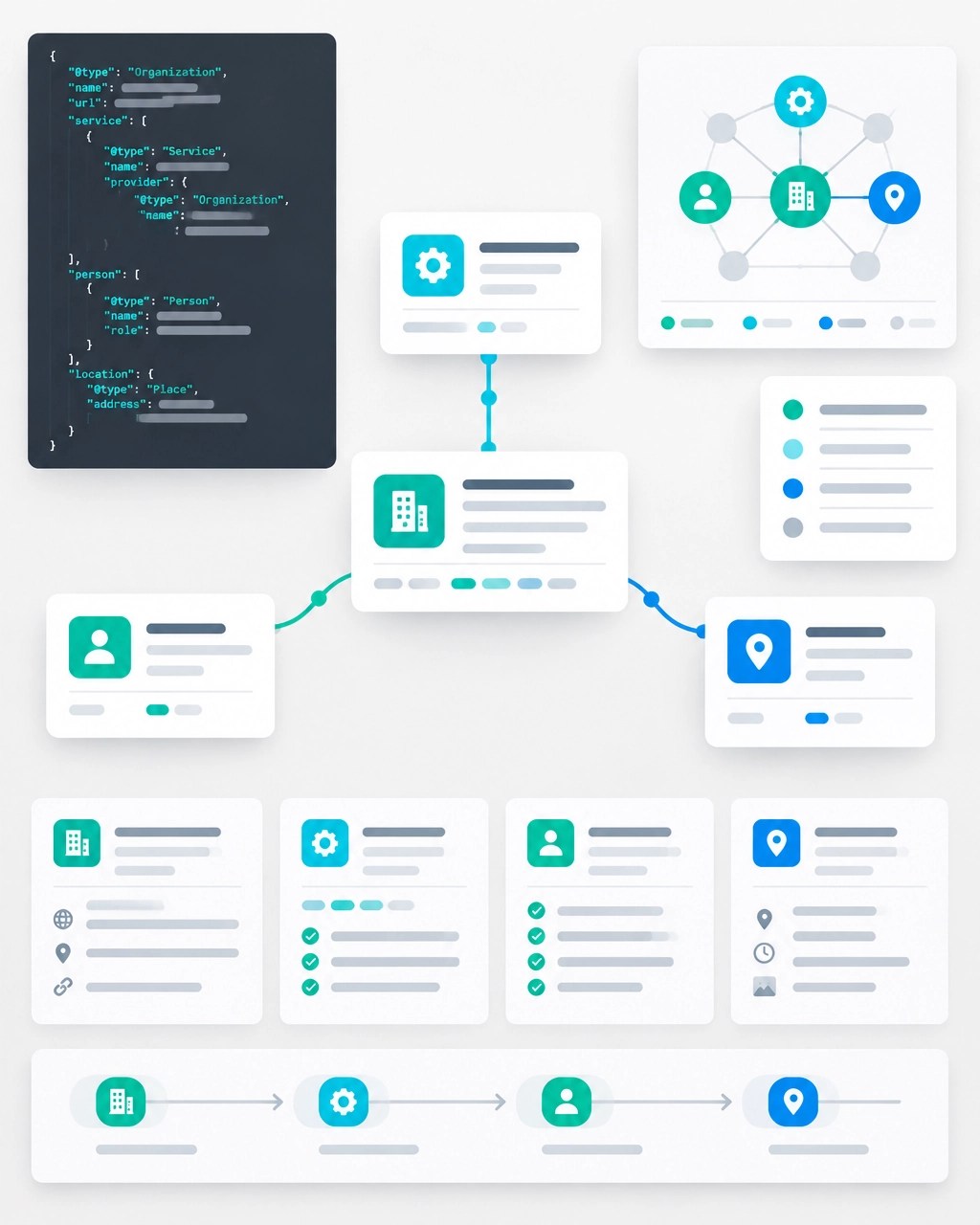
The correct objective is not to add every possible schema type. It is to create a coherent, accurate information layer that supports understanding.
3. Content Governance and Internal Architecture
Technical SEO cannot be separated from content governance.
Every important page should have a defined purpose, target audience, search intent, owner and review process. Internal linking should reinforce the hierarchy between core service pages, supporting resources and conversion pathways.
A governance framework should answer:
- Which pages represent primary commercial services?
- Which pages support awareness and education?
- Which claims require regular review?
- Which pages are outdated, overlapping or redundant?
- Which internal links should be added as the site grows?
- Which analytics events measure meaningful business outcomes?
This prevents content sprawl. It also protects the authority of the domain by ensuring that new material strengthens, rather than fragments, the existing architecture.
Transformation: Connecting Traditional Search with AI-Assisted Discovery
Search behaviour is becoming more varied. People may still visit conventional search results, but they may also encounter summaries, conversational interfaces and AI-assisted discovery systems.
The responsible position is measured. No organisation can guarantee that a page will be selected, cited or summarised by an AI system. However, the technical foundations remain important.
AI-assisted systems still require accessible information, clear language, reliable sources and unambiguous relationships. Crawlability, indexability, structured information, performance and content quality therefore remain relevant across the broader discovery environment.
This is not a separate shortcut called “AI SEO”. It is a continuation of sound information architecture.
Introducing Nova
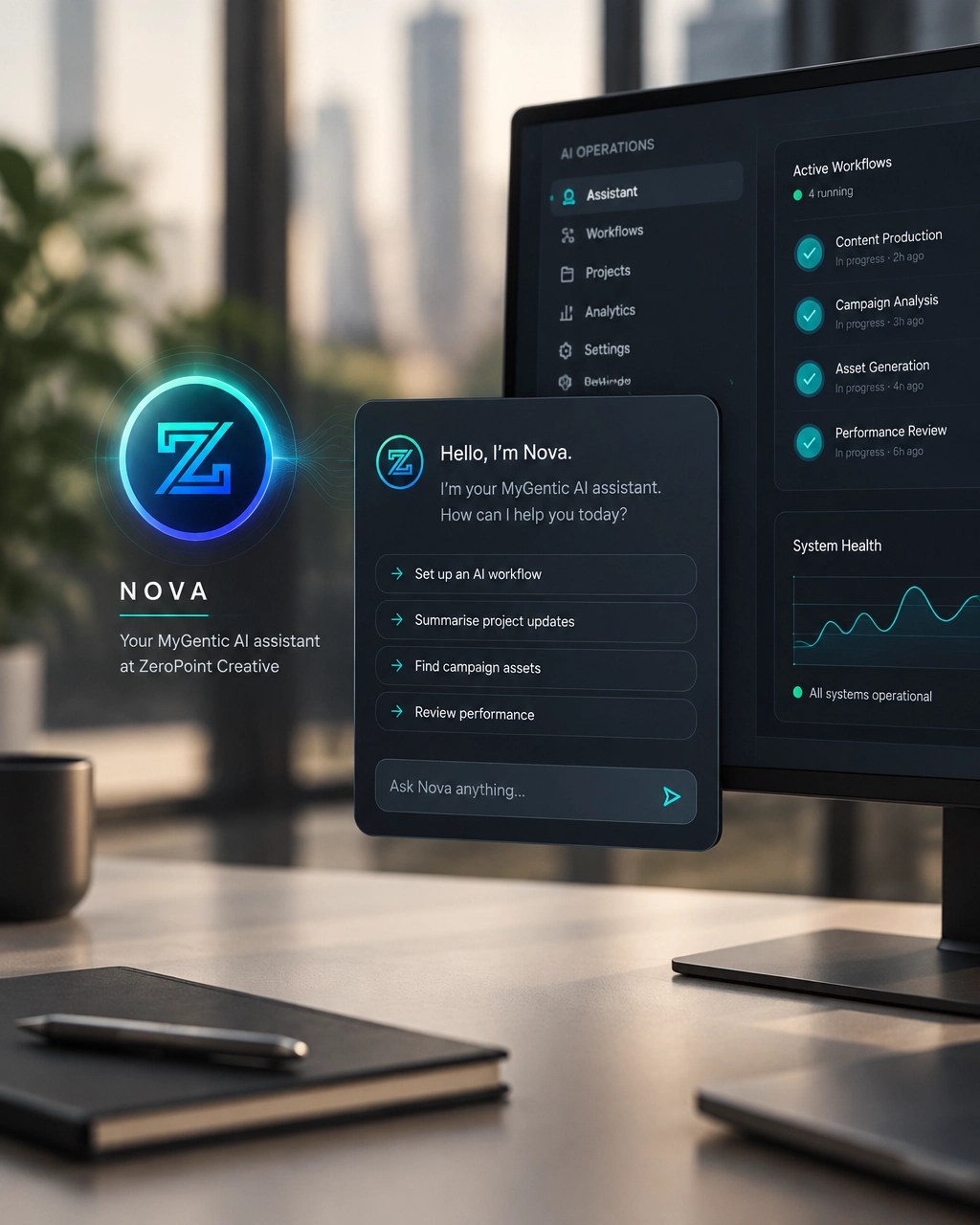
Nova is ZeroPoint Creative’s MyGentic AI assistant. Her role illustrates why machine-readable information and content governance matter operationally.
An assistant can only provide reliable guidance when the underlying service information, internal processes and business terminology are organised and maintained. If your website contains contradictory pricing, outdated service descriptions or unclear ownership, automated assistance is exposed to the same structural confusion as a human visitor.
Nova is not presented as a replacement for technical SEO. She is an example of the wider digital operations principle: intelligent systems require governed inputs.
Information quality is infrastructure.
Growth: From Visibility to Predictable Commercial Performance
A search visibility system supports growth by reducing uncertainty.
When priority pages are crawlable, indexable, fast, clearly structured and connected through logical internal links, your organisation has a stronger foundation for discovery. When analytics are configured around enquiries, bookings, qualified leads and other meaningful actions, you can evaluate commercial performance rather than celebrate surface-level traffic.
Continuous monitoring should include:
- Organic impressions and clicks
- Index coverage and crawl errors
- Priority keyword groups
- Branded and non-branded visibility
- Core Web Vitals
- Broken links and redirect changes
- Structured data validity
- Conversion events
- Content freshness
- Search intent alignment

This is the point at which technical SEO becomes digital operations management. The work is not completed when an audit is delivered. It continues through prioritisation, implementation, verification and recurring review.
ZeroPoint Creative provides SEO and Visibility support covering on-page improvements, keyword targeting, metadata updates, technical SEO checks and visibility-focused recommendations. We can also support the wider operational framework through Digital Operations Management.
The model is managed, data-informed and performance-driven.
Conclusion: Precision Is the Only Sustainable Visibility Strategy
Technical SEO is not a collection of isolated ranking tactics. It is the engineering discipline responsible for maintaining search access, information clarity, performance integrity and measurable authority across a changing digital environment.
The systemic problem is visibility decay. The infrastructure is crawlability, indexability, structured information, performance, content governance, entity clarity, analytics and continuous monitoring. The transformation is a more coherent discovery system that can support both conventional search and AI-assisted journeys without unsupported promises.
Rankings may fluctuate. A governed infrastructure gives your business the capacity to respond.
ZeroPoint Creative acts as a technical SEO and digital operations partner for modern businesses that require reliable, hands-off oversight. We rectify structural weaknesses, standardise digital information and maintain the operational conditions required for scalable acquisition.
Stability is the primary metric. Growth follows structural integrity.
Leave a Reply