

Category: SEO
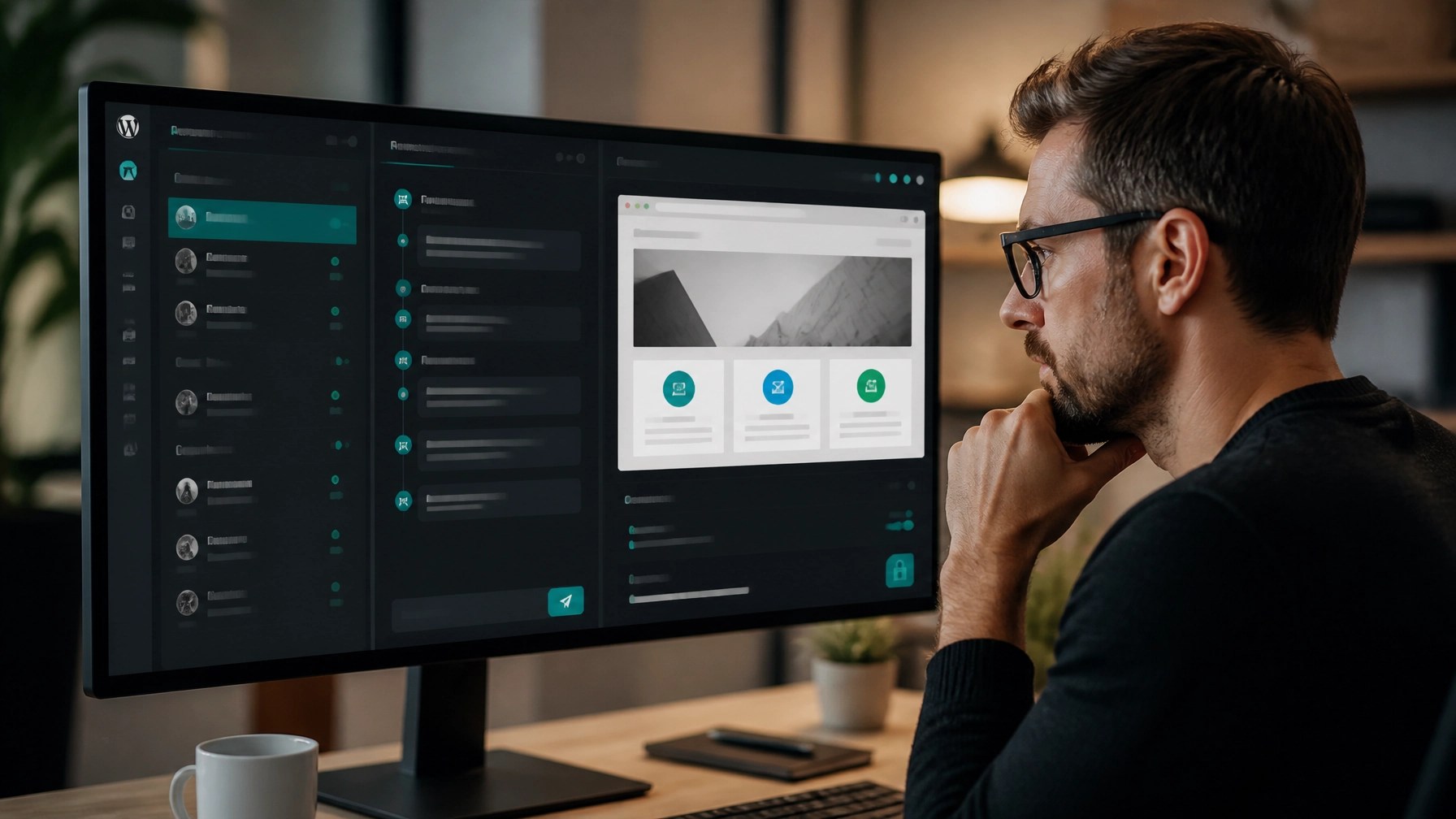
On 24 August 2026, WordPress.com announced a redesigned WordPress Studio desktop experience built around Studio Code, its AI WordPress expert. The new interface is available in beta for macOS, Windows and Linux, combining a local site list, an AI conversation and a live preview in one workspace.
That is a material change in how WordPress development may be managed. It is not, however, an announcement that WordPress Studio can autonomously manage every website.
The distinction matters. Studio Code can build and modify local WordPress sites, themes and plugins through natural-language prompts. It can run certain audits, create content and prepare changes for review. The official workflow still places the local environment between experimentation and production, with the user deciding when to sync changes to supported hosting.
For business owners, the implication is clear: agentic capability may reduce implementation friction, but it does not remove the requirement for permissions, staging, backups, monitoring or human approval.
The operational problem: faster changes can create faster failure
Website management has traditionally suffered from fragmented ownership. One supplier controls the domain, another handles hosting, a freelancer updates plugins and an internal employee publishes content. No single party retains complete operational context.
An AI agent can reduce some of that friction. It can also amplify the consequences of a poorly defined instruction.
A prompt that appears simple : “update the enquiry form”, “install this plugin” or “make the site faster” : may affect code, permissions, layouts, integrations, structured data and customer-facing content. If those changes are made directly against production without a controlled process, the business inherits technical debt at machine speed.
This is why the Information Commissioner’s Office guidance on UK GDPR security is relevant. Article 32 requires controllers and processors to implement technical and organisational measures appropriate to risk, including confidentiality, integrity, availability, resilience, restoration and regular testing.
The agent is not the control framework. It is one component within it.
Key takeaways
- WordPress Studio’s new agentic desktop experience is currently beta, not a universal production management system.
- Its strongest current use case is supervised local development and prototyping.
- Production changes should pass through permissions, staging, backups, testing and explicit approval.
- AI automation for business requires governance, monitoring and exception handling.
- Managed WordPress website management remains essential because infrastructure stability extends beyond code generation.
1. Website development becomes more intent-based
The first change is a shift from instruction-by-instruction implementation to intent-based development.
Instead of manually creating a page structure, installing a theme, configuring blocks and checking the result across multiple interfaces, a business owner or developer can describe the intended outcome in natural language. Studio Code can then work on a real local WordPress installation, creating or modifying elements within that environment.
The official documentation describes capabilities including site creation, plugin and theme management, content changes, performance audits and block validation. Its live preview also allows the operator to inspect the result while the work is taking place.
This has practical value. It can accelerate:
- Early-stage site prototypes
- Landing page structures
- Internal content experiments
- Block-theme development
- Repetitive taxonomy or content administration
- Developer handover and feedback cycles
However, intent is not the same as specification. “Make the site more professional” is not a measurable technical requirement. A resilient workflow converts the instruction into defined acceptance criteria: page speed thresholds, accessibility checks, brand constraints, conversion objectives, data handling rules and approval points.
Definitive result: agentic development can reduce implementation time when business intent is converted into controlled, testable specifications.
2. Local development and staging become non-negotiable
The second change is architectural. Agentic capability makes a local or staging environment more valuable, not less.
WordPress Studio is designed around local development. Changes can be made and reviewed without immediately altering a public website. According to WordPress.com, users can then sync suitable work to supported production or staging environments when it is ready.
That separation is a primary risk-control mechanism. It provides a place to:
- Test plugin compatibility
- Review layout and responsive behaviour
- Check forms and integrations
- Run performance assessments
- Validate structured content
- Confirm metadata and internal links
- Roll back unsuccessful experiments
A production website is a live commercial system. It handles customer journeys, personal information, payment processes, search visibility and brand credibility. It should not be treated as an unrestricted test environment for an experimental AI workflow.
WordPress Studio’s beta status reinforces this point. Beta features are still being developed and may change. A capability that performs correctly in one local build should not automatically be considered production-ready across every theme, plugin stack, hosting platform or custom integration.

Definitive result: staging converts agentic experimentation from a live-site liability into a recoverable development protocol.
3. Permissions and human approval become part of the product
The third change concerns authority.
An AI agent that can create files, run commands, install plugins or modify a site requires clearly defined boundaries. The correct question is not simply, “What can the agent do?” It is, “What is the agent authorised to do within this environment, and who approves the outcome?”
A business-grade permission model should distinguish between:
- Local development access
- Staging access
- Production access
- Content publication rights
- Plugin and theme installation rights
- Customer-data access
- Administrative credentials
- Financial or transactional systems
The principle of least privilege should apply. An agent does not require unrestricted administrator access merely because that access is technically convenient.
Human approval is equally important. The responsible operator must be able to inspect the proposed change, understand its effect and reject it where necessary. This is particularly important for regulated content, legal statements, pricing, accessibility, customer data and search-critical pages.
WordPress Studio allows agentic features to be disabled, and the new experience can be switched back to the classic workflow. That flexibility is useful. It provides a control point while teams establish confidence and operating standards.
Definitive result: permission boundaries and explicit approval prevent automation from becoming uncontrolled production access.
4. Monitoring and backups become the operational safety net
The fourth change is that AI-assisted development increases the requirement for continuous oversight.
A generated change may be technically valid but commercially harmful. A plugin may function while degrading performance. A content update may read well while weakening search intent. A template change may pass desktop review while damaging mobile usability. These are not purely coding failures. They are operational failures.
Before introducing agentic tooling, a business should establish:
- Scheduled, off-site backups
- Tested restoration procedures
- Uptime and performance monitoring
- Security hardening
- Change records
- User and permission reviews
- Staging-to-production controls
- A defined incident response process
A backup that has never been restored is an assumption, not a recovery plan. ZeroPoint Creative’s Security and Backups service is designed around scheduled backups, security controls, monitoring and practical recovery support.
Monitoring must also cover search performance. Changes to headings, metadata, internal links, schema, indexability or page speed can create visibility decay even when the website appears operational. Our SEO services treat these issues as a technical performance protocol rather than a one-off content exercise.
Definitive result: monitoring identifies harmful drift, while tested backups preserve the ability to recover without extended commercial disruption.
5. AI automation for business moves from prompts to governed workflows
The fifth change is strategic. Agentic WordPress capabilities demonstrate how AI automation for business is likely to mature: not as a replacement for operational judgement, but as a supervised workflow layer.
A useful automation should have five defined components:
- Trigger : what starts the workflow?
- Action : what does the system perform?
- Permission : what is it allowed to access?
- Approval : which actions require human confirmation?
- Evidence : how is the result logged and assessed?
At ZeroPoint Creative, we refer to this supervised operational layer as Nova. Nova is not a claim that WordPress Studio can independently control every website. It represents a controlled way to coordinate AI-assisted tasks with human oversight, resilient infrastructure and measurable outcomes.
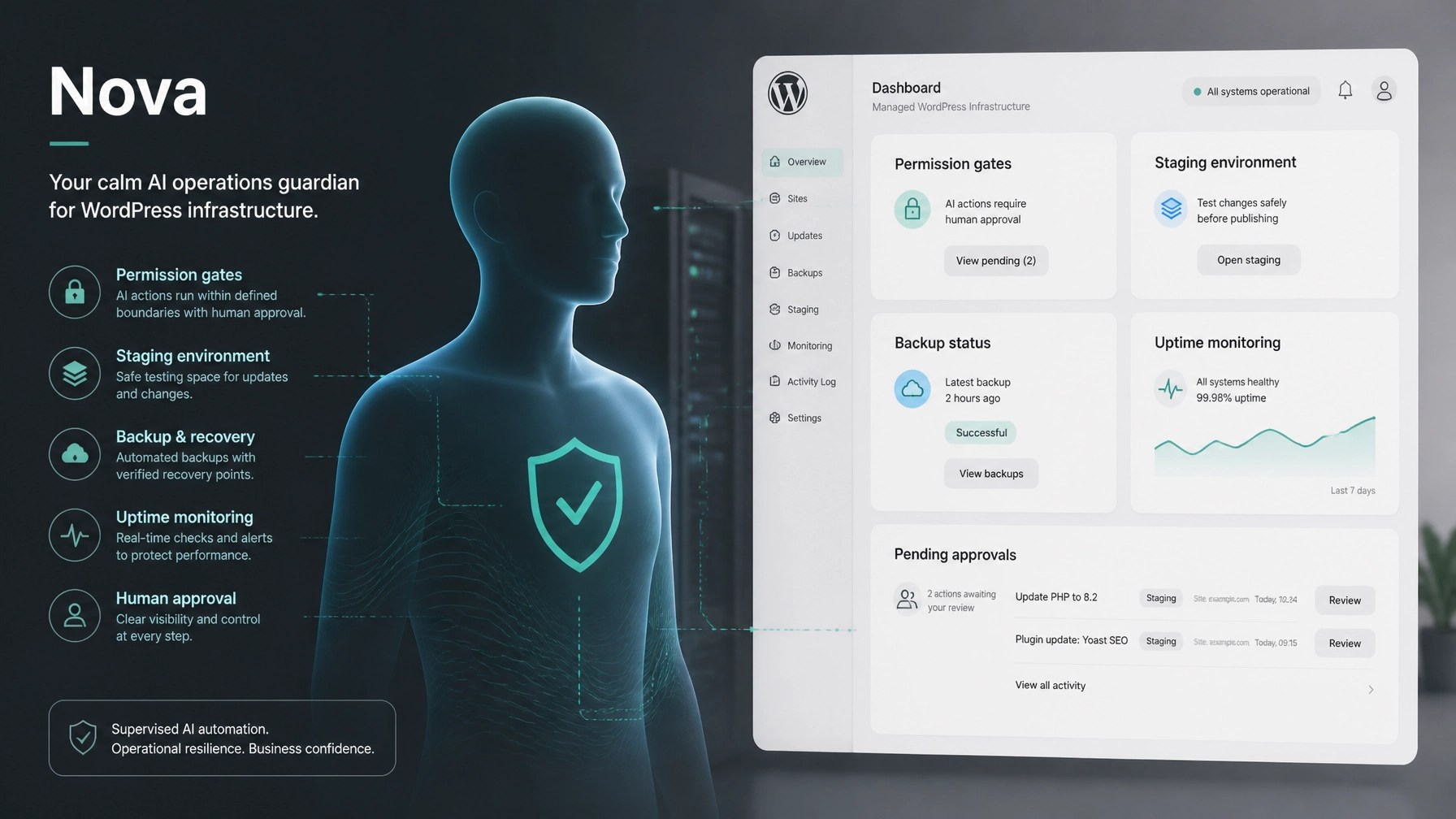
For example, an approved workflow might identify a broken link, create a proposed correction, present the change in staging and request approval before publication. A less responsible workflow would grant an AI tool broad production access and assume that a successful response means a successful business outcome.
This is also where Digital Operations Management becomes relevant. The service coordinates workflows, systems and routine online processes so that automation remains aligned with business requirements rather than becoming another disconnected tool.
Definitive result: governed automation reduces repetitive workload while retaining the accountability required for commercial and compliance-critical decisions.
What should a business do now?
Do not begin by connecting an experimental agent to your live website. Begin with an infrastructure assessment.
A controlled adoption path should look like this:
- Inventory your WordPress sites, themes, plugins, integrations and data flows.
- Confirm that reliable backups exist and that restoration has been tested.
- Establish a local or staging environment separate from production.
- Define permissions and identify actions requiring approval.
- Pilot low-risk tasks such as prototypes, audits or non-sensitive content structures.
- Review performance, accessibility, SEO and security outcomes.
- Record successful workflows before standardising them across the business.
- Monitor the system continuously and review the process as the beta develops.
Businesses seeking a broader framework can review ZeroPoint Creative’s managed website packages, which combine hosting, updates, backups, monitoring and ongoing support.
Conclusion: agentic capability requires stronger infrastructure
WordPress Studio’s agentic beta is a significant development in WordPress website management. It shows how natural-language instructions, local development and live preview can compress parts of the implementation cycle.
It does not eliminate technical responsibility. It does not make every website autonomous. It does not replace staging, permissions, backups, monitoring or human approval.
The commercial opportunity is real when the capability is introduced as part of a managed architecture. The businesses most likely to benefit will be those that standardise their environments, protect production access and measure outcomes with clinical precision.
The correct objective is not maximum automation. It is dependable automation.
That is how faster implementation becomes operational excellence, and how operational excellence supports scalable growth.
Sources and References
- WordPress.com: WordPress Studio Is Now Agentic : Try the Beta
- WordPress Developer Documentation: Studio Beta Features
- WordPress.com: Your WordPress Expert, Now on Desktop : Studio Code Beta
- WordPress.com: Studio Code : An Agentic Coding Tool for WordPress
- Information Commissioner’s Office: A Guide to Data Security
- UK GDPR Article 32: Security of Processing