
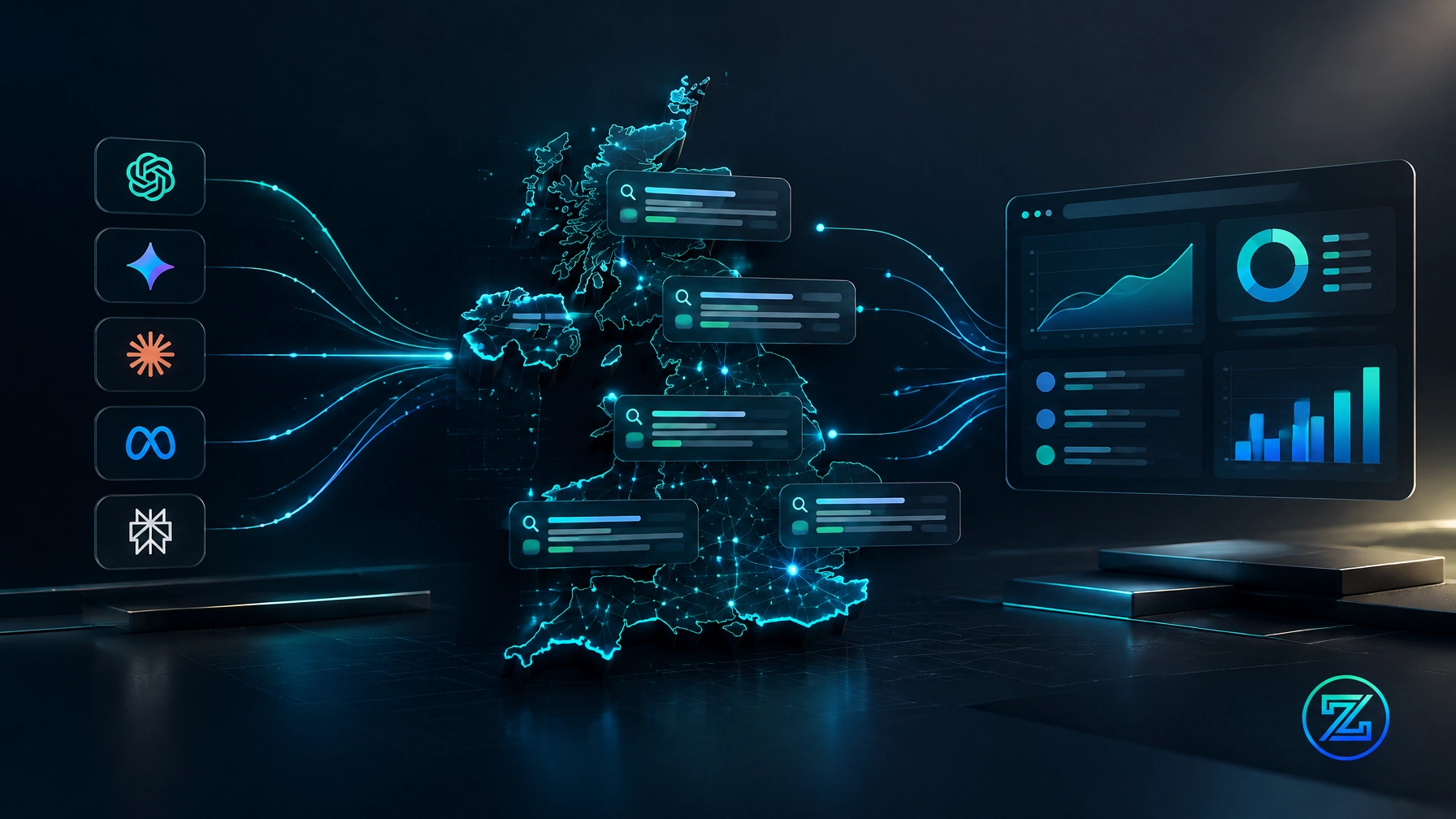
AI search visibility is not one ranking to win. It is a set of changing retrieval and citation systems, each selecting information differently. A provider that promises to “get you into AI” without explaining which platforms it measures, or how it distinguishes a citation from a named brand mention, is asking you to accept a claim without an audit trail.
That distinction matters. In a month-long analysis of eight B2B projects, Eugen Ullrich found that ChatGPT, Perplexity and Google AI Overview drew on substantially different cited-source pools. Across the tracked prompts, around four in five cited domains appeared on one engine only. A separate Rankability study found that no pair of platforms in its sample shared more than 24.1% of cited pages. These findings describe specific studies, not a guarantee of how every sector or future platform will behave. But they make one point clear: a single blended “AI visibility” score can hide important gaps.
Your task as a buyer is to identify an AI SEO agency that treats visibility as an engineered system, not a bundle of buzzwords. Precision is the starting point.
The problem: a new label can conceal an old offer
Some AI SEO services are simply traditional SEO relabelled. Others focus on producing a volume of content or promise inclusion in particular AI answers without showing how that result will be achieved or verified.
Both approaches leave a decision-maker with the same problem: what work is being done, what evidence will show progress, and what happens if visibility changes?
AI search adds complexity, but it does not make core technical discipline irrelevant. A page still needs to be accessible, useful and clearly connected to the organisation it represents. Your content and structured information need to present an accurate, consistent account of your business. And measurement needs to reflect the platform being assessed.
A DIY checklist may help establish a baseline. It is not a substitute for accountable technical oversight. Out-of-the-box promises of “optimisation for all AI” can be a trap: they obscure platform differences and create technical debt rather than a resilient system.

What should AI SEO services include?
An AI SEO engagement should explain its scope and connect each activity to a defined operational purpose. The following components provide a useful benchmark.
1. Technical retrievability
Before publishing more content, a provider should review whether priority pages can be crawled, accessed and understood. That means examining technical barriers, site structure, internal links and page-level clarity, then documenting issues and priorities.
Technical SEO is the foundation, not a claim of guaranteed citation. It supports discoverability and gives the rest of the work a sound structure.
2. Entity clarity and structured information
Your organisation, services and expertise should be described consistently across your digital presence. A provider should explain how it will review this information, including relevant structured data, and how it will keep claims accurate.
Schema can help clarify what a page describes. It is not a universal citation switch.
3. Connected content hubs
A collection of isolated articles is harder to govern than a connected information system. Related pages should answer distinct user needs, link to one another where useful, and reinforce a clear picture of your services and expertise.
This is not an argument for publishing more pages for every query variation. It is a case for useful coverage, controlled terminology and deliberate internal linking. Our article on query fan-out and search visibility explains why connected intent matters.
4. Accurate, maintained information
A provider should have a process for reviewing facts, service descriptions, dates and references when information changes. Freshness is a governance task, not a publication-date trick. In its August 2026 snapshot, Rankability reported the same 61-day median age for AI-cited and traditional search results. That finding does not show that freshness never matters; it cautions against assuming there is one universal age threshold for every platform.
Ask how updates are prioritised and recorded. Changing a date without materially reviewing the information is not maintenance.
5. Third-party reinforcement
Your own website is one part of your visibility ecosystem. Other credible sources may provide useful context, depending on the platform and subject. Search Engine Land’s analysis of nine million AI answers reported an association between YouTube citations and a 2.8-times visibility lift. That is an observed relationship, not proof that adding videos will cause a lift for your business.
A responsible provider should explain why external coverage or video is relevant to your audience, how it will be developed, and how its impact will be assessed.
6. Per-engine measurement
Reporting should separate platforms and distinguish retrieved sources, citations and named brand mentions where the data allows. Search Engine Land also reported that up to 75% of answers citing a page did not name the brand. That finding makes raw citation counts an incomplete measure of whether buyers can recognise your business.
Ask for a repeatable method: which prompts are tracked, which engines are included, how often measurement happens, and how changes in the method are disclosed. Our guide to getting your business cited in AI search sets out the wider visibility framework.
A buyer’s checklist: questions to ask any provider

Use these questions in a supplier conversation. Ask for a clear answer and an example of the evidence you would receive.
-
How do you measure AI visibility, and do you report results separately for each engine?
Ask for the prompt set, reporting frequency and method. A blended score can conceal platform-level weaknesses. -
Do you distinguish citations from named brand mentions?
A source may inform an answer without the business being named. Ask how the report handles that difference and its limitations. -
Which technical foundations do you audit before recommending new content?
Look for a documented review of accessibility, site structure and relevant page issues, not an immediate recommendation to publish at scale. -
How do you assess entity clarity and schema?
A credible answer should cover accurate organisation and service information, and explain schema as a means of clarification rather than a guaranteed ranking lever. -
How do you manage content freshness?
Ask what triggers a review, how substantive updates are recorded, and how the approach accounts for differences between platforms. Be cautious of blanket promises based only on changing publication dates. -
What deliverables arrive each month, and what evidence accompanies them?
Request an itemised description of work completed, findings, decisions and next steps. Reporting should help you understand what changed and why. -
Do you guarantee rankings, citations or specific placements?
A guarantee of inclusion in a particular AI answer is a warning sign. Providers can define the work and measurement protocol; they cannot control a platform’s answer.
What to avoid
Be cautious of unverifiable claims such as “AI-proof content”, or assurances of guaranteed citation. Treat a single proprietary visibility score with care if the provider cannot explain its inputs and limitations.
One-off content exercises without follow-up measurement make it difficult to separate useful change from noise. So do undifferentiated citation totals, dashboards that blend platforms without explanation, and strategies that prioritise volume over accurate information.
Finally, clarify ownership. Your business should retain appropriate access to its content, reporting and data. Ask how those assets are handled if the engagement ends. Operational clarity is part of the service, not an optional detail.
Where ZeroPoint Creative fits
ZeroPoint Creative Ltd approaches AI search visibility through technical SEO and ongoing digital operations. The work can include a technical review, on-page optimisation, entity clarity, connected content hubs, information maintenance and per-engine measurement. The scope should be based on your website, requirements and available evidence, not an assumed package of tactics.
Our technical SEO services provide the technical and on-page foundation. Our article on managed digital operations explains why maintaining that foundation requires ongoing oversight.
We do not claim that any single intervention guarantees a citation or ranking. The objective is a more coherent, well-maintained information system, with measurement that makes gaps visible and informs the next decision.
Key takeaways
- AI search platforms do not share one universal source pool; evaluate each separately.
- Genuine AI SEO services should cover technical retrievability, entity clarity, connected content, information maintenance, appropriate third-party signals and measurement.
- Ask how a provider distinguishes citations from named brand mentions.
- Treat guarantees of specific AI search placements as a warning sign.
- Require transparent deliverables, explainable reporting and clear ownership of content and data.
- Choose evidence and accountability over volume, buzzwords and blended scores.
Discuss your AI search visibility
To discuss your visibility requirements with Krishna, email info@zeropointcreative.com or call 0800 870 8203. You can also use the call symbol on zeropointcreative.com to reach Nova.

ZeroPoint Creative Ltd
71–75 Shelton Street, Covent Garden, London, WC2H 9JQ
Sources and References
- Eugen Ullrich, Why visibility in one AI engine says little about the next. One-month retrieval and citation analysis across eight B2B projects.
- Rankability, AI search statistics. Published 23 September 2026.
- Search Engine Land, What 9 million AI answers reveal about search visibility.
- ZeroPoint Creative, AI SEO: How to Get Your Business Cited in AI Search.
- ZeroPoint Creative, SEO Services.
- ZeroPoint Creative, Who Fixes It When Nobody Is Watching? The Case for Managed Digital Operations.
- ZeroPoint Creative, One Query, Twenty Answers: How Google’s New Query Fan-Out Rewrites Search Visibility.
