Google Research has announced Retrieve-for-Train, a framework designed to accelerate complex search by expanding one broad query into multiple related retrieval directions. Search Engine Journal reports that the framework, called Retrieve-for-Train-Diffusion or R4T-Diffusion, generated fan-outs between 12 and 20 times faster than autoregressive approaches in the reported experiments.
That does not mean Google has confirmed its deployment across live search.
The distinction is material. The available evidence describes a research announcement and an architecture presented as ready for production-scale retrieval. It does not prove that R4T-Diffusion is currently operating across Google Search, nor does it establish a new ranking factor.
The operational implication is still clear. Search visibility is becoming less dependent on a single keyword-to-page relationship and more dependent on whether your digital ecosystem presents a coherent, retrievable structure across related intents.
Precision is now an infrastructure requirement.
Key Takeaways
- Query fan-out breaks one broad prompt into several related sub-queries or retrieval directions.
- Google Research’s R4T framework trains for diversity, groundedness and alignment across a complete result set.
- R4T-Diffusion is a research framework, not confirmed evidence of a live Google Search deployment.
- Entity clarity, consistent terminology, structured architecture and technically sound pages become more important as search systems explore broader intent.
- Technical SEO should be treated as a managed visibility system, not a one-off keyword exercise.
- No responsible provider can promise rankings from these developments. The correct objective is stronger structural integrity and clearer retrieval signals.
The Problem: Search Visibility Is No Longer a Single-Page Exercise
Traditional SEO planning often begins with a simplified assumption: identify a keyword, create a page, optimise the page and monitor its position.
That model was already incomplete. A business rarely operates around one isolated query. A prospective customer may search for a service category, a location, a technical problem, a comparison, a cost consideration and evidence of competence before making contact.
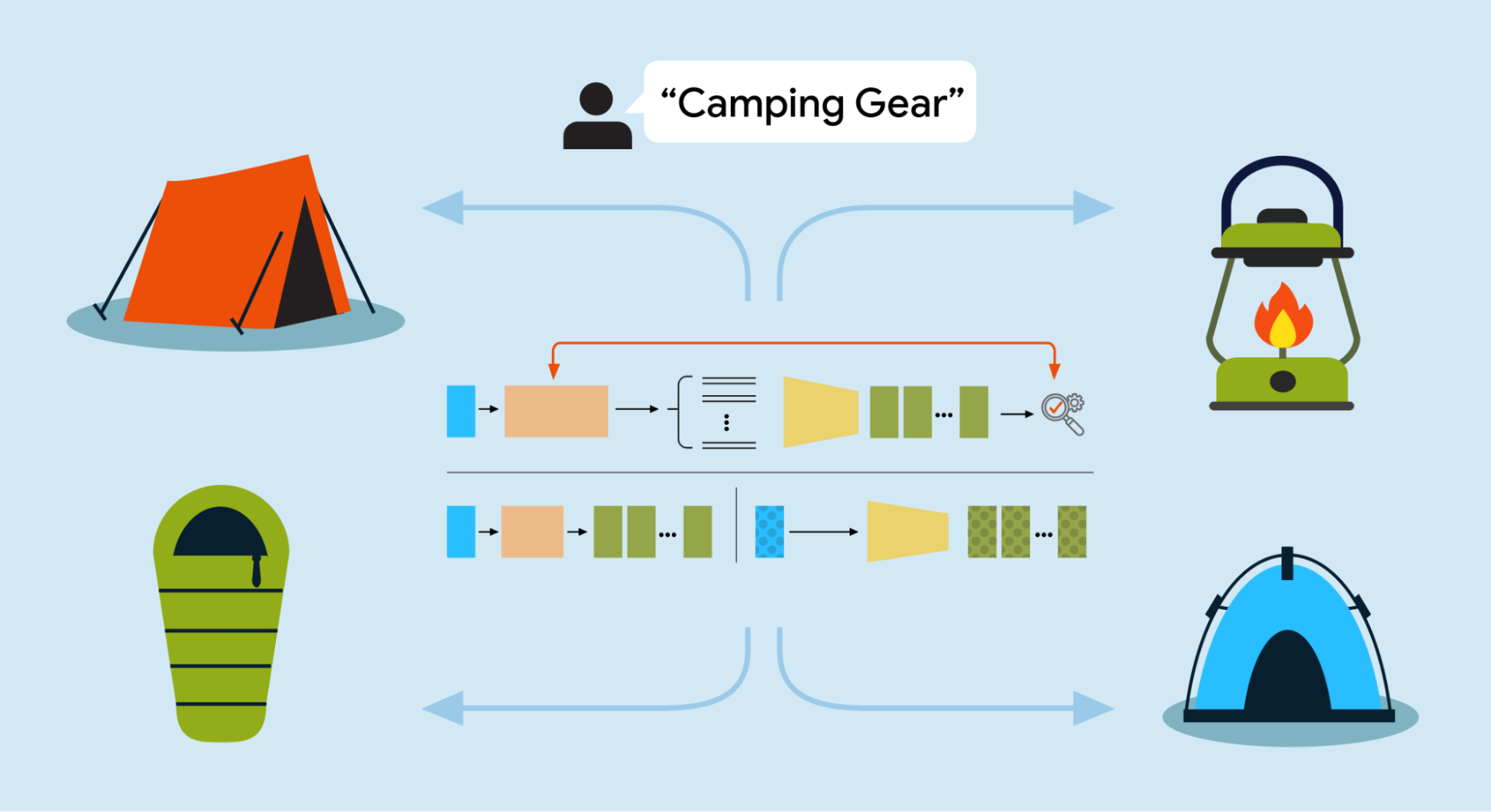
Query fan-out formalises this broader pattern at the system level. Google Research describes it as a technique that breaks a single broad prompt into several related sub-queries to cover potential user interests. In the research example, someone searching for “camping gear” should receive a complementary collection that may include a tent, sleeping bag, portable stove and headlamp, rather than several near-identical tents.
The distinction is between a list of individually relevant results and a coherent set of results.
For a business, this creates a structural risk. If your site describes one service using inconsistent terminology, separates related information across disconnected pages, or provides thin pages without clear evidence, a search system may have difficulty understanding the relationship between those assets.
This is not a confirmed R4T ranking rule. It is a practical SEO inference from the framework’s stated objectives. When retrieval systems are designed to identify diverse, aligned and grounded directions, businesses should ensure that their own information architecture expresses those properties clearly.
A website built around disconnected keyword targets creates data leakage and semantic friction. A website built around a clear entity, defined services, consistent terminology and evidence-backed information creates a more stable retrieval environment.
The first failure is structural. The remedy begins with visibility architecture.
What R4T-Diffusion Actually Does
Google Research presents Retrieve-for-Train as a three-stage framework. Its purpose is to move computationally expensive discovery into training, allowing a smaller model to generate a complete set of retrieval directions in a single pass.

1. Fan-out language model training
The first stage trains a fan-out language model using reinforcement learning. The model generates sub-queries intended to remain aligned with the original prompt while exploring distinct aspects of it.
Google identifies three principal properties in its composite reward:
- Groundedness, meaning that generated directions should correspond to retrievable items within the target database.
- Diversity, meaning that the result set should cover different semantic directions rather than repeat near-synonyms.
- Alignment, meaning that the directions should remain connected to the original query rather than drifting into unrelated subjects.
This is a set-level approach. The system is not only asking whether one result is relevant. It is assessing whether the complete collection is useful, varied and coherent.
2. Supervision synthesis
The second stage uses the trained fan-out language model to create query-to-target-set examples offline. Google describes this as a reward-to-data compilation process.
The important architectural decision is that the demanding optimisation work is performed before live inference. The system is trained on examples of what a high-quality fan-out should look like, rather than being required to rediscover the entire process for every user query.
3. Diffusive retriever training
The third stage trains a compact 53.9-million-parameter diffusion model. According to Google Research, this model maps a query embedding directly to a complete set of target embeddings in one non-autoregressive pass.
The model therefore generates retrieval directions simultaneously rather than producing them one after another through an extended sequence of text generation.
Google reports a 12 to 20 times speed improvement over autoregressive approaches in its experiments. The research announcement also states that, under large context batches, autoregressive latency approached 50 seconds, while Retrieve-for-Train-Diffusion remained between sub-second and a few seconds.
These figures belong to the reported research environment. They should not be interpreted as a guarantee of identical performance in Google Search or any commercial search product.
The technical result is nevertheless significant. Retrieval can be engineered around the quality of a set, not merely the relevance of an individual document.
What Query Fan-Out Means for Business Visibility
The direct SEO consequence is not that every business must publish twenty new pages for every query. That would create duplication, technical debt and visibility decay.
The correct response is to strengthen the information architecture that connects related intents.
Entity clarity
Your organisation should be described consistently across the website. The business name, service categories, operating locations, specialisms and customer outcomes should not change from page to page without explanation.
Entity clarity gives related pages a common centre of gravity. A technical SEO page, a service page and a contact page should clearly belong to the same organisation and describe compatible capabilities.
Inconsistent naming creates ambiguity. Standardised language creates structural integrity.
Consistent service terminology
If one page refers to “technical SEO”, another refers to “search optimisation infrastructure” and a third describes “website visibility support”, the relationship may be clear to a human but less explicit to a retrieval system.
Terminology should be precise and controlled. Define the primary service term, then explain related terminology where necessary. Do not generate pages by replacing a few words while leaving the underlying content unchanged.
A service ecosystem must be semantically coherent.
Structured site architecture
Related services should be connected through deliberate navigation and internal linking. Important pages should not be isolated in a flat archive or buried beneath unnecessary layers.
A resilient architecture might include:
- A clear service category page.
- Dedicated pages for distinct services or use cases.
- Supporting articles that explain technical problems and operational outcomes.
- Internal links that establish relationships between those assets.
- Accessible contact and organisation information.
- Clear page titles, headings and metadata.
This is not a guarantee of inclusion or ranking. It is a method for reducing ambiguity and improving discoverability.
Clear service pages
A service page should answer operational questions with clinical precision:
- What is the service?
- Which technical or commercial problem does it address?
- What is included?
- What is excluded?
- Who is it appropriate for?
- How is delivery managed?
- What evidence supports the process?
- What is the next factual step?
Generic claims create weak retrieval signals because they do not establish a specific capability. Clear scope, defined processes and relevant evidence create a more reliable information asset.
Technical integrity
Query fan-out cannot compensate for an inaccessible or unstable website. Technical SEO remains the underlying control layer.
Your site should be regularly assessed for indexability, crawl paths, broken internal links, duplicate or conflicting page signals, mobile usability, performance and implementation errors. Content updates should not create orphaned pages or contradictory metadata.
This is why ZeroPoint Creative’s technical SEO service treats visibility as an engineered system. The work combines technical auditing, on-page optimisation, internal linking, content structure and ongoing monitoring. It does not promise rankings. It establishes the conditions for clearer search interpretation and more disciplined growth.
The Infrastructure Response: Build for Retrieval Coherence
The correct response to query fan-out is not a sudden increase in publishing volume. It is a controlled review of the digital estate.
Begin with an entity and terminology audit. Document how your organisation, services, locations and processes are described. Identify contradictions, duplicated pages and important subjects that are only mentioned indirectly.
Next, map your site by intent rather than by publication date. Group pages around the questions a stakeholder may ask, including discovery, evaluation, implementation and support.
Then rectify the technical layer. Confirm that priority pages are indexable, internally connected and supported by clear metadata. Review redirects, canonical signals, structured data and performance issues as part of one cross-platform governance process.
Finally, build evidence-backed content. Case studies, process explanations, service boundaries, technical documentation and clearly attributed references are more valuable than repetitive pages designed solely to capture variations of a phrase.
ZeroPoint Creative’s technical SEO approach is designed around this principle: visibility requires continuous oversight because data rot and terminology drift accumulate over time.
Stability is the primary metric.
The Growth Outcome: More Coherent Access to Demand
No framework announcement can guarantee commercial results for an individual website. Search systems remain dynamic, and Google has not confirmed that R4T-Diffusion is deployed across live search.
However, the direction of travel is operationally relevant. Search systems are being researched and engineered to retrieve coherent collections of information across complex intents. Businesses with strong entity definitions, structured architecture, technically resilient pages and evidence-backed content are better positioned to present a consistent digital footprint as those systems evolve.
That positioning supports more than organic visibility. It improves user navigation, reduces content duplication, clarifies service selection and gives stakeholders a more reliable route to contact.
Growth follows structural clarity. It does not replace it.
Contact ZeroPoint Creative
If your website has accumulated inconsistent terminology, disconnected service pages or unresolved technical debt, contact ZeroPoint Creative for a factual discussion about your visibility infrastructure.
ZeroPoint Creative Ltd
71–75 Shelton Street, Covent Garden, London, WC2H 9JQ
Email: info@zeropointcreative.com
Telephone: 0800 870 8203