
In 2026, the era of experimental AI implementation has concluded. For modern enterprises, the novelty of single-prompt chatbots has been replaced by a clinical requirement for business workflow automation that delivers measurable, predictable, and scalable results. The transition from "asking an AI" to "orchestrating an AI workforce" represents the most significant shift in digital infrastructure since the move to cloud-based operations.
However, moving from isolated prompts to integrated multi-agent workflows is not a mere creative exercise; it is a complex engineering challenge. Without a managed architectural framework, businesses risk accumulating significant technical debt, security vulnerabilities, and operational friction. At Zero Point Creative, we view AI not as a tool, but as a mission-critical operational system that requires the same level of guardianship as your core web infrastructure.
The Problem: The "Single-Prompt" Ceiling and Visibility Decay
Many organisations remain trapped in the "Single-Prompt" phase of AI adoption. This reliance on manual, ad-hoc interactions with large language models (LLMs) creates several systemic failures that impede commercial expansion.
1. Operational Friction and Labour Inefficiency
When a human operator must manually copy and paste data between different AI tools, the primary benefit of automation: speed: is lost. This manual orchestration creates a new form of "digital labour" that is both expensive and prone to human error. In the context of the UK’s rising National Living Wage and increasing operational costs, this inefficiency is a direct threat to profit margins.
2. Technical Debt and "Data Rot"
Unmanaged AI use often leads to data silos. Information processed by an AI agent in one department is frequently invisible to another, leading to "visibility decay." Without a centralised ecosystem stability protocol, your business data becomes fragmented, making it impossible to leverage for long-term strategic insights.
3. Compliance Risk and Data Leakage
In a post-EU AI Act and UK GDPR-aligned landscape, the risks of data leakage via unsecured AI prompts are catastrophic. Businesses using "out-of-the-box" solutions often lack the structural integrity required to ensure sensitive client data remains within secure, managed boundaries.

Unmanaged digital systems, including fragmented AI workflows, lead to operational instability and technical debt.
The Infrastructure: Architecting Multi-Agent Workflows
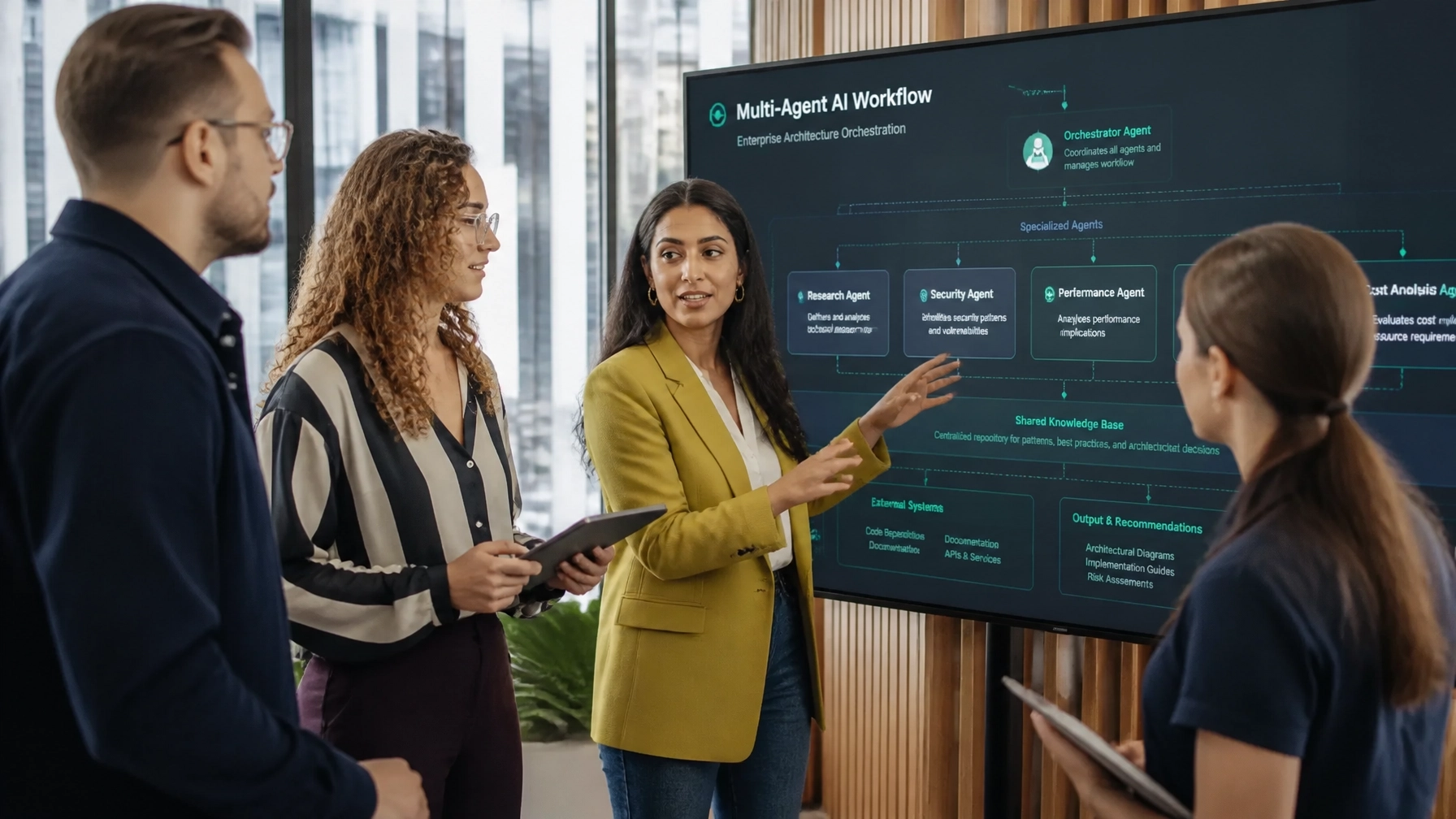
To rectify these systemic failures, businesses must move toward multi-agent workflows. This approach involves deploying specialised AI agents that work in concert, governed by a sophisticated architectural framework. This is the foundation of modern ai automation for business.
The Supervisor/Worker Pattern
The most resilient pattern for 2026 is the Supervisor/Worker model. In this architecture:
- The Supervisor Agent: Acts as the technical architect. It receives a high-level business objective, decomposes it into specific sub-tasks, and assigns them to specialised workers.
- The Worker Agents: These are "specialist" agents tuned for specific functions: such as technical SEO analysis, lead qualification, or content synthesis. They execute their tasks within a strict, managed environment.
- The Critic Agent: A secondary layer of QA that reviews the output of the workers against predefined compliance and quality benchmarks before any data is finalised.
Parallel Execution and Scaling
One of the primary USPs of a multi-agent system is parallel execution. Unlike a human-led process that is linear and slow, a managed AI workforce can execute multiple research, analysis, and generation tasks simultaneously.
For instance, while one agent is scraping competitor data, another is auditing your internal managed website infrastructure, and a third is cross-referencing both against current market trends. This parallelism ensures that your business intelligence is always-on and data-dense.

Precision coordination is the hallmark of an engineered AI workflow.
Managed AI Staffing: Removing the Technical Headache
The primary barrier to adopting these advanced systems is the "technical headache": the sheer complexity of orchestration, security, and maintenance. Most businesses are not equipped to manage the underlying API integrations, vector databases, and guardrail protocols required for a resilient AI ecosystem.
Zero Point Creative solves this by providing Managed AI Staffing. We do not just provide "tools"; we provide a fully managed, 24/7 supported digital workforce integrated directly into your operations.
Security and Governance
We treat AI agents as privileged infrastructure. This means:
- Standardisation: Every agent follows a clinical protocol for data handling.
- Risk Mitigation: We implement "kill switches" and rigorous audit logs for every tool call an agent makes.
- SLA-Driven Performance: Our AI workflows are backed by a robust Service Level Agreement (SLA), ensuring your automation is as reliable as your hosting.
The 24/7 Digital Team
Our managed AI team operates across five core business roles, providing everything from lead generation to customer service. This is not a "plug-and-play" bot; it is an engineered staffing solution designed for stability and commercial scalability.

Growth: Scalable Acquisition and Operational Excellence
When the infrastructure is stable, growth becomes a predictable outcome rather than a creative gamble. By leveraging business workflow automation, organisations achieve:
- Predictable Performance: By removing the "human bottleneck," tasks are completed with clinical precision every time.
- Reduced Overhead: Managed AI agents handle high-volume, low-complexity tasks at a fraction of the cost of traditional labour, allowing your human staff to focus on high-level strategy.
- Scalable Acquisition: Automation allows you to scale your marketing and sales efforts infinitely without a corresponding increase in headcount or technical friction.
At Zero Point Creative, we ensure that your digital presence: from your core website build to your automated AI workflows: is engineered for longevity. We mitigate the risks of "out-of-the-box" failures by providing a resilient, managed architecture that grows with your business.

Summary: The Path to Digital Maturity
The shift to multi-agent AI workflows is inevitable. The choice for business leaders in 2026 is whether to build these systems on shifting sands or to invest in a managed, professional infrastructure.
Stop treating AI as an experiment. Rectify your technical debt and leverage the power of a managed digital workforce to secure your commercial future.
Ready to operationalise your AI strategy? Explore our Custom Core plans and discover how our AI Staffing Add-On can provide the technical integrity your business requires.