
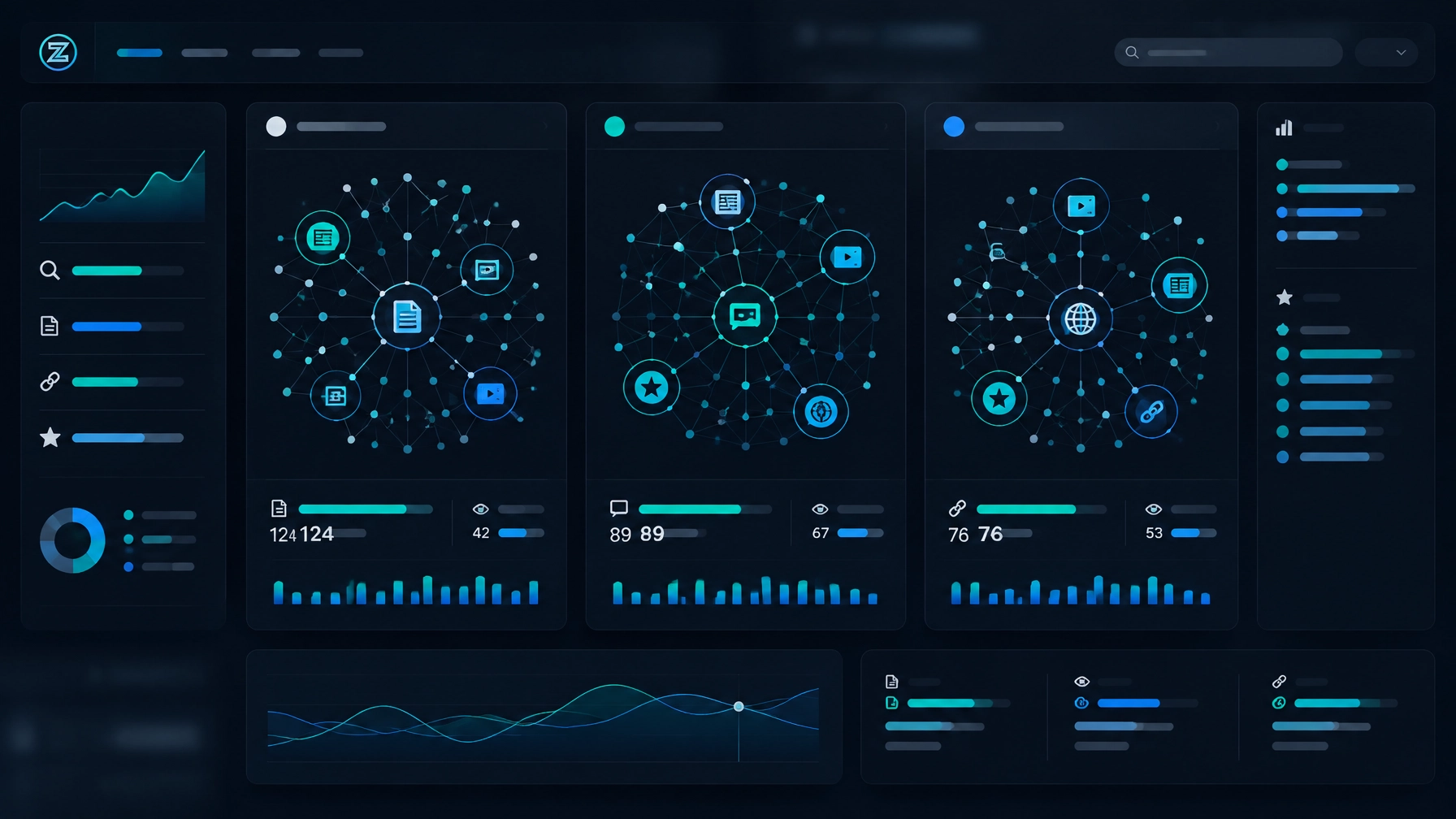
AI search visibility is difficult to manage when the measurement system reports one blended score. A business might be cited in an answer without being named, or appear in one platform while remaining absent from another. If those outcomes are collapsed into a single number, the dashboard obscures the operational gap.
A useful measurement framework separates three questions: Was your business named? Was your website cited? Which competitors were named instead? Answering them consistently gives you a more reliable view of visibility and a clearer basis for action.
The problem: one score can hide several failures
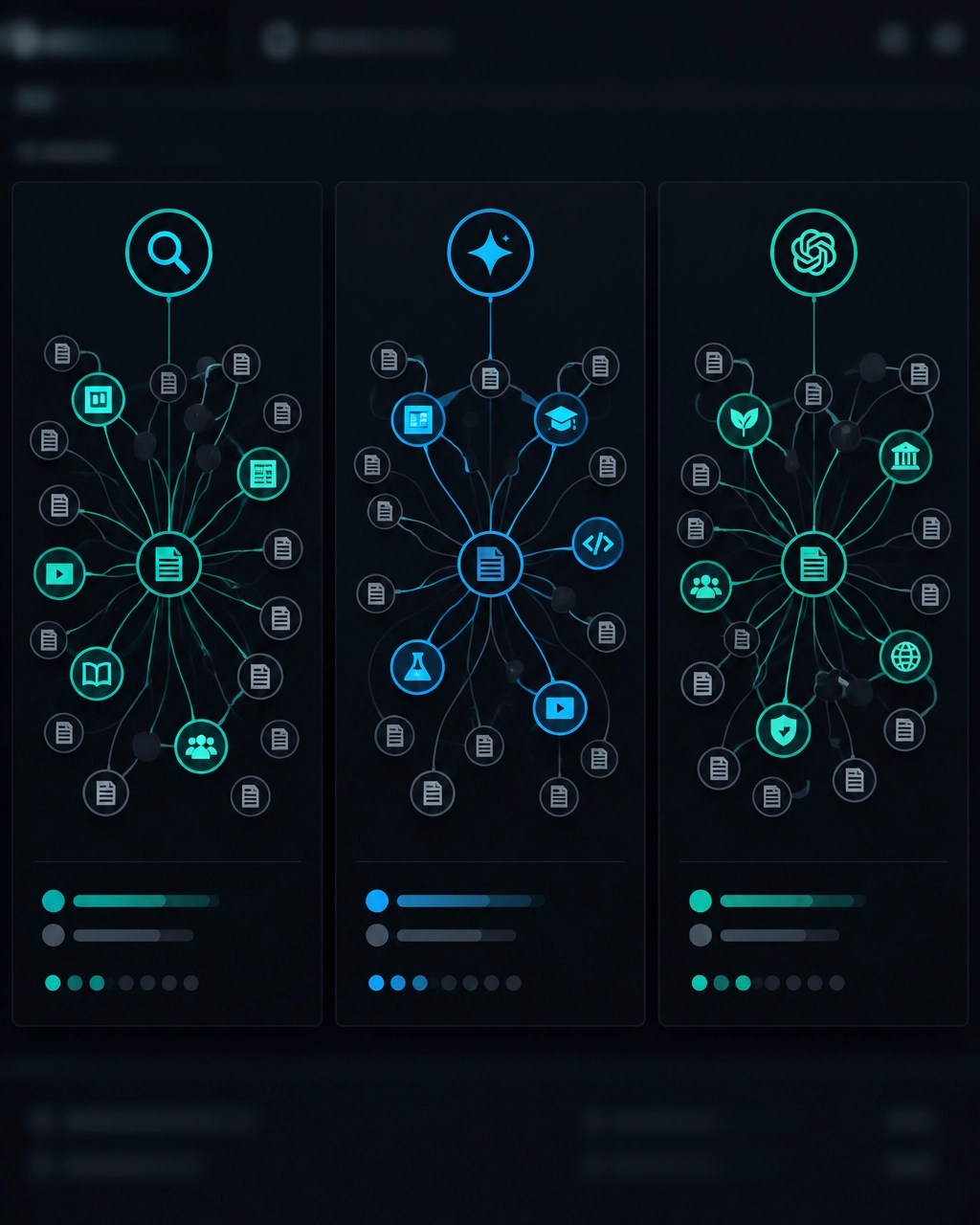
AI search is not a single channel with a uniform source pool. In an August 2026 study of 31 topics, Rankability found that no pair of the platforms it analysed shared more than 24.1% of the pages they cited. That was the highest overlap in the study, between Brave AI and Claude, not a universal benchmark for every topic or platform (Rankability, 23 September 2026).
Eugen Ullrich’s one-month analysis across eight B2B projects also found substantial separation between the cited-domain pools of ChatGPT, Perplexity and Google AI Overview. Four in five cited domains appeared on only one engine in that dataset (Ullrich, 19 July 2026).
The practical consequence is straightforward: performance on one engine cannot stand in for performance on another. A blended dashboard may show an apparently stable total while one platform loses visibility and another gains it. You cannot identify that change if results are combined before they are reviewed.
Measure each engine separately. A blended score is not a diagnosis.
Citation counts do not equal brand visibility
A citation count records how often a source is cited. It does not tell you whether the answer names your business.
A Search Engine Land analysis of nine million AI answers describes “ghost citations”: cases where an AI answer cites or draws on a brand’s content without naming the brand. Its analysis argues that competitive share of voice is more useful for understanding whether a brand is visible in the answer itself.
Keep these measures distinct:
- Raw citation count: how often your pages appear as cited sources.
- Named mention: how often an answer explicitly identifies your business by name.
- Named share of voice: your business’s share of the named visibility received by you and a defined set of competitors.
Citations still matter. They show that a page is being used as a source. But a citation without a named mention is not the same outcome as a buyer seeing your business presented as an option. Treat citations as a diagnostic measure, not a substitute for named visibility.
Track your own website as a source
A named mention does not reveal which material informed the answer. Your business might be named on the basis of a third-party directory, review site or news article, while its own website is absent from the cited sources.
That distinction matters when deciding what to improve. You need to know whether your own pages are being retrieved and cited, as well as whether your brand is being named.
Itera’s analysis of 1.2 million AI citations found that companies whose own websites accounted for at least 5% of sources were named in 32.3% of answers on average. Companies whose websites were not used as sources were named in 4.7% of answers. This is a correlation, not evidence that increasing your website’s share of citations will cause more mentions (Itera, 6 October 2026).
The operational lesson is to record both the named result and the source behind it. That makes it possible to distinguish your site’s contribution from third-party coverage.
A practical measurement framework
Begin with a repeatable protocol. The purpose is not to produce a perfect score from a single test, but to establish comparable observations over time.
1. Define a consistent prompt set
Select realistic questions relevant to your market, services and buyer intent. Include research and comparison prompts, not only searches that contain your company name. Keep the prompt wording and market context consistent between measurement cycles.
2. Run the prompts on each engine
Record the results separately for every engine you monitor. Do not combine them into a cross-platform total before reviewing the individual outcomes. The source-pool studies show why: platforms can return materially different sources for similar prompts.
3. Record the same fields for every response
For each prompt and engine, note:
- Whether your business is named.
- Whether your website is cited.
- Which pages or other sources are cited.
- Which defined competitors are named.
- The date the response was checked.
Apply the same counting rules each time. If an answer names your business and two competitors, record all three. If it cites your website without naming your business, record the citation but not a named mention.
4. Calculate named share of voice
Define your competitor set before calculating the metric. One practical method is:
Named share of voice = your named mentions ÷ all named mentions of you and your defined competitors
For example, if the tracked answers contain 10 named mentions across your business and competitors, and 3 belong to your business, your share is 30%. This is a share of recorded brand mentions, not a claim that your business appeared in 30% of all AI answers.
Also track your named answer rate: the percentage of tested answers that name your business. That measure shows how often you appear across the full prompt set. Reporting both prevents a small number of answers with many brand names from distorting the picture.
5. Repeat on a fixed cadence
Run the same prompt set at regular intervals and compare the trend, not isolated snapshots. Answers can change, so record the date and preserve the response evidence behind each result.
A spreadsheet is sufficient to start. As the process matures, tracking can be automated, provided the underlying prompt set, engine-specific results and counting rules remain transparent.

Turn the measurement into a diagnosis
Different result patterns point to different technical work.
High citations, low named share of voice: your pages may be informing answers without your business receiving clear attribution. Review entity clarity across your website, including consistent business details, descriptive page content and relevant structured data. More content volume is not the first response. The goal is to make the relationship between your organisation, services and evidence easier to interpret.
Strong visibility on one engine, little or none on another: treat this as a platform-specific gap. Examine the pages and sources used by each engine, then assess whether the relevant content is accessible, clearly structured and supported by appropriate evidence. Do not assume that a change that coincides with improvement on one platform will transfer to another.
Brand named, own site not cited: investigate which third-party sources are being used. This may reveal that your current visibility depends on external listings or coverage rather than your own information architecture.
These are diagnostic signals, not guaranteed explanations. Use them to prioritise investigation, then connect the findings to the technical and content foundations in our AI SEO guide. Our technical SEO services address site structure and accessibility, while managed digital operations provide ongoing oversight as systems and content change.
Key takeaways
- Measure named visibility separately from citations.
- Report each AI engine independently because source pools differ.
- Track whether your own website appears among cited sources.
- Define prompts, competitors and counting rules before measuring.
- Use named answer rate and named share of voice together.
- Compare consistent measurements over time, not one-off snapshots.
- Treat low named visibility as a diagnostic signal, not a reason to publish more content indiscriminately.
A disciplined measurement system turns AI search visibility from an anecdotal observation into an operational process. It gives you evidence to identify platform-specific gaps, assess whether your own site contributes to answers and prioritise improvements with greater precision.
Discuss your AI search visibility measurement
To discuss an engine-by-engine measurement framework with Krishna, email info@zeropointcreative.com, call 0800 870 8203, or use the call symbol on zeropointcreative.com to reach Nova.

ZeroPoint Creative Ltd
71–75 Shelton Street
Covent Garden, London WC2H 9JQ
Sources and References
- Rankability, 35 new AI search statistics for 2026, 23 September 2026.
- Eugen Ullrich, Why visibility in one AI engine says little about the next, 19 July 2026.
- Search Engine Land, What 9 million AI answers reveal about search visibility.
- Itera, Whether your name appears in an AI answer differs sevenfold depending on whether your own site is used as a source, 6 October 2026.
