
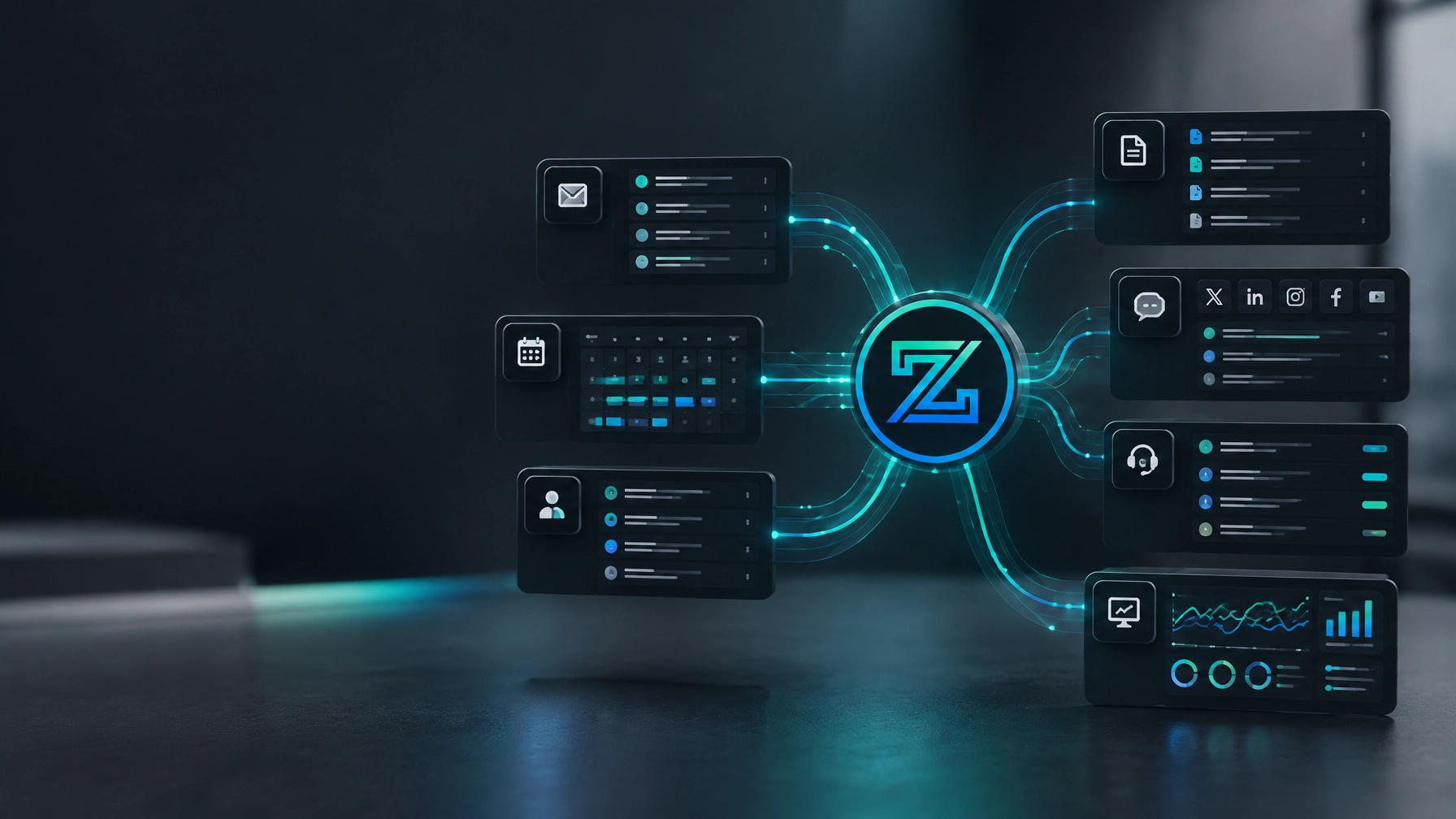
Your website is visible. It is not the whole business.
Behind every enquiry, booking, proposal and customer relationship sits a wider operational system: inboxes, calendars, CRM records, social channels, documents, payment processes, integrations, monitoring and support. When these components operate as disconnected tools, the business develops technical debt long before anyone identifies a visible failure.
This is the central challenge of digital operations management. The objective is not simply to maintain a website. It is to engineer a managed operational layer that keeps the wider digital ecosystem connected, governed and resilient.
The regulatory position is equally clear. Under UK GDPR guidance from the Information Commissioner’s Office, personal data must be handled lawfully, securely and transparently. That data may exist in an inbox, a CRM, a calendar invitation, a document or an automation log. Compliance therefore extends beyond the public-facing website.
Your digital infrastructure requires architectural oversight.
The Problem: A Business Built from Disconnected Systems
Most businesses do not deliberately design fragmented operations. Fragmentation develops incrementally.
A new inbox is added for sales. A separate calendar is introduced for bookings. A CRM is adopted to track leads. Documents are stored in cloud folders. Social enquiries arrive through several platforms. Support requests are handled through email or direct messages. Automation is then added to connect the gaps.
Each decision may appear reasonable in isolation. Collectively, the business becomes dependent on manual coordination.
The symptoms are predictable:
- Leads arrive in an inbox but are not consistently recorded in the CRM.
- Meetings are booked without being connected to a customer record.
- Follow-up commitments exist in personal task lists rather than a controlled workflow.
- Important documents are stored across multiple folders with inconsistent naming.
- Social enquiries are answered manually, with no reliable record of intent or outcome.
- Integrations fail silently when an API, password or data field changes.
- Support issues are discovered only after a customer reports them.
- No single person has a complete view of the operational system.
This is data leakage in an operational sense. Information is not necessarily stolen; it is lost between stages, platforms and people. Context disappears. Duplicate records emerge. Decisions are made from incomplete information.
The result is visibility decay.
A business may still appear active from the outside while its internal infrastructure becomes increasingly brittle. Manual workarounds multiply, undocumented dependencies accumulate and every new tool adds another possible point of failure.
DIY and out-of-the-box solutions are particularly dangerous when they are treated as permanent architecture. They may be suitable for a narrow task, but they rarely provide the governance, monitoring, error handling and ownership required for a mission-critical operational system.
Fragmentation is not an inconvenience. It is technical debt with commercial consequences.
The Infrastructure: Engineering a Managed Operational Layer
Digital operations management begins with an audit of how work actually moves through the business.
This is not a software inventory alone. It is a technical and operational map covering:
- Communication : where enquiries arrive, how they are categorised and who is responsible for the next action.
- Customer records : where contact details, conversations, opportunities and commitments are stored.
- Scheduling : how appointments are booked, confirmed, changed and connected to the correct customer record.
- Documents : how proposals, agreements, briefs and internal records are named, stored and retrieved.
- Lead handling : how a new enquiry is qualified, assigned, followed up and moved through the pipeline.
- Social channels : how public comments and private messages are monitored, answered and escalated.
- Integrations : which systems exchange information, what triggers those exchanges and what happens when they fail.
- Monitoring and support : how the business detects operational, security and performance issues before they affect customers.
The purpose is to establish a controlled operational backbone rather than add another isolated platform.
A Single Source of Truth
Not every system needs to connect directly to every other system. That approach creates unnecessary complexity. The correct architecture identifies the authoritative source for each category of information.
For example:
- The CRM may remain the system of record for customer and opportunity data.
- The calendar may control appointments and availability.
- A document system may manage approved files and version history.
- The inbox may remain the primary communication channel while important interactions are recorded against the relevant customer record.
- A support system may hold incidents, actions and resolution history.
The objective is not to eliminate every tool. It is to define the role of each tool and ensure that critical information moves between them through controlled workflows.
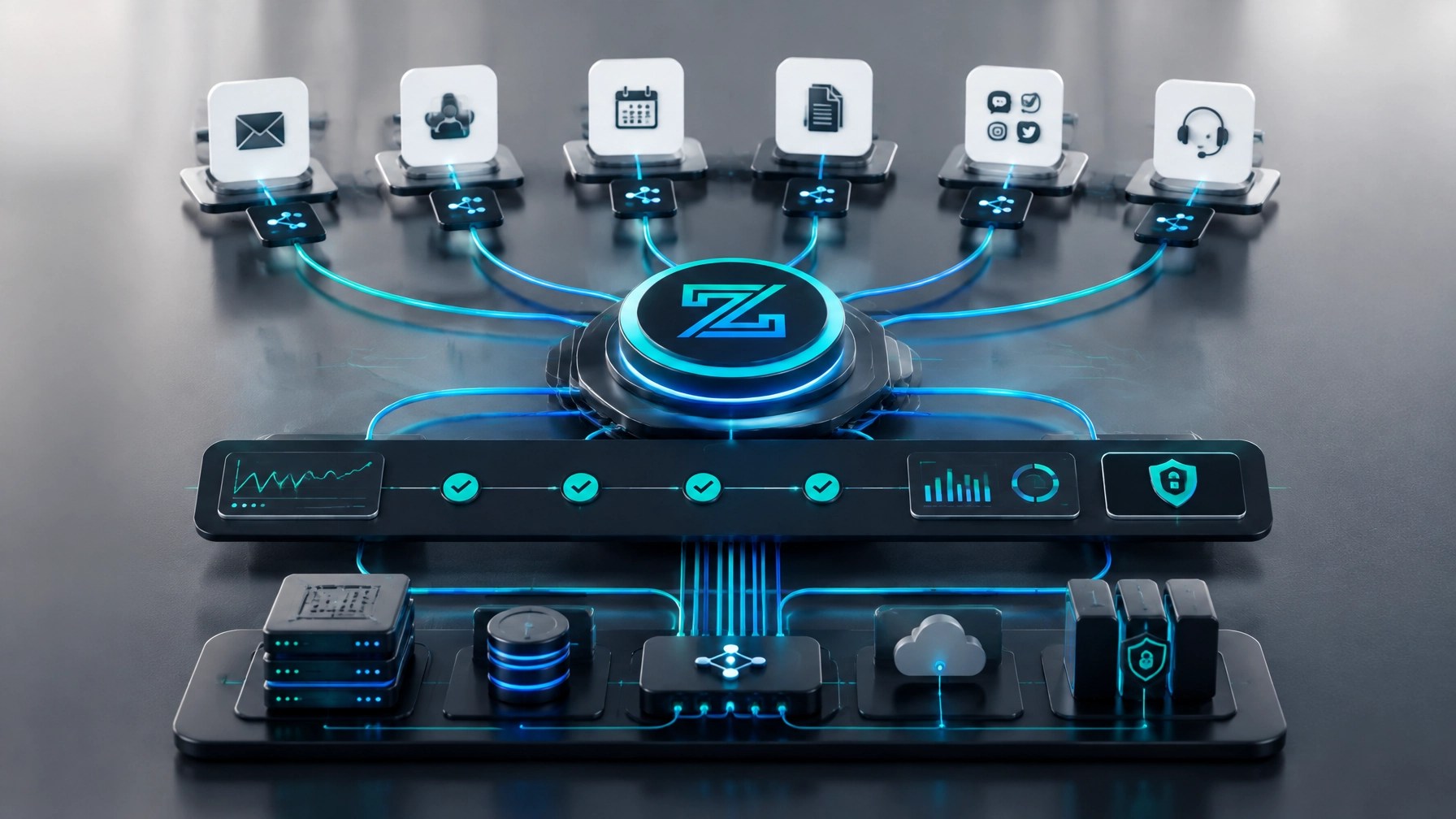
ZeroPoint Creative provides digital operations management as a managed layer across this ecosystem. The work may include workflow mapping, integration planning, content and document governance, support coordination, monitoring and ongoing optimisation.
This is infrastructure management, not software accumulation.
Monitoring and Support as Core Infrastructure
A workflow that operates correctly today may fail tomorrow. Platforms change. Authentication tokens expire. Data fields are renamed. APIs are updated. People change roles. Customer requirements develop.
Without monitoring, these failures remain invisible.
A resilient operational layer should include:
- Health checks for important integrations.
- Alerts when a workflow does not complete.
- Clear ownership for exceptions and escalations.
- Access control and regular permission reviews.
- Scheduled backups for critical data and configuration.
- Documented recovery procedures.
- Review cycles for obsolete or duplicated information.
- Human oversight where automated decisions carry material risk.
The ZeroPoint security and backup service follows the same principle: protection is not a single installation event. Scheduled backups, access controls, security hardening and ongoing oversight are required to maintain structural integrity.
The NCSC Small Business Guide also emphasises practical controls such as strong passwords, restricted access, current software and reliable backups. These are not optional technical details. They are the baseline of operational continuity.
Stability is the primary metric.
Transformation: From Tool Collection to Operational System
Once the operational map is established, the business can transition from reactive coordination to managed execution.
Consider a typical lead journey.
A prospect sends an enquiry. The message is categorised according to intent. Relevant information is recorded in the CRM. A response is issued. A booking link is provided or an appointment is scheduled. The meeting is associated with the correct record. Follow-up actions are created. Documents are prepared from an approved template. If the lead becomes a client, the handover is recorded and the delivery workflow begins.
The process does not need to be fully autonomous. It needs to be consistent, observable and correctly governed.
This is where AI assistants and automation can provide value. They can support repetitive classification, draft responses, summarise conversations, prepare follow-up actions and maintain operational continuity. However, they must operate within defined permissions and escalation rules.
Introducing Nova

Nova is Krishna’s MyGentic AI assistant. She supports the operational layer around his business activities, including handling social replies and booking appointments.
Nova is not presented as a replacement for human judgement. Her role is to reduce operational friction around high-frequency tasks so that important conversations do not depend entirely on manual availability.
This distinction matters. Generic AI is not an operational strategy. A prompt without context, permissions, workflow logic or monitoring is simply another isolated tool. A managed assistant must be connected to the appropriate business context and operate within a controlled framework.
The same principle applies to AI staffing and automation services. The technical objective is not to add an artificial employee for appearance. It is to engineer a reliable workflow that handles defined tasks, records its actions and escalates exceptions appropriately.
Human-in-the-loop governance remains essential for sensitive, complex or commercially significant decisions.
The transformation is therefore structural:
- From scattered conversations to recorded customer context.
- From personal memory to assigned workflow ownership.
- From manual reminders to controlled follow-up protocols.
- From hidden failures to monitored exceptions.
- From duplicated documents to governed information.
- From disconnected tools to an integrated operational layer.
That is how technical debt begins to reduce.
Growth: Stability Enables Commercial Expansion
Growth places pressure on every digital system.
More enquiries create more records. More customers create more communication. More staff create more access requirements. More services create more documents, workflows and exceptions. If the underlying infrastructure is fragmented, growth increases the volume of failure.
A managed operational layer changes that relationship.
When core processes are standardised and monitored, the business can:
- Onboard new staff with clearer procedures.
- Respond to leads with greater consistency.
- Maintain a more complete customer history.
- Reduce repetitive administrative coordination.
- Identify operational bottlenecks earlier.
- Improve the reliability of cross-platform reporting.
- Scale activity without relying entirely on individual memory.
- Protect critical information through defined access and recovery protocols.
This does not guarantee a particular revenue outcome. It creates the conditions for predictable execution.
Commercial expansion depends on more than acquisition. It depends on the organisation’s ability to fulfil commitments accurately, communicate consistently and maintain service quality as demand increases.
That is the purpose of managed digital operations from ZeroPoint Creative: to provide the technical oversight required to keep the ecosystem coherent while the business develops.
Key Takeaways
- Your website is one interface within a much wider digital operating system.
- Inboxes, calendars, CRM records, documents, social channels and support workflows must be treated as connected infrastructure.
- Fragmented systems create data leakage, visibility decay and technical debt.
- A single source of truth should be defined for each category of operational information.
- Monitoring, access control, backups and recovery procedures are core requirements, not optional extras.
- AI assistants such as Nova should operate within governed workflows with clear human escalation points.
- DIY and out-of-the-box solutions become liabilities when they are allowed to form mission-critical architecture.
- Stability enables growth by making execution more consistent, visible and scalable.
Conclusion: Build the Layer Behind the Business
The modern business does not run on its website alone. It runs on the connected systems behind the website: the inbox that receives intent, the CRM that records context, the calendar that controls commitments, the documents that define delivery, the integrations that move data and the monitoring layer that detects failure.
Without architectural oversight, these systems drift apart.
ZeroPoint Creative acts as the technical architect and Digital Guardian for this wider ecosystem. Through digital operations management, security oversight, automation and structured support, we help businesses replace fragmented tools with a resilient operational framework.
For privacy, governance and data-handling requirements, review our Privacy Policy and Legal Hub.
If your business depends on manual handovers, scattered records or undocumented integrations, the problem is not a lack of software. It is a lack of operational architecture.
Contact ZeroPoint Creative to discuss the infrastructure your business actually runs on.
Stability is the foundation. Precision is the path to growth.
Leave a Reply