
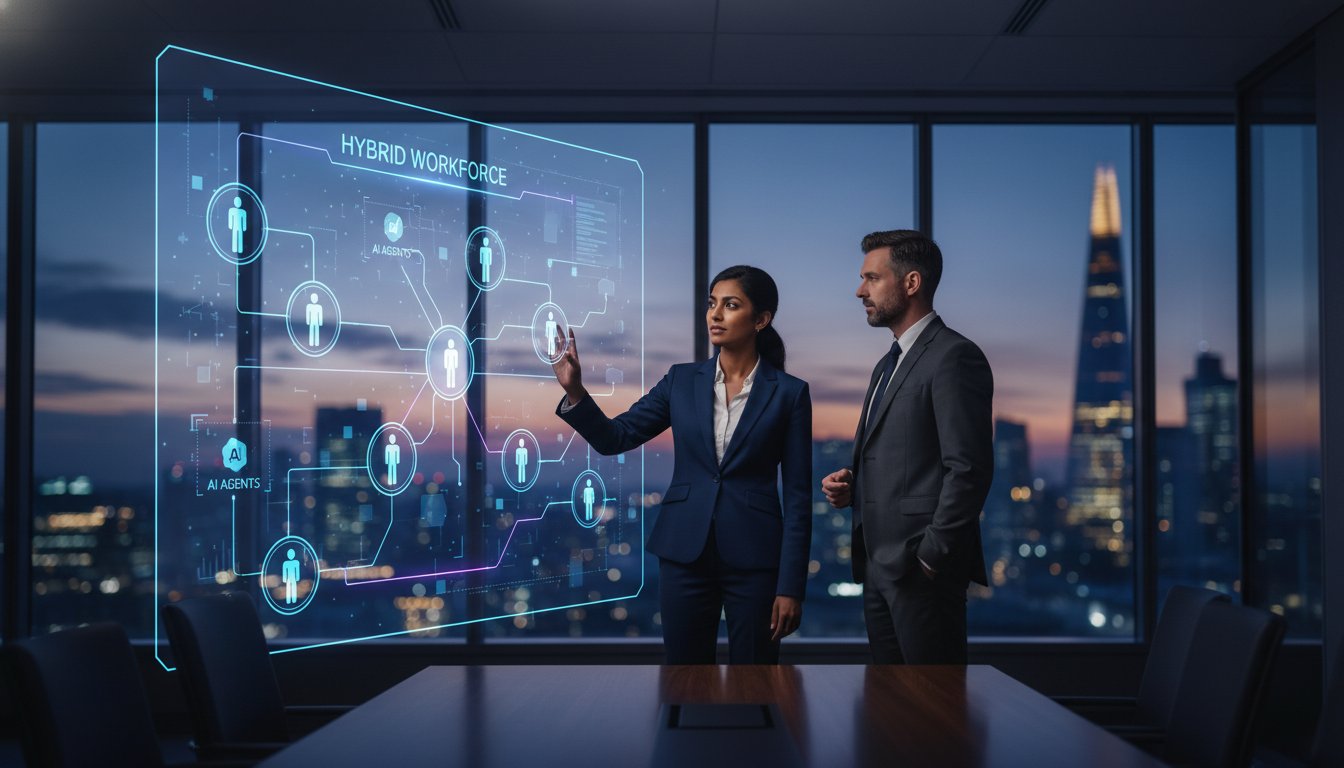
97% of UK businesses report a critical AI skills gap. Traditional recruitment cannot bridge this void. The cost of specialist talent is prohibitive; technical requirements evolve faster than the standard hiring cycle. As of February 2026, AI-related job postings have surged 127% above pre-pandemic levels. You recognise that the standard approach to headcount is no longer viable. The pressure to implement robust AI staffing strategies whilst integrating autonomous agents into human workflows is immediate.
This guide provides a definitive framework for architecting a managed hybrid workforce. It delivers a scalable blueprint that balances human expertise with digital autonomy. We will examine high-performance oversight structures, the implications of the May 2026 Data Protection Regulations, and methods for reducing manual operational load. You will gain the technical clarity needed to transform your organisational architecture for the 2026 landscape. This is the transition from experimentation to deep operational integration.
Key Takeaways
- Transition from traditional departmental silos to integrated human-AI teams to resolve persistent technical skills gaps.
- Master the AI staffing matrix by distinguishing between human-in-the-loop oversight and autonomous digital agents.
- Conduct a strategic evaluation of recruitment costs against managed automation services to optimise operational expenditure.
- Establish rigorous implementation protocols and accountability structures for the seamless onboarding of autonomous software agents.
- Secure long-term workforce stability through a managed architecture that prioritises high-performance technical oversight and systematic growth.
The Evolution of AI Staffing in the UK Corporate Landscape
The 2026 corporate environment has moved beyond departmental silos. Success now depends on the seamless integration of human expertise and autonomous software. This isn’t a replacement strategy. It’s a structural upgrade. UK enterprises are transitioning from experimental pilot programmes to fully operational AI staffing models. The goal is clear: maintain a competitive edge in a market where speed and precision are the primary currencies. You don’t just need tools; you need a managed architecture that supports them.
Recruitment trends confirm this shift. AI-related job postings have risen 127% above pre-pandemic levels as of February 2026. However, the volume of postings doesn’t equate to successful integration. Many firms remain trapped in the “experimentation” phase. They deploy tools without architecting the roles to manage them. True operational maturity requires a hybrid model where humans and agents share the same operational KPIs. The UK government’s “Regulating for Growth Bill” encourages this transition by providing sandboxes for controlled testing. It’s an opportunity to standardise your digital operations before the market reaches saturation.
The Skills Gap and the Need for Managed Systems
Scarcity is the defining challenge. 97% of UK businesses report an AI skills gap, with 57% specifically citing a lack of technical expertise. Recruiting a full-time machine learning engineer is often cost-prohibitive for SMEs. Managed systems bridge this divide. They provide the necessary technical oversight without the overhead of traditional recruitment. This approach ensures that AI systems remain stable, secure, and aligned with business objectives. It prevents the decay of technical infrastructure through continuous, expert management. You gain “always-on” reliability. You secure high-performance technical oversight. The gap between your technical requirements and your budget disappears.
Defining the Scope of Modern AI Roles
Roles have evolved. We’ve seen the rise of AI orchestrators and prompt architects. These professionals don’t just build systems; they govern them. This evolution is often discussed in the context of technological unemployment, but the reality is a redistribution of value. Traditional sectors like finance and creative services now require a “Digital Guardian” approach. This involves a high-level partner who takes responsibility for the technical ecosystem. It allows human staff to focus on high-value strategy whilst autonomous agents handle the repetitive, data-heavy workloads. The result is a workforce that is both leaner and more capable. It’s a systematic improvement in organisational performance.
Human Talent vs Digital Agents: Defining the AI Staffing Matrix
AI staffing is the strategic deployment of human experts and autonomous software agents to execute business functions. It represents a fundamental shift from traditional headcount models. You are no longer just hiring individuals; you are architecting a capacity. This matrix organises labour into two primary categories: human specialists and digital agents. The objective is to allocate tasks based on the specific strengths of each entity. High-complexity reasoning belongs to humans. High-volume execution belongs to code.
The distinction between “Human-in-the-loop” and “Autonomous Agency” is critical. Human-in-the-loop systems require human validation before a task is finalised. This is essential for high-stakes decision-making. Autonomous Agency refers to workflows that execute end-to-end tasks without intervention. By 2026, the future of work in the age of AI will depend on how effectively these two modes are balanced. It’s about reducing manual operational tasks whilst maintaining high-performance technical oversight.
The Role of the Human AI Specialist
Expert oversight remains the centre of any successful strategy. Humans provide the high-level strategy, ethics, and complex problem-solving that digital agents cannot replicate. Their role is to govern the system. They ensure every automated output aligns with the brand’s visual identity and commercial goals. This is particularly evident in specialised sectors. For instance, a Search Engine Optimisation Agency requires human architects to interpret nuanced data shifts that machines might misread. Human talent provides the creative direction; AI provides the scale.
Deploying Digital Staff: Autonomous AI Agents
Digital staff are autonomous workflows capable of executing end-to-end tasks. They are functional team members. The scalability advantages are absolute. Digital agents operate at a fixed cost with infinite uptime. This allows your enterprise to scale operations without a linear increase in headcount. Common deployment areas include:
- 24/7 Customer Support: Handling complex queries without human intervention.
- Data Processing: Executing high-volume analysis with total accuracy.
- Lead Nurturing: Automating the journey from initial contact to conversion.
It is a systematic improvement in resource allocation.
Architecting the Hybrid Workflow
A managed ecosystem ensures seamless communication between human experts and AI agents. The workflow must be frictionless. Human staff define parameters; digital agents execute volume. We detail these structures in our AI Automation Workflows pillar. This architectural approach creates a resilient workforce that is always-on. If you are ready to restructure your capacity, exploring a professional AI staffing solution is the logical next step. It provides the stability your growth requires.

Strategic Evaluation: Choosing Between Recruitment and Automation
Determining your workforce composition requires a clinical assessment of operational friction. Bottlenecks dictate your staffing strategy. If a process is repeatable and data-intensive, automation is the logical solution. If it requires nuanced negotiation or ethical judgment, traditional recruitment is necessary. Identifying these bottlenecks requires a data-driven audit of your current human workflows. This evaluation prevents the common error of over-hiring for roles that autonomous agents can execute with higher precision. It’s about capacity, not just headcount.
The “Build vs. Buy” dilemma is central to this transition. Developing bespoke AI infrastructure in-house requires significant capital and technical maturity. Most UK enterprises find that a managed approach to AI staffing provides immediate stability without the risks of failed internal development. This choice is supported by research from the OECD on the future of work, which highlights the need for adaptable organisational structures in the face of rapid technological shifts. Long-term maintenance is another factor. AI staff require constant oversight to ensure model accuracy and data security. A managed service takes full responsibility for this technical ecosystem, acting as a “Digital Guardian” for your operations.
The Financial Architecture of AI Staffing
Financial viability depends on the Total Cost of Ownership (TCO). A human specialist represents a variable cost with significant overheads including training, benefits, and potential turnover risks. Managed AI staffing operates on a predictable, scalable model. Efficiency gains and the reduction of human error drive the ROI. This architecture allows for business agility. You can expand capacity in hours rather than months. It’s a shift from fixed labour costs to flexible operational expenditure. Exploring transparent pricing models for managed services can clarify your budget requirements. The result is a leaner, more responsive balance sheet.
Technical Readiness and Infrastructure
Digital staffing cannot exist in a vacuum. Your infrastructure must support it. A robust CRM setup acts as the central nervous system for your digital agents. It ensures data remains accessible and structured. Similarly, professional email systems are essential. They provide the secure communication channels required for autonomous agents to interact with clients and human staff. Without these foundations, your AI strategy will lack the structural integrity required for long-term performance. You must standardise your data environment before deploying your digital workforce. This systematic approach ensures that every automated action is grounded in accurate, real-time information.
Implementation Protocol: Integrating AI Staff into Existing Workflows
Successful integration requires more than placement. It demands a standardised onboarding protocol for both human and digital entities. You are not simply filling a seat. You are installing a component. Accountability structures must be explicit. Autonomous agents require clear parameters; human staff require defined oversight roles. This ensures the hybrid workforce operates as a single, cohesive unit. Monitoring is constant. Performance optimisation is iterative. The objective is a frictionless operational cycle. Security remains the priority. Data integrity must be maintained amongst distributed teams through rigorous technical protocols.
Data integrity is the bedrock of this architecture. In a hybrid environment, information moves between human experts and autonomous systems. Every transfer point is a potential vulnerability. We implement end-to-end encryption and strict access controls. This ensures that your intellectual property remains secure whilst your digital staff execute their functions. Regular audits and automated backups provide an additional layer of reliability. You gain peace of mind through technical excellence. This is structural security for the modern enterprise.
The Five-Step Integration Framework
A methodical approach ensures stability. The process begins with a comprehensive audit to identify high-impact areas where AI staffing delivers the greatest efficiency. We look for repeatability and high-volume data requirements. Next, we design the architecture. This defines exactly how human specialists and digital agents interact. Deployment follows. This stage involves implementing the technical stack and specific AI staffing solutions. Finally, we move to optimisation. Continuous monitoring of outputs allows for the refinement of prompts and workflows. This systematic progression eliminates the risks associated with ad-hoc tool adoption. It creates a scalable foundation for growth.
Governance and Ethical Oversight
Control is non-negotiable. Establishing protocols for AI decision-making prevents drift. Every action taken by a digital agent must be traceable. This is critical for maintaining compliance with the Data Protection Regulations 2026. Human intervention points are pre-defined. This ensures that high-stakes scenarios are always handled by expert staff. Quality control is automated yet overseen. Brand voice remains consistent across all digital staff outputs. Security protocols protect data integrity at every touchpoint. You maintain total authority over your technical ecosystem. This is the “Digital Guardian” model in practice. If you require a managed partner to engineer this transition, explore our comprehensive AI and web services to secure your operational future.
ZeroPoint Creative: Engineering Your AI-Powered Workforce
ZeroPoint Creative acts as the Digital Guardian for your technical ecosystem. We don’t just provide tools. We engineer capacity. Our managed approach to AI staffing ensures that autonomous agents and human experts work within a standardised, high-performance architecture. This isn’t about trial and error. It’s about systematic improvement. We integrate these staffing models directly with your broader digital strategy. This includes Search Engine Optimisation, Paid Social Campaigns, and managed website solutions. The result is a unified operational front. You receive 24/7 technical oversight. We ensure continuous operational excellence whilst you focus on high-level commercial growth.
The ZeroPoint Managed Service Advantage
We focus on outcomes. Placement is a secondary concern; structural integrity is the priority. Our managed service handles every technical nuance of the hybrid workforce. We manage the model training, the prompt architecture, and the API integrations. You don’t need to hire a separate ML engineer. We provide the expertise. This clinical precision ensures that your autonomous agents remain accurate and secure. We take full responsibility for the technical ecosystem. You gain a scalable workforce without the traditional recruitment friction. It’s a high-end, specialised utility for the modern enterprise.
Comprehensive Digital Infrastructure
A hybrid workforce requires a resilient foundation. We align our staffing solutions with managed website maintenance to ensure your digital storefront remains as capable as your agents. High-performance hosting is non-negotiable. It supports the computational demands of autonomous workflows. Our “always-on” reliability guarantee means your hybrid team never goes offline. We provide the security, the backups, and the performance optimisation required for 2026. Every component is synchronised for maximum output. The technical complexity is managed. Your stability is assured.
Next Steps for Operational Excellence
Transformation begins with an audit. We invite you to initiate a discovery call to evaluate your current staffing architecture. We will identify bottlenecks and customise a roadmap for AI staffing and scalability. This is a methodical transition toward operational excellence. You can explore our full range of services to understand the depth of our technical management. Secure your competitive advantage. Architect your future workforce today. Every sentence serves a purpose. Every action drives performance. We are your partner in the digital era.
Securing Your Operational Future in 2026
The transition to a hybrid workforce is a matter of structural necessity. You recognise that integrating autonomous agents with human expertise is the only viable method for resolving the 2026 skills gap. It’s a fundamental shift from ad-hoc tool adoption to a managed architecture. Success depends on clear accountability, rigorous technical oversight, and seamless communication between human and digital staff. This is the architecture of modern growth.
ZeroPoint Creative provides the stability your enterprise requires. We deliver managed AI automation workflows, UK-based technical expertise, and 24/7 live phone support; a comprehensive framework for operational stability. You gain a scalable, high-performance capacity without the prohibitive costs of traditional recruitment. This is the “Digital Guardian” model in action. It ensures your AI staffing strategy remains secure and effective.
The era of experimentation is over. Operational integration is the new standard for UK enterprises. It’s time to move beyond departmental silos and engineer a workforce built for growth. Architect your hybrid workforce with ZeroPoint Creative and secure your path to sustained technical excellence. Your future organisational structure is ready for deployment.
Frequently Asked Questions
What is AI staffing and how does it differ from traditional recruitment?
AI staffing is the strategic deployment of human experts and autonomous software agents to execute business functions. It differs from traditional recruitment by focusing on capacity and workflow architecture rather than human headcount alone. Whilst recruitment seeks to fill a seat; this approach engineers a system. It integrates managed automation with human oversight to provide a scalable, high-performance operational model for the modern enterprise.
Can digital AI agents truly replace human employees?
Digital AI agents are designed to augment and automate specific tasks; they don’t replace the necessity for human judgment. High-level strategy, ethical oversight, and complex problem-solving remain human-centric domains. Agents handle high-volume, repetitive workloads with total accuracy. This allows human staff to focus on high-value creative and strategic initiatives. The result is a hybrid workforce that is more efficient than a purely human one.
How much does it cost to implement an AI staffing solution in the UK?
The cost of implementing these solutions in the UK varies based on the complexity of the required workflows and the level of managed oversight. Enterprises should evaluate the Total Cost of Ownership against the variable costs of traditional recruitment. Managed services typically offer a predictable monthly structure that scales with your growth. This avoids the high overheads and training costs associated with specialist in-house hires.
Is AI staffing secure for businesses handling sensitive data?
AI staffing is secure when implemented within a managed technical ecosystem that prioritises data integrity. We use end-to-end encryption and strict access controls to protect sensitive information. All deployments comply with the Data Protection Regulations 2026 and UK AI safety standards. Systematic monitoring and regular audits ensure that autonomous agents operate within defined security parameters. This provides a level of oversight that manual processes often lack.
What roles are most suited for AI staffing in 2026?
Roles suited for AI staffing in 2026 include data-intensive functions such as lead nurturing, 24/7 customer support, and high-volume administrative tasks. Technical roles like prompt architecture and AI orchestration are also critical for governing these systems. Finance and creative sectors benefit from automating repetitive data processing whilst retaining human experts for strategic direction. The objective is to automate execution whilst maintaining expert human oversight.
How do I manage a team that includes both humans and AI agents?
Managing a hybrid team requires clear accountability structures and standardised communication protocols. You must define exactly where an autonomous agent’s task ends and a human’s oversight begins. Using a managed service provides the “Digital Guardian” framework necessary to oversee these interactions. Performance is monitored through real-time data outputs. This ensures that both human and digital staff remain aligned with your commercial objectives.
What technical infrastructure is required to support AI staffing?
The technical infrastructure required includes a robust CRM setup, professional email systems, and high-performance hosting. These components act as the central nervous system for your digital agents. Data must be structured and accessible to ensure autonomous workflows execute accurately. Security protocols and automated backup systems are also essential foundations. Without this structural integrity, these deployments cannot deliver the reliability required for enterprise-level operations.

Article by
Krishna de Gruchy
Krishna de Gruchy is the founder of ZeroPoint Creative Ltd and CEO of EPC Consultancy Ltd and NeedAnOptom.com. With 30 years of operational leadership across optical retail, eye surgery, private healthcare, cosmetic medicine and travel, Krishna brings an operator's discipline to digital. Zero Point Creative runs on the same AI staffing it builds for clients.
Leave a Reply