

Most businesses have process documentation. Fewer have an accurate record of how work actually happens.
The distinction is structural.
A standard operating procedure normally describes the intended route: the clean input, the expected approval, the normal system response and the planned outcome. It rarely records the supplier whose invoices always require an additional check, the workaround used when a platform is unavailable, or the judgement call made by an experienced employee when the rules do not quite fit.
That undocumented layer is where operational knowledge resides. It is also where automation projects encounter friction, technical debt and risk.
Before you automate, you need a map of work.
Key Takeaways
- Ordinary documentation captures the designed process, not necessarily the operational reality.
- Exceptions, workarounds and judgement calls should be treated as defined process components.
- Process ownership, version history and business sign-off are controls, not administrative extras.
- A technical specification should be generated from an approved business definition wherever possible.
- Human review remains essential for ambiguous, high-consequence or poorly defined decisions.
- ZeroPoint Creative can help capture client-owned operational knowledge and translate it into governed workflows without replacing business accountability.
Problem: The documented process is often a controlled fiction
Documentation tends to be created at a particular point in time, usually during implementation, compliance preparation or a systems change. It records what the business believes should happen.
Operational work is less orderly.
Employees encounter missing information, conflicting instructions, system limitations, unusual customer circumstances and time-sensitive decisions. They compensate. They reroute work, maintain private checklists, request informal approvals and rely on precedent.
These responses are often rational. They keep the business moving. However, if they remain undocumented, the organisation develops two separate systems:
- The formal system, represented by policies, process diagrams and standard operating procedures.
- The practical system, represented by human memory, workarounds and informal judgement.
The second system is usually more accurate, but it is difficult to govern. It may not be visible to process owners, technical teams or auditors. It may also disappear when a key employee changes role or leaves the organisation.
This is why a workflow can appear simple during discovery and become unstable after automation. The happy path has been automated, while the real work continues through undocumented side routes.
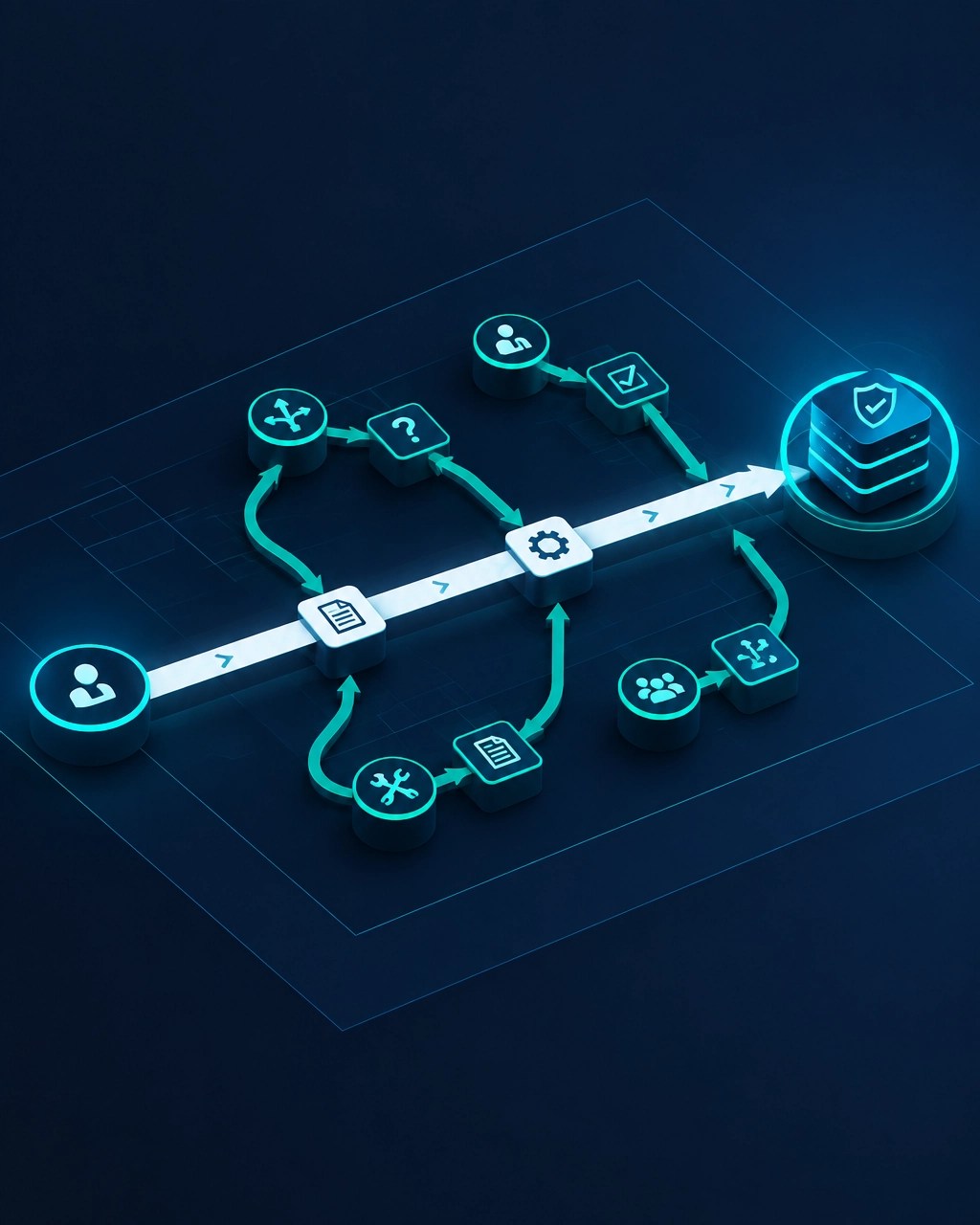
Why ordinary documentation misses the exceptions
There are several recurring causes:
- Happy-path bias: teams document the normal sequence because it is easier to explain and approve.
- Tacit knowledge: experienced employees often know what to do without consciously describing the reasoning.
- Exception fatigue: recurring deviations are treated as temporary anomalies rather than process variants.
- Documentation drift: system changes, policy updates and staff turnover cause the written process to fall behind.
- Ownership ambiguity: nobody has clear responsibility for approving and maintaining the process definition.
The result is visibility decay. The business believes it has a process, but it has only a partial representation of one.
Stability is not achieved by documenting more pages. It is achieved by documenting the right decisions, owners and exceptions.
Infrastructure: Build a map of work before you build automation
A map of work is a structured account of how a process operates in practice. It should connect the business definition to the technical implementation without allowing either side to drift.
The first requirement is a current-state map. This should identify:
- The trigger and intended outcome.
- The people, roles and teams involved.
- The systems and data objects touched.
- The rules and compliance obligations that apply.
- The normal process route.
- The exception routes and escalation points.
- The evidence required for a decision.
- The points where human review is mandatory.
- The measures used to assess performance.
This is not an invitation to create a decorative diagram. It is a requirements specification for a governed operating system.
Define process ownership
Every material workflow requires a named owner. That person is accountable for the business definition, not necessarily for writing every technical component.
The owner should be able to answer:
- What is this process intended to achieve?
- Which rules are mandatory?
- Which decisions may be delegated?
- Who may approve an exception?
- What evidence is required?
- What happens when an upstream system changes?
- When should the process be reviewed?
Without an accountable owner, automation decisions become detached from business responsibility. The workflow may run consistently, but nobody can confirm whether it is still correct.
Capture exception handling as a first-class component
For each exception, record the entry condition, the required evidence, the route, the responsible role, the decision criteria and the return path.
A useful exception record should answer:
- What caused the normal route to fail?
- Is the exception temporary, recurring or structural?
- Can it be standardised?
- Should it be automated?
- Does it require human judgement?
- Who has authority to resolve it?
- How is the decision recorded?
- Does the case return to the main process or terminate separately?
This prevents a common failure pattern in automation projects, where exception handling is added after launch as a series of urgent patches.
Exception handling belongs in the architecture from the beginning.
Separate business sign-off from technical implementation
Business documentation and technical specifications serve different audiences.
A business owner needs to confirm that the process is accurate, authorised and aligned with policy. A technical team needs precise information about integrations, data fields, permissions, triggers, error states and system behaviour.
The two should remain connected.
When a business rule changes, the technical specification should be reviewed or regenerated. When a technical constraint is discovered, the business owner should be able to assess its operational impact. Independent documents maintained manually create version drift and increase the likelihood that the build no longer reflects the approved process.
Maintain version history and provenance
A governed map should show:
- What changed.
- When it changed.
- Who proposed the change.
- Who approved it.
- Which evidence supported it.
- Which technical components are affected.
- Whether the previous version can be restored.
This is particularly important where workflows handle financial decisions, personal data, regulated activity or customer-impacting outcomes. A current process definition is useful. A traceable process definition is defensible.
UiPath Cartographer: An external example of mapping real work
UiPath Cartographer provides a relevant external example of this direction, although ZeroPoint Creative has no partnership with UiPath.
In coverage published by Reworked, UiPath Cartographer is described as creating a “Map of Work” that records process rules, exceptions and judgement calls that are often absent from formal documentation.
The official UiPath product material describes a versioned definition of how a business process runs, including the people involved, systems touched, business rules, exceptions, judgement and performance measures. It also describes governance controls such as named ownership, approval, version history, provenance and rollback.
The operating model is significant because it separates several activities that are often confused:
- Gathering existing documentation and recordings.
- Identifying contradictions and missing information.
- Capturing the way work actually proceeds.
- Producing a business-facing process document for sign-off.
- Producing a technical specification for implementation.
- Maintaining the definition as the process changes.
UiPath’s material also distinguishes Cartographer from process mining. Process mining is generally concerned with reconstructing what happened from system event data. A map of work must additionally capture intent, rules, exceptions and human judgement.
That distinction matters. An event log may show that an approval occurred. It does not necessarily show why the approval was granted, which precedent influenced the decision or whether the rule should be changed.

The principle is platform-independent: automation should be derived from an approved and maintained understanding of the work.
Human review is an architectural control
Not every judgement call should be converted into a rule.
Some decisions are repeatable and evidence-based. They may be suitable for standardisation or automation. Others depend on context, materiality, customer history, risk tolerance or incomplete information. Those decisions should remain within a defined human-review route.
Human review must therefore be designed, not merely retained as an emergency fallback.
The workflow should specify:
- Which cases require review.
- Which role is authorised to review them.
- What information must be presented.
- What outcomes are permitted.
- How the decision is recorded.
- Whether the decision changes the process definition.
- How similar cases are handled in future.
This is the difference between a governed workflow and an unattended one. Automation executes approved logic. People remain accountable for decisions that the logic cannot safely determine.
Growth: Convert operational memory into a governed asset
Once exceptions are visible, the business can make better decisions about what to do with them.
Some workarounds can be removed. Some can be standardised. Some can be automated. Others should remain human-led but better supported with structured evidence and clear escalation.
This creates a controlled path from operational knowledge to scalable infrastructure:
- Observe how work actually happens.
- Map the normal route and exception routes.
- Assign ownership and decision rights.
- Obtain business sign-off.
- Produce technical specifications.
- Build and test the workflow.
- Monitor outcomes and review exceptions.
- Update the map under version control.
ZeroPoint Creative’s bespoke operational brain and workflow consultancy is designed around this principle. We can work with your stakeholders to capture client-owned operational knowledge, clarify the decisions that sit behind the process and translate that knowledge into governed workflows.
The objective is not to impose an out-of-the-box process. That approach often creates technical debt because it forces business reality into an unsuitable model.
The objective is to preserve the meaning of your operation while improving its structural integrity.

A resilient workflow is not one that eliminates human judgement. It is one that makes judgement visible, accountable and progressively easier to manage.
Contact Krishna about your workflow architecture
If your team relies on undocumented workarounds, informal approvals or one person’s operational memory, the next step is not immediate automation.
The next step is a map.
Contact Krishna through the ZeroPoint Creative contact page to discuss your process documentation, workflow governance and operational infrastructure requirements.

ZeroPoint Creative Ltd
71–75 Shelton Street, Covent Garden, London, WC2H 9JQ
info@zeropointcreative.com
0800 870 8203
