

The operational gap in artificial intelligence is no longer whether businesses have access to AI. It is whether their infrastructure can govern, connect and support AI that acts.
New research from Cisco and Omdia reports that 95% of surveyed organisations say their existing, non-agentic AIOps tools fall short in one or more significant areas. The research surveyed 1,000 IT and network operations leaders at organisations with 500 or more employees across North America, Western Europe and Asia-Pacific.
That distinction matters. These figures describe large organisations with formal IT and network operations functions. They must not be presented as a direct measure of small-business adoption or capability. However, the operational signal is relevant to every business leader: advisory AI is reaching its practical ceiling, while agentic systems are beginning to act inside live workflows.
The question is no longer whether AI can produce an answer.
The question is whether your business can control what happens next.
Key Takeaways
- Cisco and Omdia found that 95% of surveyed enterprise leaders believe existing non-agentic AIOps tools fall short in significant areas.
- The research describes a shift from advisory AI towards AgenticOps, where systems can sense, reason, act and validate outcomes.
- 69% of surveyed leaders require detailed explainability for agent-driven actions.
- 86% consider a single integrated platform the most effective path for scaling agentic AI in network operations.
- These statistics relate to organisations with 500 or more employees, not small businesses generally.
- For businesses without an IT operations department, managed digital operations and governed workflow automation provide the practical infrastructure layer.
The Problem: Advisory AI Cannot Resolve Operational Friction
Traditional AI tools are primarily advisory. They summarise information, identify patterns and recommend a next step. A human operator must then interpret the recommendation, move between systems, approve an action and confirm whether the result was correct.
That model is becoming structurally inefficient.
Cisco and Omdia report that the average organisation in their survey generates approximately 4,100 monitoring alerts and events each day, with more than half related to the network. The report states that manually clearing the daily network-alert backlog would require roughly 100 IT specialists.
This is not simply an alert-volume problem. It is a systems problem.
Operational data is distributed across monitoring platforms, ticketing systems, identity controls, cloud environments and business applications. A fault in one domain may be caused by a condition in another. As the number of systems increases, the cost of correlation rises and the reliability of manual interpretation declines.
The Cisco/Omdia research states that 92% of surveyed organisations report that performance issues commonly span multiple domains, requiring correlation across ten or more tools for resolution. It also reports that 57% say their current change processes cannot match the speed required today.
The result is operational friction, visibility decay and technical debt. AI can identify the issue, but the business still carries the burden of execution.
That is the ceiling of advisory AI.
From AIOps to AgenticOps
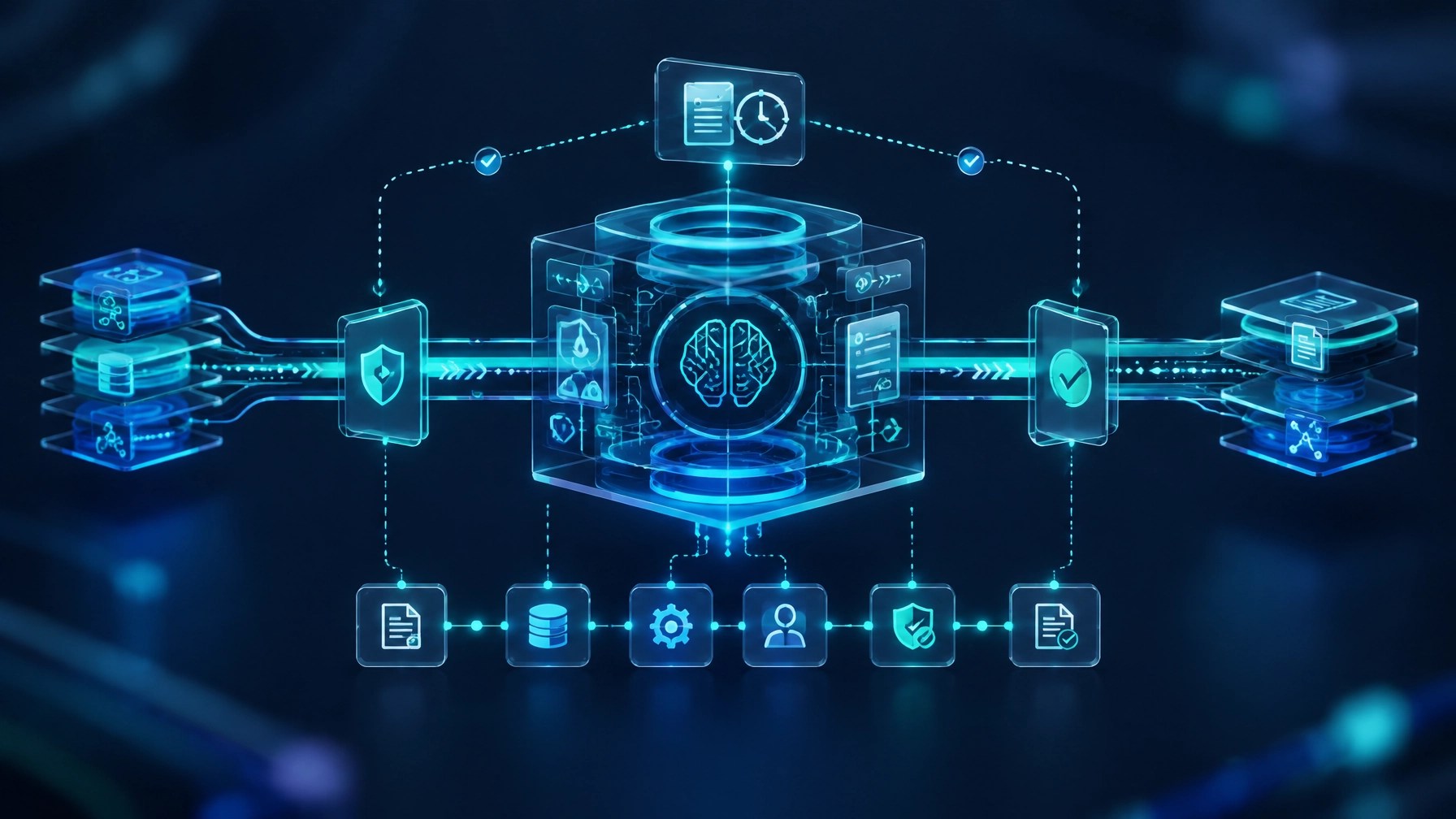
Agentic AI changes the operating model. Instead of stopping at analysis, an agentic system can be configured to interpret a defined objective, access approved data, perform a controlled action, validate the result and escalate when conditions exceed its authority.
Cisco describes this shift as AgenticOps. The operating loop is broadly:
- Sense the environment and collect relevant signals.
- Reason across data sources and operational context.
- Act within defined permissions and guardrails.
- Validate the outcome against measurable conditions.
- Escalate when confidence, authority or system state falls outside the approved parameters.
This does not mean surrendering control to an ungoverned machine. It means converting repetitive operational procedures into controlled, auditable protocols.
Cisco and Omdia report that 75% of surveyed organisations have already deployed AI for network operations, while 51% are running agentic AI that acts in production today. The study also found that 80% are comfortable granting AI a high or fully autonomous role in NetOps, including 24% who are comfortable with AI acting without human oversight.
These figures describe enterprise network operations. They do not mean that an ordinary business should grant unrestricted authority to an AI system. They do show the direction of the market.
The operational model is moving from “ask an AI” to “assign an outcome under governance”.

Infrastructure: Autonomy Requires Governance
The principal risk in agentic automation is not autonomy itself. It is unmanaged autonomy.
A system that can act across email, websites, customer records, finance tools or internal workflows must have a defined operating boundary. Permissions, escalation routes, data access, logging and rollback procedures must be designed before production activity begins.
The Cisco/Omdia findings make this requirement explicit. 69% of surveyed leaders require detailed explainability for agent-driven actions, while 36% consider full observability, including detailed tracing, summarised rationale and post-action audits, the minimum acceptable standard.
Explainability is not a decorative reporting feature. It is part of the system’s structural integrity.
A properly governed workflow should allow a stakeholder to understand:
- What objective the system received.
- Which data sources it accessed.
- What rules or conditions influenced the decision.
- Which action it took.
- What changed as a result.
- Whether the outcome met the defined success criteria.
- When and why the system escalated to a human.
This is the difference between automation and operational architecture.
The research also reports that 86% of surveyed leaders consider a single integrated platform the most effective path for scaling agentic AI in NetOps. The preference is logical. When responsibility is distributed across disconnected point tools, observability becomes fragmented and accountability becomes difficult to establish.
For smaller organisations, the equivalent problem appears in a different form. A business may have a website, domain, email system, CRM, booking platform, payment provider and marketing stack, but no IT operations department responsible for maintaining the connections between them.
The result is the same pattern at a smaller scale: disconnected systems, manual handoffs and uncertain ownership.
What AgenticOps Means for Ordinary Businesses
Most small and mid-sized businesses are not managing enterprise networks. They are managing a digital ecosystem that has accumulated over time.
A domain may be registered with one provider, email hosted with another, website access held by a former supplier and customer enquiries routed through an unmonitored form. Workflow automation may have been assembled through disconnected, out-of-the-box tools with no central record of permissions or failure states.
This is where the AgenticOps discussion becomes commercially relevant.
The lesson is not that every business needs an autonomous network operations centre. The lesson is that digital systems should be designed around controlled execution rather than isolated assistance.
Practical applications may include:
- Routing enquiries according to defined criteria.
- Triggering follow-up procedures when a lead remains unanswered.
- Checking whether website forms, domains, SSL certificates and backups remain operational.
- Escalating technical issues when a defined threshold is reached.
- Maintaining a central record of workflow activity and exceptions.
- Connecting business applications through standardised, documented procedures.
These processes require more than selecting a tool. They require architectural decisions, access controls, monitoring and ongoing maintenance.
DIY automation is often a liability because it creates invisible dependencies. Out-of-the-box systems may operate correctly during initial deployment, then degrade as permissions change, APIs are updated, staff leave or business processes evolve.
The system must be managed as infrastructure.
Managed Digital Operations as the Practical Answer
Businesses without an IT operations department should not be expected to build enterprise-grade governance alone. The practical answer is a managed operational layer that provides continuity, documentation and controlled intervention.
ZeroPoint Creative provides digital operations support across domains, DNS, email configuration, platform administration, security checks, updates and troubleshooting. This is the operational foundation required before more advanced automation can produce reliable outcomes.
For businesses progressing towards governed workflow automation, AI automation services can be structured around defined roles, approved data access, escalation protocols and measurable outputs.
The objective is not to add more disconnected tools. It is to establish a resilient operating framework.
Nova, a MyGentic assistant, can also help route an initial enquiry and identify the appropriate operational requirement. She should be treated as an access point for a managed process, not as a substitute for governance, infrastructure or human accountability.
Growth: Stability Converts Automation into Capacity
Agentic systems create value when they reduce operational friction without creating new control risks.
A managed framework allows a business to:
- Reduce repetitive administrative work.
- Respond to operational events more consistently.
- Preserve evidence of actions and decisions.
- Identify system failures before they become commercial interruptions.
- Scale workflows without adding equivalent manual overhead.
- Give stakeholders a clear view of what is happening across the digital ecosystem.
This is the commercial consequence of operational stability. When systems are monitored, documented and governed, growth does not depend on informal knowledge held by one employee or supplier.
Cisco and Omdia report that 84% of surveyed enterprise leaders expect to operate with an AI-led NetOps model within twelve months. Again, this is not a small-business forecast. It is an indicator of how quickly operational expectations are changing among larger organisations.
Businesses of every size will increasingly interact with suppliers, platforms and customers that operate through AI-led systems. Readiness will therefore become a competitive requirement. The businesses that can maintain clean data, reliable workflows and documented controls will be better positioned to integrate with that environment.
Stability is the primary metric.
Meet the Shift with Controlled Infrastructure
AgenticOps is not a licence to automate without restraint. It is a framework for moving from fragmented assistance towards governed execution.
The Cisco/Omdia research shows that large organisations are already placing AI inside production operations, but the same research makes the condition clear: autonomy must be supported by explainability, observability and integrated control.
For an ordinary business, the first step is not deploying an autonomous agent. It is rectifying the infrastructure around the business: access, data, workflows, websites, domains, security, documentation and escalation.
ZeroPoint Creative can assess that operating environment and identify where managed support or business workflow automation would provide the strongest return.
Contact ZeroPoint Creative to discuss your requirements, or speak with Nova about the appropriate next step.
Email: info@zeropointcreative.com
Telephone: 0800 870 8203
Address: 71–75 Shelton Street, Covent Garden, London, WC2H 9JQ

Sources and References
- Cisco, “Cisco AI Research: AgenticOps Scaling Quickly in the Enterprise”, 23 September 2026. This source includes findings from The Impact of Agentic AI on Network Operations, an independent Omdia survey of 1,000 IT and network operations leaders at organisations with 500 or more employees.
- Cisco and Omdia, The Impact of Agentic AI on Network Operations report.
- DQ India, “Google wants AI to stop assisting and start executing”, 24 September 2026. This report describes Google Cloud demonstrations and its stated direction towards agents that connect enterprise data, applications, models and governance to execute business workflows. It is referenced here for strategic context, not as a source for the Cisco/Omdia statistics.
About ZeroPoint Creative
ZeroPoint Creative Ltd builds and manages precision digital systems for modern businesses, including managed websites, technical SEO, digital operations support and governed business workflow automation.
