

An agentic brain is a structured model of how a specific business works, which AI systems can work from. It gives those systems the context, roles, tools and boundaries required to support real business operations.
It is not a chatbot. It is not a prompt library. It is not a generic AI subscription that starts from a blank screen each time you ask a question.
An agentic brain is business infrastructure.
If you are unclear about what one is, or how you can have one built around your organisation, this article provides the plain-language explanation.
The problem: generic AI starts from zero
Most generic AI tools begin with limited knowledge of your organisation. You provide a prompt, attach some information or explain the situation, and the system produces an answer based on the context available at that moment.
The next time you use it, you may need to explain the same business background again.
This creates operational friction.
Your terminology, professional methods, customer pathways, approval rules and internal processes remain distributed across documents, emails, staff knowledge and separate software platforms. The AI may be capable, but it does not have a reliable operating model for your organisation.
That leads to:
- Repeated explanations.
- Inconsistent outputs.
- Lost business context.
- Unclear decision-making authority.
- Manual checking and correction.
- Technical debt caused by disconnected tools.
- Data leakage between systems and workflows.
This is why simply adding another AI tool rarely produces operational excellence. The issue is not a lack of access to AI. The issue is the absence of a governed business framework for AI to work within.
A generic tool can answer a question. An agentic brain helps an organisation move work forward.
What sits inside an agentic brain?
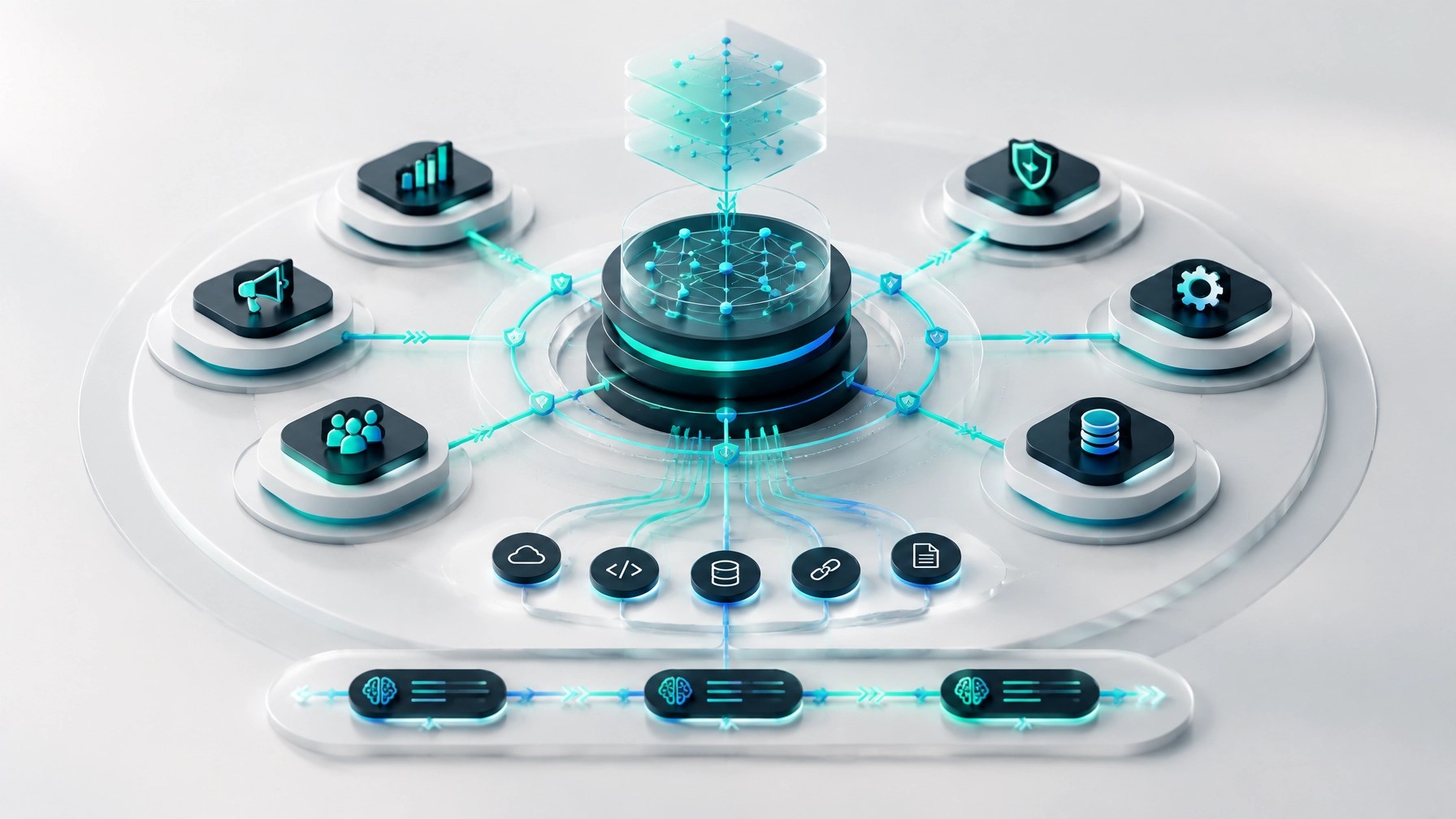
An agentic brain is built around the actual structure of a business. Its contents vary according to the organisation, but a properly designed brain normally contains several connected layers.
1. Business context
This is the foundation.
It includes information about your organisation, its services, customers, objectives, terminology, operating environment and professional standards. It may also include the decisions that have shaped the business and the practical methods used to deliver work.
Context gives AI systems something more reliable than a blank prompt.
2. Defined professional domains
A business does not operate as one undifferentiated block. It contains distinct areas of responsibility.
These may include:
- Leadership.
- Operations.
- Sales.
- Customer service.
- Recruitment.
- Compliance.
- Finance.
- Clinical or professional delivery.
- Marketing and visibility.
- Technical support.
Each domain requires its own language, priorities, workflows and authority limits. Defining these domains creates structural integrity and helps prevent one system from attempting to handle every task without appropriate boundaries.
3. Existing business tools
An agentic brain becomes more useful when it is connected to the tools your organisation already relies on.
Depending on the requirement, these may include calendars, booking systems, customer records, email, document repositories, communication platforms and internal operational systems.
The objective is not to replace every existing platform. It is to create a controlled intelligence layer that can work across the relevant ecosystem.
4. Defined agent roles
Different tasks require different responsibilities.
One agent may support bookings. Another may classify enquiries. Another may prepare information for a professional review. Another may coordinate internal administration.
Agent roles should be explicit. Each agent needs a defined purpose, an authorised set of tools and a clear escalation route. This is more reliable than expecting one generic AI system to perform every role without separation.
5. Governance rules
Governance determines what the system may access, what it may recommend, what it may complete and where a human must approve the next action.
Rules may cover:
- Data access.
- Permissions.
- Confidentiality.
- Escalation.
- Approval levels.
- Record keeping.
- Human intervention.
- Deletion and revocation.
- Connected tools.
- Audit requirements.
Autonomy without governance is a liability. An agentic brain must be designed as a controlled operating environment.
Generic AI versus an organisation-specific brain
The difference is straightforward.
A generic AI tool starts with a blank prompt. You provide the question, the background and the desired result. The system then attempts to interpret your request.
A brain built around one organisation retains the business context between tasks. It understands the organisation’s terminology, methods, professional domains, tools and boundaries.
A generic AI tool
- Starts with limited business context.
- Requires repeated explanation.
- Produces broadly applicable answers.
- May not know which tools or processes are authorised.
- Usually requires more manual interpretation.
- Is not inherently aligned with your approval structure.
An organisation-specific brain
- Holds structured business knowledge.
- Understands defined professional domains.
- Works with the tools the organisation already uses.
- Coordinates specific agent roles.
- Applies agreed governance rules.
- Escalates decisions according to human approval requirements.
- Can be refined as the organisation changes.
This is the difference between an answer engine and an operational architecture.
The generic automation and bespoke agentic workflow guide explains this distinction in more detail. Fixed automation remains useful for predictable tasks, while a bespoke agentic workflow is more appropriate where context, exceptions and professional judgement are involved.
How can you have an agentic brain?
There are two practical routes.
Route one: licence an Expert Brain
An Expert Brain is a structured layer of specialist knowledge made available through the MyGentic Expert Brains marketplace.
This route gives your organisation access to an established professional method that can be applied to relevant tasks. It may be suitable when you want to introduce specialist expertise without commissioning an entirely new brain from the ground up.
ZeroPoint Creative will soon make its own brain available through the marketplace. The listing is forthcoming, and further details will be published when it is ready.
You can read the ZeroPoint Creative marketplace announcement for the current position.
A marketplace licence provides access to an expert method. It does not mean that you own the underlying intellectual property of that expert’s method.
Route two: commission a bespoke brain
The second route is to commission a brain built around your own organisation.
This is the route for businesses that want their own knowledge, methods, terminology, tools, roles and governance rules structured into a durable operational asset.
It is not an out-of-the-box installation.
How a bespoke brain is built
A bespoke build should be treated as an architectural process rather than a software shortcut.
Stage one: gather the context
The first stage is to understand how the organisation actually operates.
This includes its services, customers, objectives, existing documents, professional terminology, decision patterns, constraints and operational dependencies. The purpose is to capture the real business, not an idealised version of it.
Stage two: define the professional domains
The organisation’s areas of responsibility are then separated and documented.
A clinic, recruitment business, professional service firm and multi-site operator will each require a different domain structure. The brain must reflect the organisation’s actual responsibilities and risks.
Stage three: structure the brain
The captured information is organised into a usable framework.
This may include knowledge layers, operating methods, workflows, priorities, terminology and decision logic. The objective is to convert fragmented expertise into a coherent system that agents can work from.
Stage four: connect existing tools
The relevant tools and systems are identified and connected where appropriate.
This may include booking, communication, document, customer management and reporting systems. Connections should be limited to what is necessary and governed according to the organisation’s permissions and data requirements.
Stage five: define agent roles
Each agent is assigned a specific operational function.
The design should establish what each agent can do, which information it may access, which tools it may use and when it must escalate to another agent or a human.
Stage six: establish governance and human oversight
Approval thresholds are defined before the system is allowed to progress consequential actions.
Some tasks may be completed automatically. Others may require a human to review the information, approve the recommendation or grant a specific level of authority.
This is the point at which accountability is made visible.
Stage seven: refine continuously
A business changes. Its services, staff, tools, regulations and customer expectations develop over time.
A bespoke brain therefore requires ongoing refinement. Context must remain current, permissions must be reviewed and agent performance must be monitored.
The architecture is not complete because it has been launched. It remains effective because it is governed.

Who is a bespoke brain for?
A bespoke brain may be appropriate for:
- Founders whose knowledge is central to the business.
- Professional service firms with defined methods and compliance requirements.
- Clinics managing multiple operational and professional workflows.
- Recruitment businesses coordinating candidates, clients and internal teams.
- Multi-site operators requiring consistent processes across locations.
- Organisations where expertise is currently held by a small number of people.
- Businesses that have outgrown disconnected automation.
The value is not simply speed. It is the preservation and controlled application of organisational knowledge.
Own it, literally
A bespoke brain should be treated as a business asset owned by the organisation that commissions it.
That means the business knowledge shared during the process belongs to the client. The methods, terminology, operational context and information supplied by the client are not transferred to someone else merely because they have been structured into an agentic system.
Three governance commitments must remain clear:
-
All business knowledge shared is owned by the client.
The organisation retains ownership of its business information, operating knowledge and intellectual property. -
Clients can delete or revoke information.
Information can be removed, and access or permissions can be revoked, when the client requires it. -
All decisions are reviewed through human intervention.
A human grants the level of approval. Agents do not receive unlimited authority by default, and consequential decisions remain subject to the approval structure defined by the organisation.
This is the distinction between owning a business asset and subscribing to someone else’s method.
A licensed Expert Brain provides access to external expertise. A bespoke brain preserves and operationalises your own expertise.

Nova is the working example
Nova is Krishna’s MyGentic AI assistant.
She provides a working example of an agentic system operating around a real business environment rather than a theoretical demonstration. Nova handles business knowledge, bookings, appointments and one-to-one sessions. She also coordinates multiple AI agents depending on the task and currently holds more than 700 saved skills.
This matters because the system is organised around operational requirements.
Nova is not a generic chatbot. She is not a ZeroPoint Creative product or internal agent. She is Krishna’s MyGentic AI assistant, operating as a structured digital assistant for his working environment.
The Meet Nova article explains how this model supports bookings, appointments, social replies and business communication.
The related article on agentic workflows in eye care demonstrates how domain-specific workflows can be structured around professional operations.
Nova is evidence of the principle: business context can be structured, agent roles can be coordinated and human authority can remain in place.
Key Takeaways
- An agentic brain is a structured model of how a specific business works.
- It is not a chatbot, prompt library or generic AI subscription.
- It contains business context, professional domains, existing tools, agent roles and governance rules.
- Generic AI starts from a blank prompt, while an organisation-specific brain retains business context.
- You can access an Expert Brain through the forthcoming MyGentic marketplace or commission a bespoke brain for your organisation.
- A bespoke brain is built through context gathering, domain definition, structuring, tool connection, agent role design, governance and ongoing refinement.
- A bespoke brain is a client-owned business asset.
- Clients retain ownership of their business knowledge and can delete or revoke information.
- Human intervention remains central, with a human granting the level of approval.
- Nova is Krishna’s MyGentic AI assistant and a working example of structured agentic operations.
- Stability comes from governance, not from adding more disconnected AI tools.
Reach Nova through ZeroPoint Creative
If you want to understand how an agentic brain could work within your organisation, reach Nova through the call symbol on the ZeroPoint Creative website.
You can also:
- Call 0800 870 8203
- Email info@zeropointcreative.com
- Contact ZeroPoint Creative Ltd at 71–75 Shelton Street, Covent Garden, London, WC2H 9JQ
The correct starting point is not another generic tool. It is a clear assessment of your business context, operational requirements and governance structure.
Stability is the primary metric. Ownership creates long-term control.
