

Category: SEO
For over a decade, WordPress website management has been a fragmented exercise in "plugin-stacking." Businesses have historically relied on a disparate collection of tools to handle everything from SEO to ecommerce, creating significant technical debt and operational friction.
With the release of WordPress 7.0, the ecosystem has undergone a fundamental architectural shift. The introduction of the Abilities API and a provider-agnostic AI Client has transitioned WordPress from a content management system into an AI-native operational framework. For the modern enterprise, this is not merely a feature update; it is a structural revolution.
At ZeroPoint Creative Ltd, we view digital assets as mission-critical infrastructure. This guide dissects how to leverage the WordPress 7.0 Abilities API to rectify systemic inefficiencies and automate your digital operations with clinical precision.
The Problem: Systemic Failure of Legacy Management
Traditional WordPress environments suffer from "visibility decay" and "data rot." When operations: such as inventory updates, content optimisations, or lead processing: are handled manually or via uncoordinated plugins, the risk of failure increases exponentially.
Common systemic failures include:
- Operational Friction: High-latency manual workflows that prevent real-time response to market changes.
- Technical Debt: Over-reliance on "black-box" plugins that do not communicate, leading to security vulnerabilities and performance bottlenecks.
- Visibility Decay: A lack of standardised data schemas makes it impossible for AI agents or automation tools to accurately "read" and manage the site.
Unmanaged digital infrastructure is a liability. Without a proactive protocol, businesses face the constant threat of outages and data leakage. To understand the risks of reactive management, see our analysis on 7 mistakes you’re making with website maintenance.

The Infrastructure: What is the Abilities API?
The Abilities API is a technical registry of typed, permission-gated, and schema-validated functions. It defines exactly what your site can do: its "abilities": in a format that both humans and machines can interpret.
In the 2026 digital landscape, your website must be "callable" by external AI agents and internal automation logic. The Abilities API provides the standardised interface required for this level of managed website maintenance.
Key Components of an "Ability"
Every ability registered within the WordPress 7.0 framework contains:
- Stable Namespaced ID: A unique identifier (e.g.,
zp-ops/issue-refund) to ensure no naming collisions. - JSON Input/Output Schemas: Rigorous data definitions that ensure the automation tool knows exactly what data is required and what will be returned.
- Permission Callbacks: Integrated security checks to verify that the entity (user or AI agent) has the authority to execute the action.
- Execute Callback: The actual PHP logic that performs the task on your server.
By standardising these operations, we mitigate the risks associated with ad-hoc API integrations and create a resilient ecosystem for growth.
Implementation: How to Automate Your Digital Operations
To transition to an automated operational model, you must first audit your existing workflows and identify "high-friction" tasks. Once identified, these tasks are registered as abilities within the WordPress core registry.
1. Defining the Operation
Suppose your business requires a high-performance content audit protocol. Instead of a manual check, you register a content/audit ability. Using the wp_register_ability() function, you define the parameters (e.g., post ID, target keyword) and the expected output (e.g., SEO score, readability metrics).
2. Leveraging the AI Client
WordPress 7.0 includes a built-in AI Client (wp_ai_client_prompt()). This allows your site to "talk" to large language models in a provider-agnostic way. Within your ability’s execution callback, you can invoke the AI to analyse data, generate content, or make operational decisions.
3. Orchestration via UI or Agents
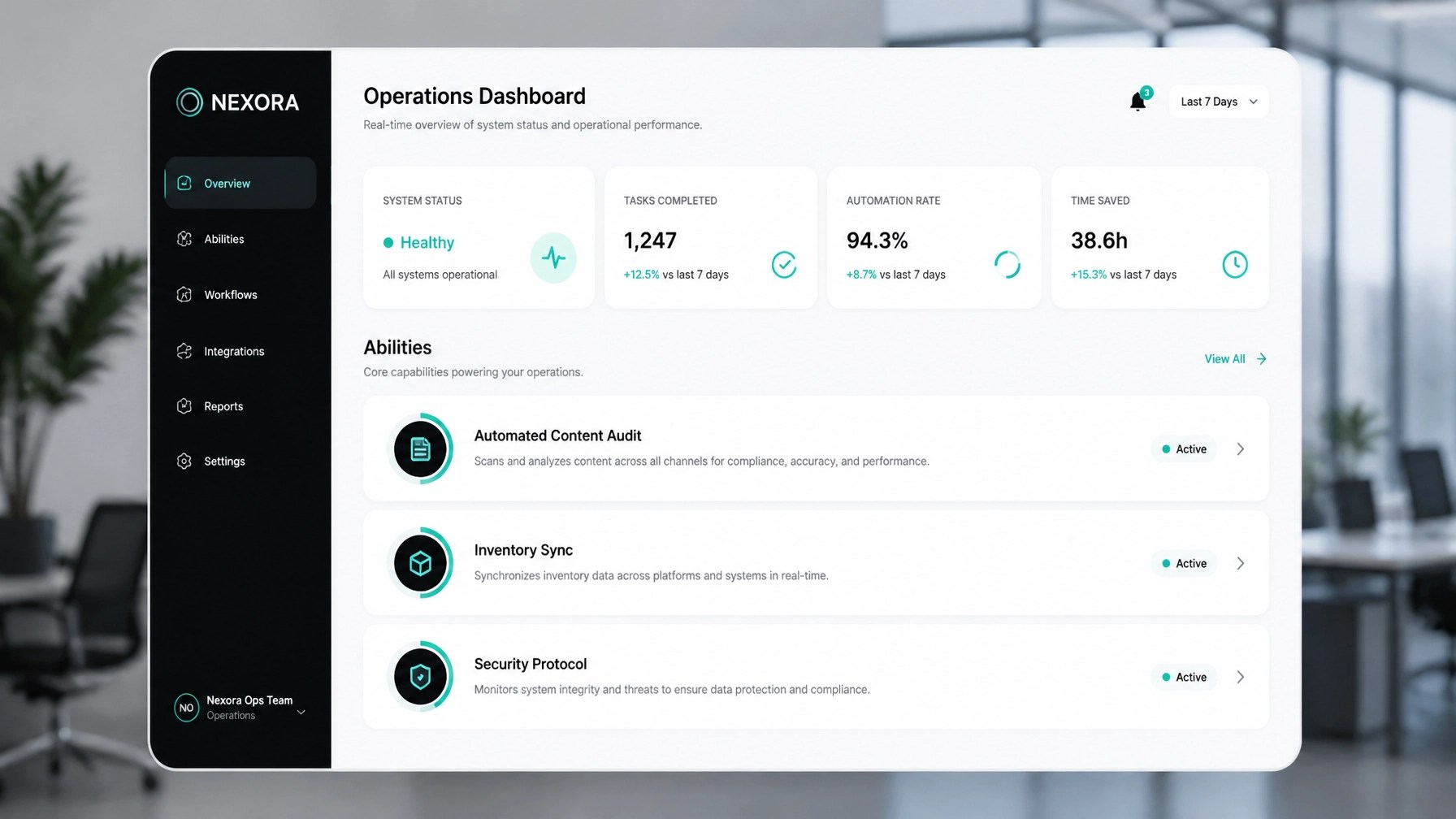
Once registered, these abilities appear in the WordPress Command Palette. Admins can trigger complex workflows: such as "Summarise all unoptimised posts and update their meta descriptions": with a single command. More importantly, these abilities can be leveraged by AI Staffing agents to manage the site 24/7 without human intervention.
Growth: Scaling Through Stability
Precision is the only path to conversion. When your digital operations are handled by a standardised, automated system, you eliminate the "human bottleneck." This leads to:
- Scalable Acquisition: Automated SEO and content workflows ensure your visibility never decays.
- Predictable Performance: Managed infrastructure provides a stable foundation for high-traffic campaigns.
- Reduced Overhead: Replacing manual labour with automated abilities significantly lowers operational costs, a critical factor given the rising impact of the National Living Wage on digital management costs.
For businesses looking to professionalise their presence, our Core Plan provides the high-performance infrastructure required to leverage these advanced WordPress 7.0 features.

Conclusion: The Architecture of Excellence
The WordPress 7.0 Abilities API is more than a technical upgrade; it is a blueprint for operational excellence. By treating your website as a technical system rather than a creative project, you rectify the structural weaknesses that prevent scaling.
ZeroPoint Creative Ltd specialises in architecting these precision systems. We handle the complex infrastructure: the SSL, the backups, the security protocols, and the API integrations: so you can focus on commercial expansion.
Stability is our primary metric. Precision is our method.
Is your digital infrastructure ready for the automation era? Consult with our operational strategists to rectify your technical debt today.
