

Scaling a business is frequently mistaken for a creative challenge or a matter of "working harder." In reality, scaling is an engineering discipline. If your operations are buckling under increased volume, it is rarely due to a lack of effort. It is almost always a failure of the underlying architecture.
In the current UK landscape of 2026, where the National Living Wage and operational overheads continue to rise, inefficiency is no longer just a nuisance: it is a systemic risk. Digital operations management is the process of identifying these structural weaknesses and rectifying them with clinical precision.
Here are the 10 primary reasons your business workflow is failing to scale, and the technical protocols required to mitigate them.
1. Fragmented Tooling and Siloed Data
Many businesses manage sales, inventory, and support on separate, disconnected platforms. This fragmentation creates "data leakage," where critical information is trapped in silos, requiring manual entry to bridge the gaps. As volume grows, the friction of manual data transfer becomes a hard ceiling on growth.
The Infrastructure Fix: Adopt an API-first approach. Instead of ad-hoc tools, build a unified ecosystem where core entities: customers, orders, and tickets: are synchronised in real-time across all systems. High-performance digital services rely on this foundational connectivity.
2. Technical Debt from "Bespoke" Traps
Early-stage businesses often build highly customised, one-off workflows for individual clients. While this "creative" approach wins initial deals, it creates immense technical debt. Bespoke processes are impossible to automate because they lack standardisation.
The Infrastructure Fix: Standardise your operational frameworks. Treat your workflows as configurable templates rather than unique builds. By leveraging a managed website infrastructure, you ensure that your digital presence scales without the bloat of legacy code or custom-built bottlenecks.

3. Absence of AI-Driven Decisioning
By 2026, relying solely on human intervention for routine routing and classification is an operational failure. If your team is manually sorting emails or triaging support tickets, you are wasting high-value human capital on low-value logic.
The Infrastructure Fix: Integrate AI staffing solutions that act as autonomous digital workers. Agentic AI can handle the "straightforward 80%" of operational decisions: classifying leads, extracting invoice data, and routing enquiries: leaving only the complex 20% for your expert staff.
4. Non-Resilient Hosting and Infrastructure
Workflow automation is only as reliable as the environment it runs in. Many businesses attempt to scale complex automations on "out-of-the-box" shared hosting. When traffic spikes or automation triggers increase, the system experiences latency or total failure.
The Infrastructure Fix: Deploy on performance-driven, UK-based infrastructure with continuous monitoring. A managed environment with 24/7 technical oversight ensures that your automated workflows remain "always-on," mitigating the risk of visibility decay or downtime.
5. Consultant-Driven Mismatch
Many organisations invest in expensive consultants who propose "game-changing" AI projects that never move beyond the proof-of-concept stage. These solutions fail because they are not deeply integrated into the actual data realities of the business. They are creative ideas, not engineering solutions.
The Infrastructure Fix: Prioritise functional integration over flashy demos. Focus on business workflow automation that connects to your existing CRM and ERP systems via robust APIs, ensuring that AI agents have access to the real-time data they need to function.

6. Lack of Process Ownership and Governance
A workflow without a clear owner is a system destined for rot. When technical updates occur or compliance regulations (such as UK GDPR) shift, unmanaged workflows become liabilities. Without structural integrity in your governance, scaling only accelerates your exposure to risk.
The Infrastructure Fix: Implement role-based access control (RBAC) and formalise your legal and compliance protocols. Every automated step must be documented, version-controlled, and audited to ensure it aligns with both commercial goals and regulatory requirements.
7. The "Human-in-the-Loop" Bottleneck
Full automation is a myth; effective automation is about strategic human intervention. Many workflows fail because they either try to automate too much (leading to errors) or too little (leading to burnout). If an exception occurs and there is no engineered path for a human to rectify it, the system stalls.
The Infrastructure Fix: Design "human-in-the-loop" checkpoints into your AI automation for business. This allows AI to handle the volume while providing a clinical, data-dense interface for humans to review and approve high-stakes decisions, ensuring both speed and precision.
8. Missing Observability and Metrics
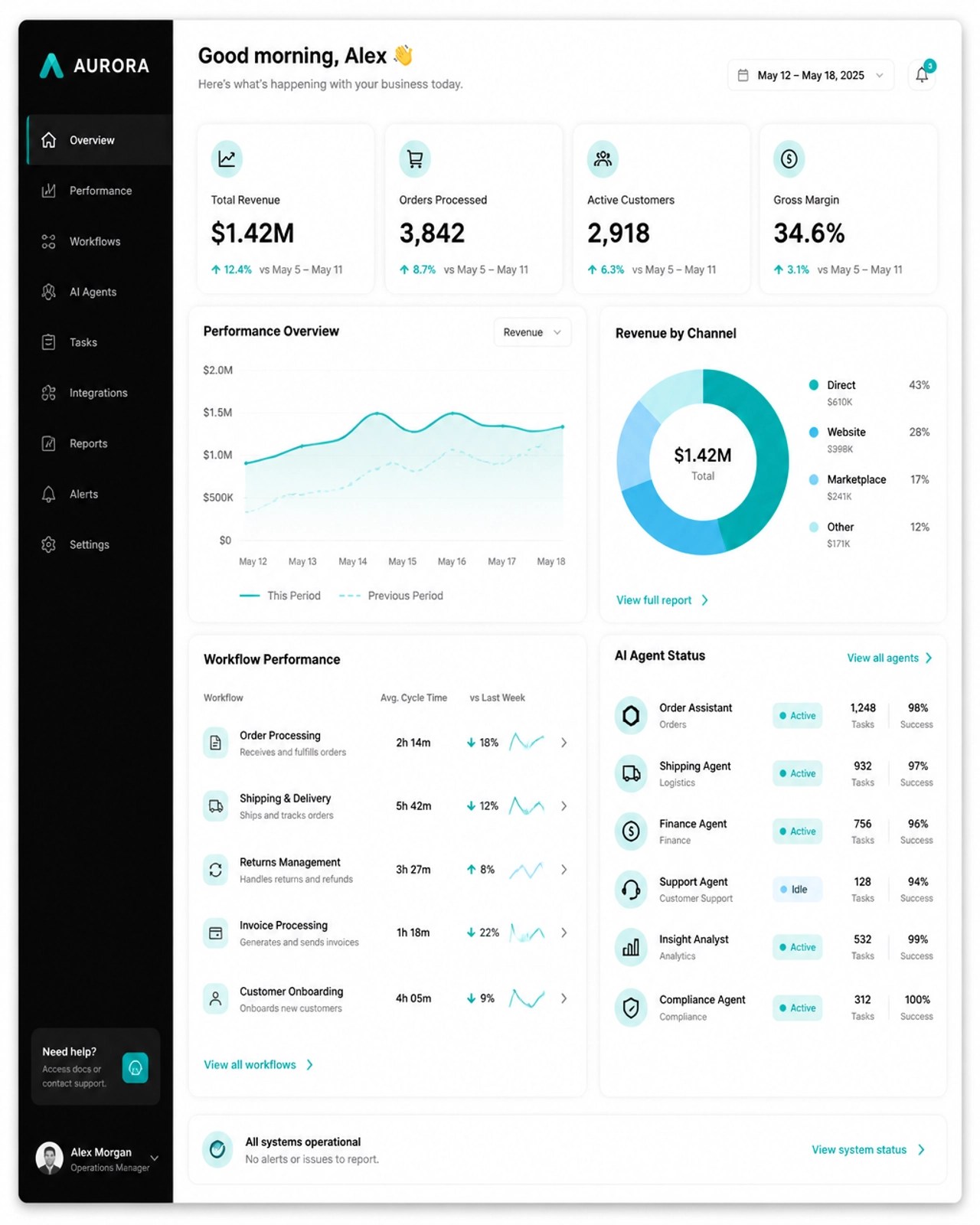
You cannot optimise what you do not measure. Many businesses scale their workflows "blind," without real-time visibility into cycle times, failure rates, or throughput. This lack of data makes it impossible to identify the next bottleneck until the system has already failed.
The Infrastructure Fix: Instrument your workflows with end-to-end observability. Use centralised dashboards to monitor the health of your digital ecosystem. Stability is the primary metric; once the system is stable, performance engineering can begin to drive further efficiency.
9. Brittle Integration Logic
Using basic "no-code" tools for mission-critical workflows often leads to brittle connections that break when a third-party app updates its UI. Relying on "scraped" data rather than formal APIs is a recipe for operational friction.
The Infrastructure Fix: Standardise on API-first integrations. By leveraging managed digital services that prioritise structural integrity, you build a resilient ecosystem that can withstand the frequent updates and changes of the modern SaaS landscape.
10. Cultural Resistance to Technical Adoption
The final barrier to scaling is often internal. If your team views AI and automation as a threat rather than a tool for operational excellence, they will find manual workarounds that bypass the engineered system. This creates "shadow operations" that are invisible to management and impossible to scale.
The Infrastructure Fix: Frame automation as an operational upgrade. By removing the drudgery of repeat work, you allow your team to focus on high-impact strategic tasks. Providing a stable, frictionless environment is the best way to ensure company-wide adoption of new digital standards.
From Friction to Growth
The transition from a struggling, manual operation to a scalable digital system requires a shift in mindset. You must stop viewing your website and back-office processes as creative projects and start viewing them as mission-critical infrastructure.
At ZeroPoint Creative, we act as the Technical Architects for your growth. We don't just "fix" problems; we rectify systemic failures by building resilient, managed, and automated frameworks. Whether through AI staffing or fully managed hosting, our objective is to provide the stability required for your commercial expansion.
Precision is the only path to conversion. Efficiency is the only path to scale.
Ready to audit your digital infrastructure? Explore our Core Packages and begin the process of operational standardisation today.
